AI Memory Tax: The 7 Brutal Costs Crushing Big Tech in 2026
The AI memory tax is no longer a theoretical risk — it is reshaping the balance sheets of the world’s most powerful technology companies right now. After years of debate about the so-called “Nvidia tax” on AI accelerator chips, a second, equally punishing cost wave has arrived in the form of exploding memory prices, and the financial consequences are only beginning to surface.
Table of Contents
What Is the AI Memory Tax?
The term “AI memory tax” refers to the disproportionate and rapidly escalating cost that hyperscale cloud operators — companies like Microsoft, Meta, Amazon, and Google — are now forced to pay for high-bandwidth memory (HBM) and DRAM to power their AI infrastructure.
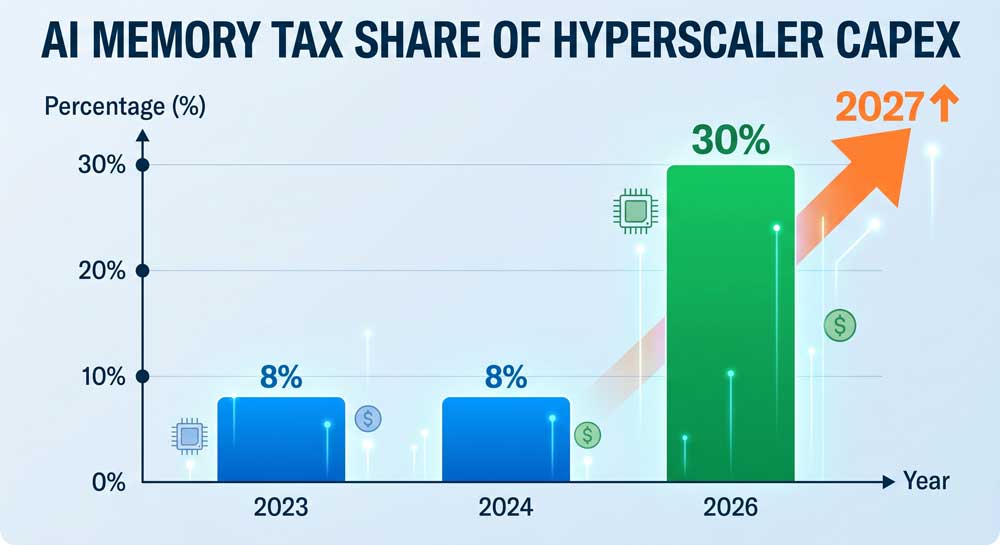
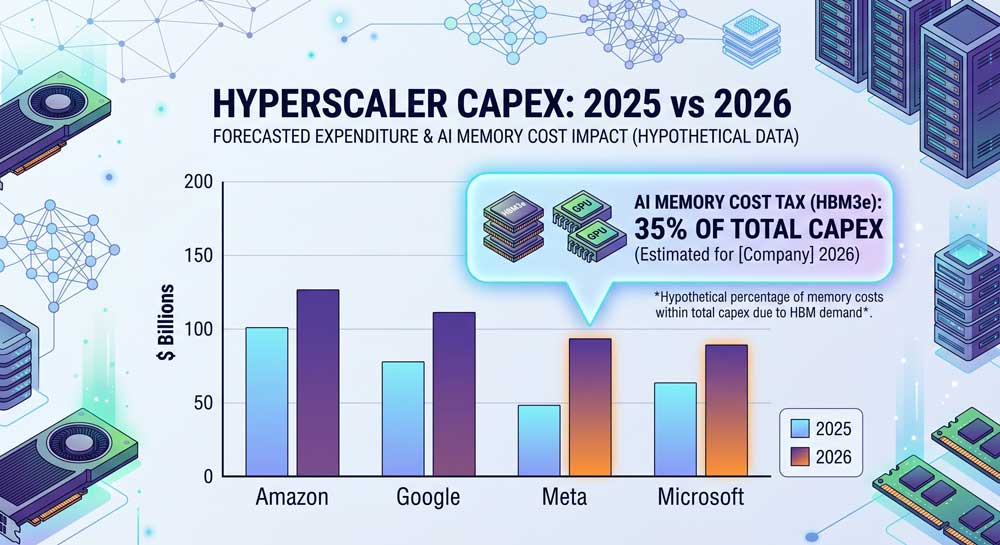
According to SemiAnalysis, memory spending accounted for roughly 8% of total hyperscaler capital expenditure in 2023 and 2024. That figure is projected to jump to approximately 30% by the end of 2026, and to climb even further in 2027. In practical terms, that represents a near-quadrupling of memory’s share of total AI infrastructure spending within just four years — a structural shift that deserves far more attention than it has received.
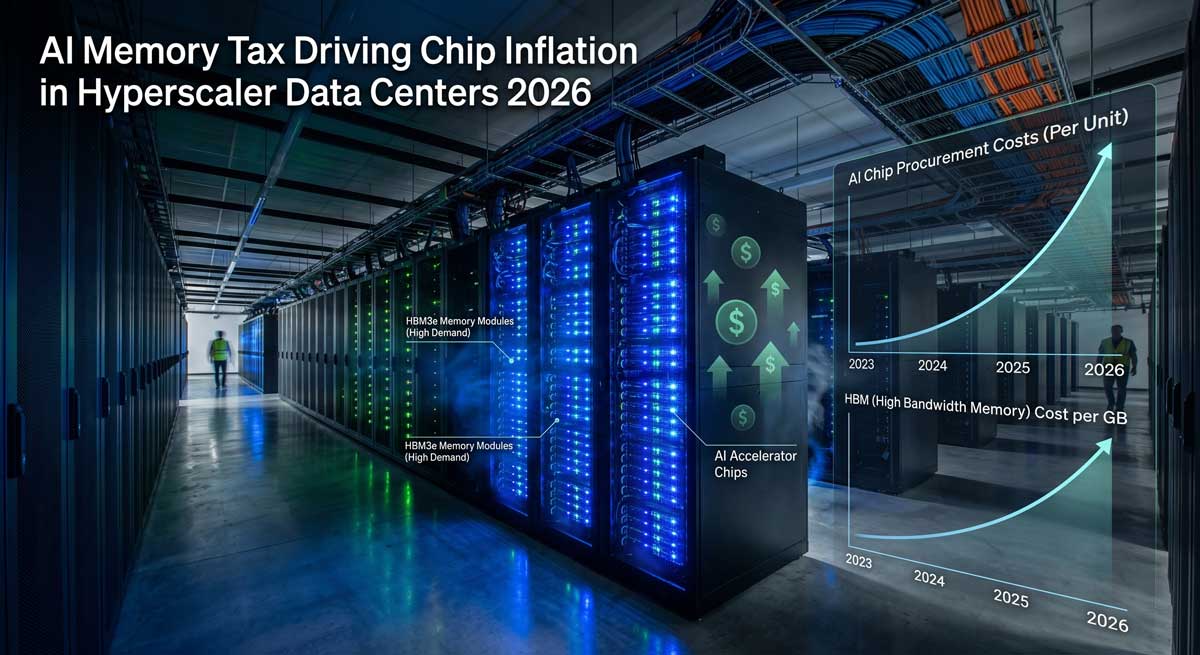
The underlying driver is architectural. Modern AI accelerators depend on enormous quantities of HBM — a vertically stacked, silicon-intensive form of DRAM that provides the ultra-fast temporary storage AI workloads demand. HBM supply has been structurally constrained, while demand from AI data centers has grown exponentially.
From Nvidia Tax to Memory Tax: A Double Squeeze
For years, the semiconductor industry’s conversation centred on Nvidia’s grip on the AI accelerator market. With gross margins on AI chips consistently exceeding 75%, Nvidia has effectively imposed a structural premium on any company building AI infrastructure at scale. That premium — the “Nvidia tax” — forced hyperscalers to pay far above commodity pricing simply to access the compute capacity the market demands.
What I find particularly striking now is the emergence of a second, compounding layer of cost pressure sitting directly below the GPU. DRAM prices are projected to more than double in 2026 alone, with further double-digit percentage increases expected in 2027. LPDDR5 contract prices have already tripled since the first quarter of 2025, and open-market prices could break through $10 per gigabyte this quarter. Meanwhile, SemiAnalysis has highlighted an important market distortion: Nvidia holds what analysts describe as “very, very preferred” DRAM procurement pricing, far below the rates that hyperscalers and broader market participants pay. This arrangement effectively masks the true severity of the supply squeeze from public view while concentrating costs further up the value chain.
| Cost Layer | Who Benefits | Who Pays |
|---|---|---|
| Nvidia GPU premium (75%+ gross margin) | Nvidia | Hyperscalers, AI cloud customers |
| HBM/DRAM price surge (2x+ in 2026) | SK Hynix, Samsung, Micron | Hyperscalers, consumer device makers |
| LPDDR5 tripling since Q1 2025 | Memory manufacturers | Smartphone, PC, gaming OEMs |
| B200 server price +20% by end 2026 | Nvidia, memory suppliers | Hyperscalers |
The Balance Sheet Impact Is Already Visible
The AI memory tax is not a forward-looking risk — it is already hitting quarterly earnings reports in measurable ways. Microsoft has indicated that higher hardware component prices will add approximately $25 billion to its full-year capital expenditure, pushing its total projected spend to a staggering $190 billion. Meta raised the midpoint of its capex guidance by $10 billion, attributing the revision primarily to component costs, with memory chips cited as the main driver.
These are not isolated disclosures. Across the hyperscaler landscape, total combined capital expenditure for 2026 is now forecast to exceed $800 billion, representing a 67% year-over-year increase, with some projections pointing toward $1 trillion by 2027. The concentration of value at the chip layer is, as Goldman Sachs equity research has argued, historically unprecedented — and it is being funded by the companies that sit above it in the stack, not by the chipmakers themselves.
Memory Suppliers Are Printing Record Profits
The other side of this equation is equally striking. SK Hynix reported an operating profit margin of 71.5% in its most recent quarter — a figure that surpasses even Nvidia’s 65% and stands orders of magnitude above the 7.94% average for KOSPI-listed manufacturers. The company has openly acknowledged that its customers are prioritising volume security over price negotiation, a dynamic that removes any meaningful ceiling from near-term pricing.
Samsung’s DRAM average selling prices increased by more than 90% quarter-on-quarter in the same period, while Micron reported an operating profit margin of 67.6%. Nomura Securities projects SK Hynix’s annual operating profit could reach 256 trillion won, with the combined profits of Samsung and SK Hynix alone potentially approaching 580 trillion won. The three dominant memory suppliers — SK Hynix, Samsung, and Micron — now collectively represent a combined market capitalisation exceeding $2.8 trillion.
| Memory Company | Operating Profit Margin | Key Driver |
|---|---|---|
| SK Hynix | 71.5% (Q1 2026, record) | HBM dominance, AI server supply |
| Micron | 67.6% | DRAM ASP surge, AI demand |
| Samsung | ~57–60% (memory segment) | DRAM ASP +90% QoQ |
| Nvidia (for comparison) | ~65% | GPU monopoly premium |
Can Self-Designed Chips Break the Cycle?
Hyperscalers are not sitting still. The strategic response across the industry has been a significant push toward custom silicon, with the explicit goal of reducing exposure to both Nvidia’s pricing power and the memory supply oligopoly.
Amazon’s Trainium chip is expected to save the company tens of billions of dollars annually in AI infrastructure costs, and both Anthropic and OpenAI have already committed to multi-billion-dollar procurement agreements for that capacity — though near-term supply is largely spoken for. Google’s Tensor Processing Units (TPUs), Amazon’s Trainium, and Microsoft’s Maia 200 all represent serious strategic investments in reducing external chip dependency. Google’s TurboQuant compression technology offers a complementary path to reducing memory consumption, while Arm Holdings has indicated its next-generation CPUs could cut data centre construction costs by roughly $10 billion per gigawatt.
The honest assessment, though, is that none of these alternatives provide near-term relief. Semiconductor fabrication facilities take years to commission, and the cyclical nature of the industry has conditioned many participants toward caution on aggressive capacity expansion. The 2027 repricing wave — which SemiAnalysis warns has not yet been incorporated into Wall Street consensus forecasts — may arrive before alternative supply can meaningfully materialise.
Spillover Effects: Consumers and Macroeconomics
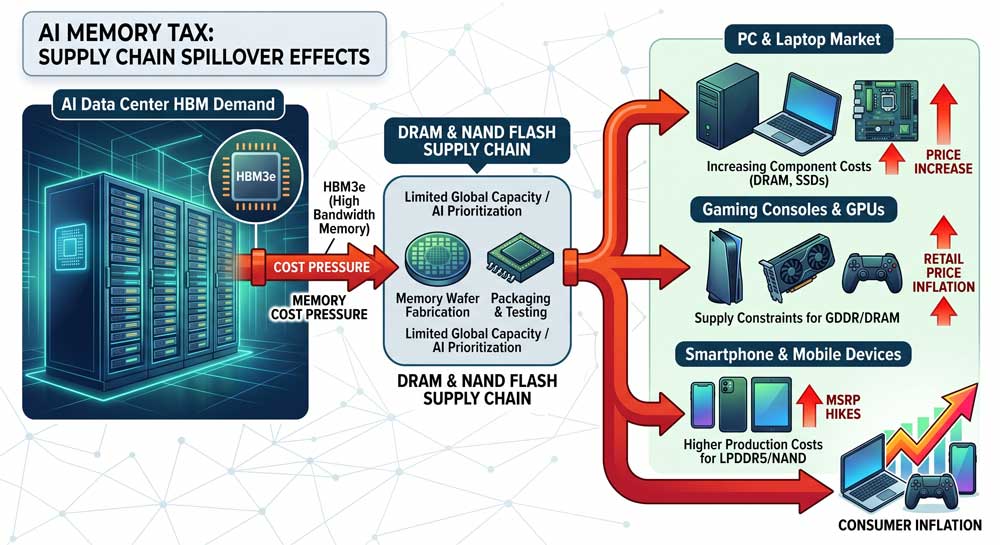
The AI memory tax does not stop at the hyperscaler balance sheet. Memory manufacturers are allocating production capacity toward the far more profitable data centre and long-term hyperscaler contracts, leaving smartphone makers, gaming console manufacturers, and PC OEMs competing for tighter supply at higher prices. Global smartphone shipments are projected to fall by approximately 13% this year, with budget device categories taking a disproportionate hit. Nintendo has already announced price increases for the Switch 2 in direct response to component cost pressures.
At the macroeconomic level, the dynamic is beginning to interact with broader inflationary forces. Economists at Pimco have noted that the massive demand for semiconductor and memory capacity appears to be transmitting into consumer goods prices, citing rising personal consumption expenditure data as evidence. Countries importing large volumes of AI-related hardware are also seeing these purchases widen trade deficits — a dynamic that sits in direct tension with the current U.S. administration’s trade policy agenda.
| Impact Area | Effect | Affected Parties |
|---|---|---|
| Smartphone pricing | Supply squeeze, price rises | OEMs, consumers |
| Gaming consoles | Hardware price increases (e.g. Switch 2) | Nintendo, Sony, consumers |
| PC/server DRAM | DDR5 64GB RDIMM potentially 2x by end 2026 | Enterprise IT, PC builders |
| Consumer inflation (PCE) | Upstream memory costs transmitting downstream | General population |
| Trade deficits | AI hardware imports widening deficits | Trade-policy-sensitive economies |
The Structural Question Nobody Is Asking
The deeper issue here goes beyond any single earnings cycle. The current architecture of the AI arms race concentrates an extraordinary share of economic value in a narrow band of chipmakers — Nvidia at the compute layer, and an HBM oligopoly of three at the memory layer. The hyperscalers funding this build-out are, by definition, paying above-cost premiums at every level of the stack to access infrastructure they cannot yet build themselves at competitive cost.
If those infrastructure investments fail to generate the revenue needed to justify the spend, or if central banks find themselves unable to lower rates because AI-driven component inflation is keeping prices elevated, the bill for this technological transformation will not be paid by the companies placing the bets. It will be distributed across consumers, workers, and taxpayers in ways that are already beginning to appear in the data.
The AI memory tax, in that sense, is not just a line item on a balance sheet. It is a signal about who bears the cost when a handful of industries bet everything on a single technological paradigm — and how those costs quietly flow outward into the broader economy.
Reference URLs
- SemiAnalysis — Memory Is Taking Over Hyperscaler CapEx: DRAM Prices, HBM Supply, and the 2026–2027 Repricing Wave
- Goldman Sachs — Why AI Companies May Invest More Than $500 Billion in 2026
- Octopart Pulse — How AI Broke the Memory Market: Inside the 2024–2026 DRAM, NAND, and HBM Crunch
- Korea Herald — SK Hynix on Course for Record Profit as AI Memory Boom Drives Full-Scale Industry Upcycle
- Chosun English — SK Hynix Posts 71.5% Operating Profit Margin, Tops Global Manufacturing Rankings
- EEWorld — From 8% to 30%: Memory Spending Skyrockets in AI Data Centers
- Yahoo Finance / BofA — AI Could Take CapEx to $1 Trillion in CY27
- CreditSights — Technology: Hyperscaler Capex 2026 Estimates
- ElevenLab — Storage Chip Prices Are Exploding: 3 Shocking Reasons Your Next SSD Will Cost More
- ElevenLab — Nvidia H200 Chips China Sales Hit Zero: 7 Shocking Reasons Trump’s Strategy Backfired
- ElevenLab — 5 Critical Reasons Why OpenAI’s $750B IPO Could Reshape AI Economics by 2027