The $5 Trillion AI Investment Bubble: Can the Boom Outrun Reality?
Executive Summary
Artificial Intelligence (AI) remains the centerpiece of global investment narratives in 2026. From Nvidia’s meteoric rise to the dominance of the “Magnificent Seven” tech stocks, market optimism shows no sign of cooling — at least on the surface.
Yet, beneath this trillion-dollar enthusiasm lies a sobering economic question:
Can AI truly deliver profits proportional to its explosive cost?
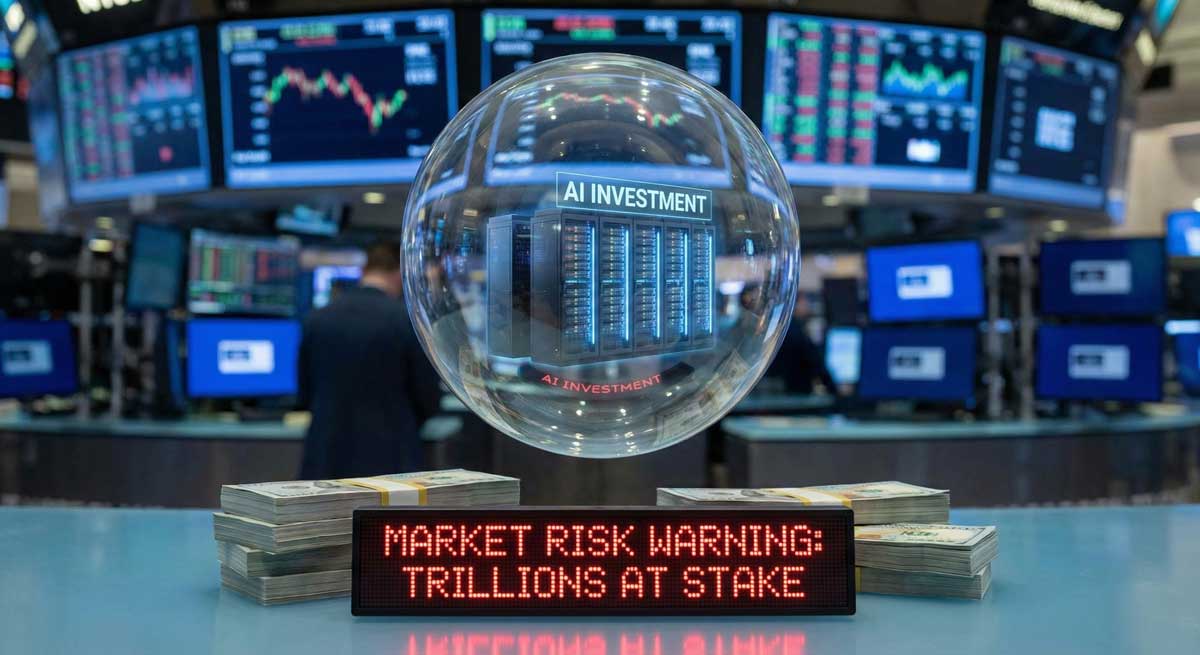
Estimates from J.P. Morgan suggest over USD 5 trillion (≈ AUD 7.3 trillion) will be spent building data centers, chip supply chains, and power systems to sustain AI growth. But investors and policymakers are starting to ask whether this capital surge represents sustainable innovation or dangerous over-extension.
The Economic Core of the AI Investment Bubble
At the heart of the AI Investment Bubble lies a paradox of belief. Many investors assume that a handful of technology giants — led by Nvidia, Microsoft, and Alphabet — can dominate the future of AI and secure outsized profits.
Yet, as economists Brian Redican and Emily Perry remind us, market manias often collapse under their own expectations.
This fear parallels the broader macroeconomic fragmentation described in 2025 Global Economy: A Fractured World Chasing Growth, where innovation and financial imbalances now move in tandem across continents.
Risk 1: Commoditization — The Economics of Abundance
A core law of economics is that when supply increases, prices fall.
If AI models keep improving and costs fall through competition and open source innovation, profitability may shrink dramatically.
In 2025, DeepSeek shocked markets by releasing a model at a tiny fraction of Western costs, echoing trends documented in The Physical Truth Behind the US-China AI Race: Electrons, Not Just Silicon. As competition converges on hardware efficiency rather than model differentiation, profit pools may evaporate faster than investors anticipate.
Economically, this mirrors the lightbulb revolution a century ago. The technology was groundbreaking, but the long-term winners weren’t the manufacturers — they were the consumers who benefited from cheaper lighting.
Table 1. The Abundance Paradox in Technology
| Sector / Era | Capital Spent (USD bn) | Long-Term Price Effect | Primary Beneficiary |
|---|---|---|---|
| Railways (1800s) | 200 | Prices ↓ drastically | Passengers & shippers |
| Internet fiber (2000s) | 500 | Bandwidth cost ↓ 90% | Application providers |
| AI models (2020s–2030s) | 5,000 (est.) | TBD | End-users & consumers |
Insight: As AI model training becomes standardized, margins shift away from model creators toward application developers who deploy AI efficiently.
Risk 2: ROI Math — The $650 Billion Dilemma
The second risk lies in the raw arithmetic of return on investment (ROI).
According to J.P. Morgan’s analysts, achieving a mere 10% annual return on AI infrastructure spending through 2030 would require $650 billion in new recurring revenue — every year. That’s an astronomical goal, only achievable if AI delivers massive real-world productivity gains.
Table 2. The “Impossible” Revenue Math
| Scenario (2030 Target) | Extra Monthly Cost per User | Annual Revenue Required |
|---|---|---|
| iPhone users | $34.72 / month | ≈ $650 billion |
| Netflix subscribers | $180 / month | ≈ $650 billion |
Even for trillion-dollar corporations, those figures are unsettling.
Moreover, capital spending races create feedback loops. As firms compete to build data centers and buy GPUs, they end up inflating their own costs — similar to how iron ore companies once bid up labor and materials during the mining rush.
Result: margins shrink even before revenues materialize.
Risk 3: Physical and Energy Constraints
The AI boom isn’t only a financial challenge — it’s a physical infrastructure problem.
Sonya Sawtell-Rickson, Chief Investment Officer at HESTA, warns that energy demand is emerging as a hard cap on AI growth.
“Data centers now consume so much electricity that they’re driving up residential prices and triggering regulatory pushback.”
Rising energy prices in U.S. states like Virginia and Texas are already forcing regulators to reconsider zoning, emission standards, and tax incentives for new data centers. Similar pressures are appearing in Sydney and Singapore, two major APAC AI hubs.
Table 3. Electricity Load and Data Center Density (2025 Projections)
| Region | AI Data Centers | Power Usage Growth | Regulatory Reaction |
|---|---|---|---|
| U.S. (North Virginia) | 94 | +22% | Planning limits on new sites |
| Singapore | 33 | +18% | Moratorium on new centers |
| Australia (NSW) | 27 | +15% | Public inquiry into grid impact |
Source: HESTA 2025 Annual Report
Chart showing the impact of the AI investment bubble on electricity demand.
Historical Parallel: Infrastructure Rarely Wins
The early 2000s proved that Google, Amazon, and Apple — not telecoms — captured most of the value from internet infrastructure. In today’s era, firms like Google are again outpacing infrastructure-centric rivals through strategic integration, as examined in Beyond the Model: How Google’s Ecosystem Strategy is Outmaneuvering OpenAI.
Table 4. Historic Winners: Infrastructure vs Application Layer
| Epoch | Infrastructure Spenders (Outcome) | Application Innovators (Winners) |
|---|---|---|
| Dot-com era (2000) | Telecom firms (mass bankruptcies) | Google, Amazon, Apple |
| Mobile era (2010s) | Chip manufacturers | App stores, social platforms |
| AI era (2020s) | Cloud & chip providers (under scrutiny) | AI-driven software applications |
If this pattern repeats, the upcoming AI killer apps — not today’s chip producers — will capture lasting value. Investors should therefore look beyond Nvidia and watch emerging leaders in productivity tools, healthcare AI, and automation SaaS.
Investor Implications: Navigating the Hype Safely
Avoiding AI stocks entirely has become impractical. AI now represents roughly 20% of global equities. Still, prudent exposure management is essential — particularly as monetary tensions intensify globally, reflected in The Great Capital Migration: Why Global Investors Are Fleeing Australian Assets in 2026.
Table 5. Global Market Exposure to AI Sector
| Market / Index | AI Sector Weight | 3-Year Annualized Return |
|---|---|---|
| S&P 500 (U.S.) | 25%+ | 58–62% |
| ASX 200 (AUS) | 12% | 30% |
| MSCI Global | 18–20% | 46% |
Source: Bloomberg Intelligence (Dec 2025)
Institutional investors like HESTA treat AI as both a growth driver and a systemic risk — a fitting metaphor for global markets torn between innovation and inflation.
Portfolio Strategy: Beyond the “Shovel Sellers”
Nvidia’s GPUs may be the “shovels” in today’s AI gold rush, but shovel markets eventually saturate. Successful investors will:
- Diversify toward application-driven firms — where AI drives customer value and recurring software margins.
- Watch energy policy — regulation of data center emissions will directly affect profitability.
- Monitor open-source innovation — it accelerates price compression across models.
- Expect volatility — competition and cost disruption events (like DeepSeek) can trigger market repricing overnight.
For retail investors, that means holding balanced tech ETFs or funds with exposure across both hardware and software layers.
Chart: AI Spending vs Return Projections (2026–2030)
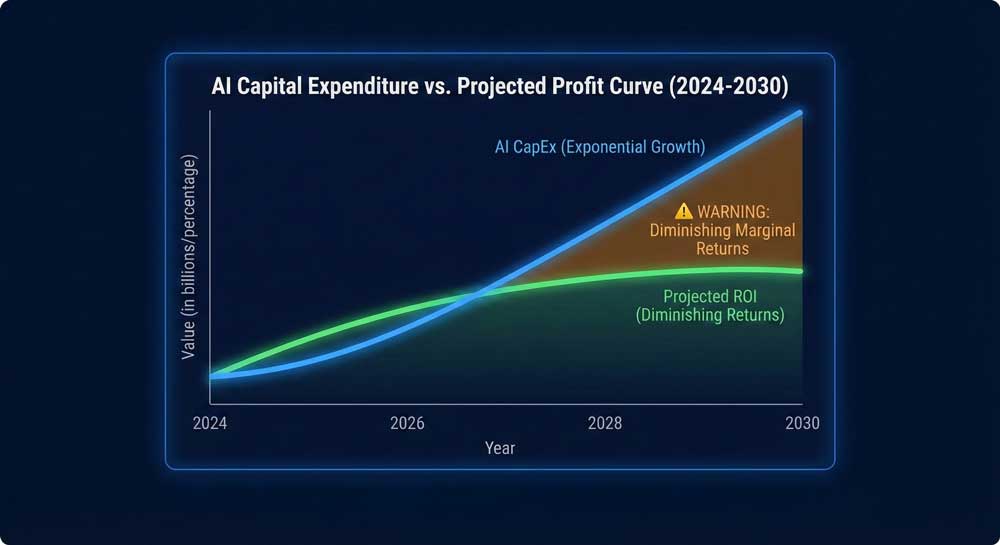
Description: The chart illustrates that while AI CapEx is expected to rise exponentially through 2030, projected ROI follows a flattening curve — warning of diminishing marginal returns.
Conclusion: The Cycle Always Turns
Every technology revolution has followed the same rhythm:
innovation → exuberance → overbuild → correction → renewal.
AI may redefine global productivity, but it cannot defy economic gravity forever. Costs will normalize, valuations will adjust, and only sustainable use cases will survive.
For investors, the lesson is not to avoid AI — but to understand its stage in the cycle.
As J.P. Morgan’s analysts conclude:
“Even if everything goes right, the AI ecosystem’s massive capital intensity ensures that future markets will produce a handful of extraordinary winners, and a larger field of costly losers.”
In other words — intelligence itself may scale infinitely, but investor capital never does.
References
- J.P. Morgan Outlook 2026: Promise and Pressure — Covers AI’s transformative potential alongside investment risks.
- Bloomberg Intelligence: Generative AI Revenue Forecast to $1.3T by 2032 — Projects massive AI market growth, including hardware/software spending.
- HESTA 2025 Calendar Year Investment Performance — HESTA’s official update with CIO commentary on AI margins and market performance.
- MIT Technology Review: Optimism on AI Energy Efficiency — Analyzes energy constraints and commoditization trends in AI.