The Financial System Explained: 5 Stages from Basic Lending to Global Markets
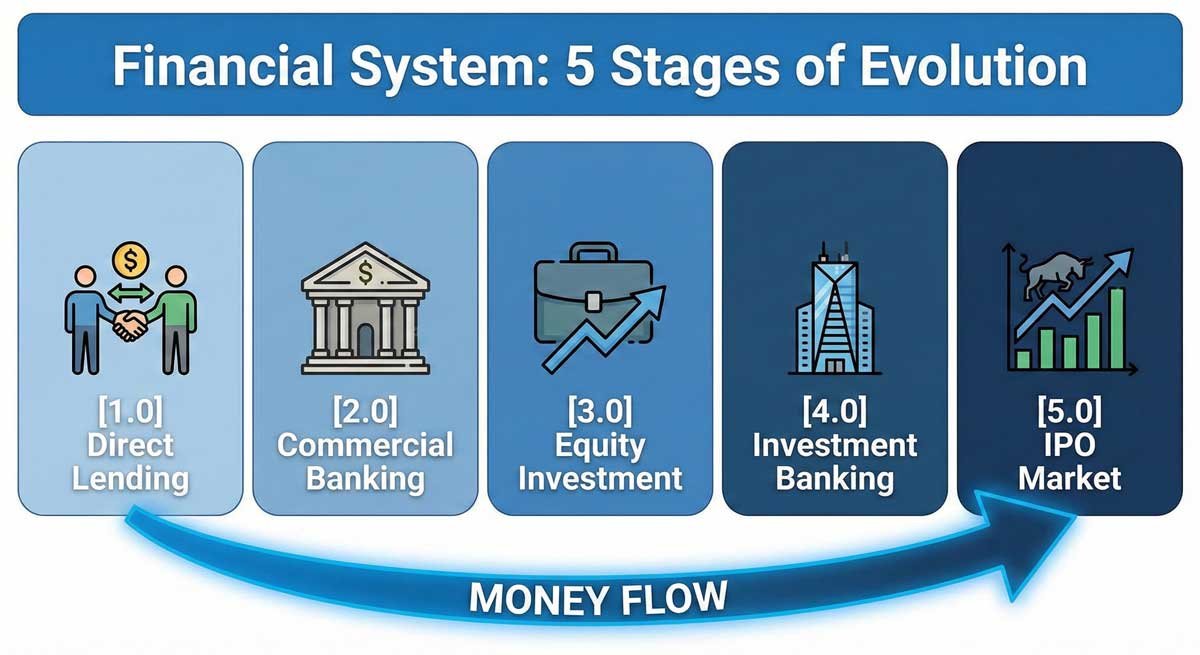
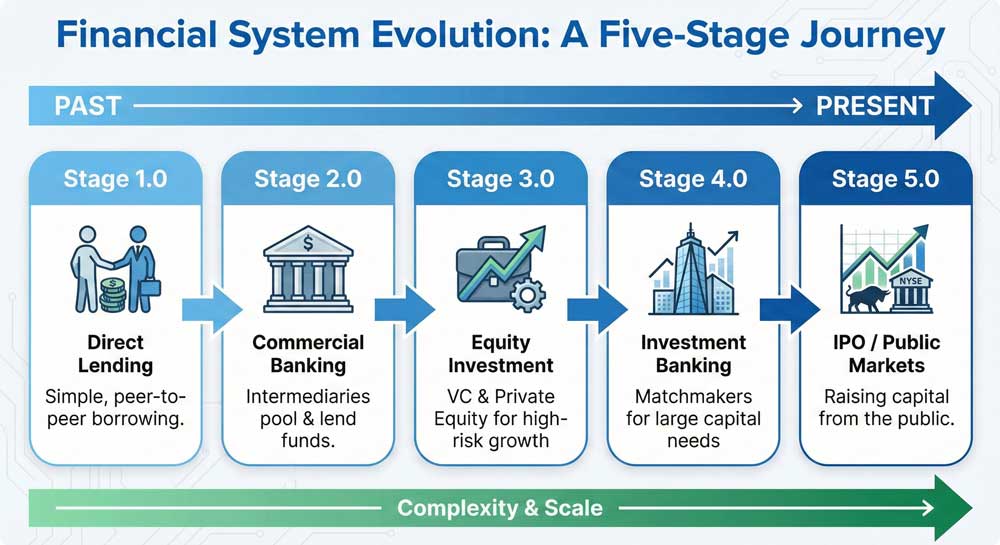
The financial system explained: if you’ve ever wondered how money flows from savers to businesses, or why banks, investment firms, and venture capital exist, you’re not alone. Understanding the financial system is crucial whether you’re choosing a major, exploring career transitions, or simply trying to make sense of how the economy actually works. This comprehensive guide breaks down the complex world of finance into five clear evolutionary stages—from simple peer-to-peer lending to trillion-dollar public markets.
The financial system attracts ambitious professionals with promises of prestige, high salaries, and career growth. Yet despite finance’s popularity, many students and even professionals struggle to explain the fundamental differences between commercial banks, investment banks, venture capital funds, and asset management firms. Let’s demystify the financial system by following the journey of a single entrepreneur—and see how each stage builds upon the last.
Table of Contents
- Why the Financial System Exists
- Stage 1.0: Direct Lending
- Stage 2.0: Commercial Banking
- Stage 3.0: Equity Investment
- Stage 4.0: Investment Banking
- Stage 5.0: Public Markets
- Building Your Finance Career
- Conclusion
Why the Financial System Exists: The Core Purpose
Before diving into the five stages, we need to understand what “finance” actually means. At its heart, the financial system is simply the flow of money to where it creates the most value.
Finance moves capital from those who have excess savings to those who can use it productively, improving resource allocation and increasing overall societal wealth. Every financial transaction, no matter how complex, involves three core participants:
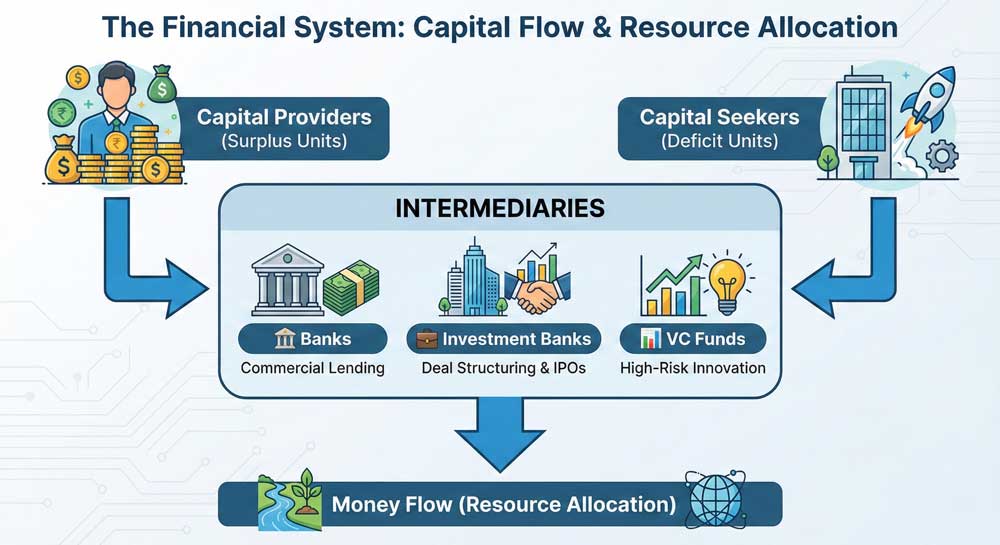
- Capital Seekers: Entrepreneurs, corporations, and governments who need funding
- Capital Providers: Individuals, pension funds, and institutional investors with excess capital
- Financial Intermediaries: Banks, investment firms, and exchanges that connect seekers with providers
Let’s explore how this simple framework evolved from handshake deals to the New York Stock Exchange.
Stage 1.0: Direct Lending—Finance in Its Purest Form
Imagine a world centuries ago without financial institutions. You’re an entrepreneur with a brilliant idea but no capital. Your neighbor is a saver with money sitting idle. This is where finance begins.
- Meet Sarah, an aspiring entrepreneur who makes exceptional coffee but lacks startup capital.
- Meet Mr. Johnson, her wealthy neighbor with savings earning zero returns.
Sarah approaches Mr. Johnson with a proposition: “Lend me $100 to start my coffee business. When I’m profitable, I’ll return $110 by year’s end—your principal plus 10% interest.”
Why This Works for Everyone
- Why Mr. Johnson agrees: His cash generates no returns sitting idle. By lending to Sarah, he earns 10% annually.
- Why Sarah agrees: She gains the capital to launch her business and is confident she can generate returns exceeding the 10% cost.
- Why society benefits: Customers gain access to quality coffee, Sarah builds a business, and Mr. Johnson’s idle capital becomes productive.
This represents the financial system explained at its most fundamental level: money flows from an idle position to a productive use, creating value for all parties involved.
Key Takeaway: Finance improves social welfare by directing capital to its most productive uses.
Stage 2.0: Commercial Banking—The Power of Intermediation
Sarah’s coffee business thrives. She wants to expand with five new locations. But Mr. Johnson has no more money to lend, and Sarah lacks time to search for additional lenders. Meanwhile, other entrepreneurs face identical challenges.
Enter commercial banks: the institutional solution to decentralized lending.
How Commercial Banks Work
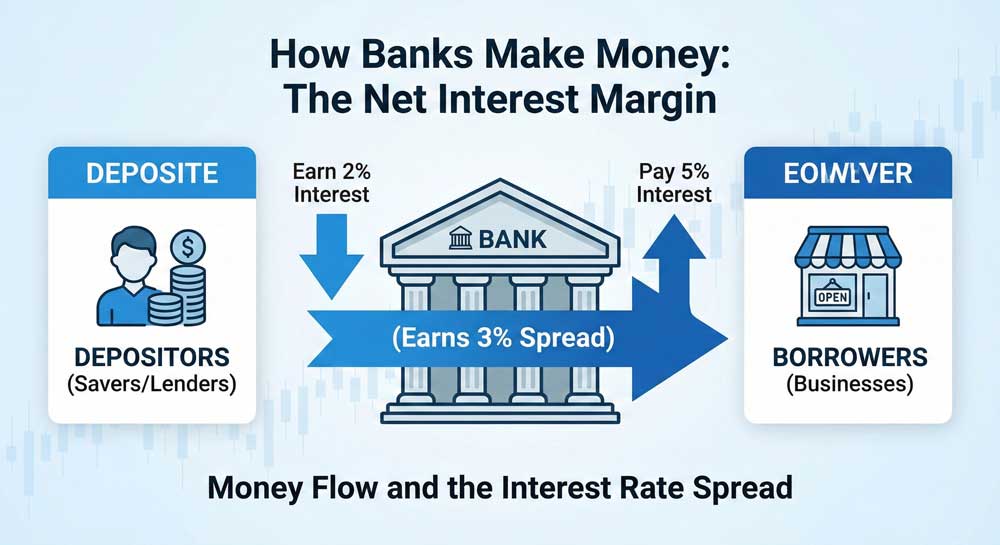
Banks act as financial intermediaries, sitting between savers and borrowers:
On the deposit side: Banks aggregate savings from thousands of individuals, offering security, liquidity, and modest interest returns.
On the lending side: Banks assess creditworthiness and lend pooled capital to businesses like Sarah’s coffee shop.
The profit mechanism: Banks earn the interest rate spread—paying depositors 2% while charging borrowers 5%, capturing the 3% difference as profit.
| Before Banks (Stage 1.0) | With Banks (Stage 2.0) |
|---|---|
| Individual negotiations | Centralized marketplace |
| Limited lending capacity | Pooled capital resources |
| High search costs | Efficient matching |
| Amateur risk assessment | Professional credit evaluation |
| No deposit insurance | Government-backed protection |
Key characteristics: Low-to-medium risk, fixed interest rates, heavily regulated to protect depositors, and serving individuals, small businesses, and corporations needing standard banking services.
Stage 3.0: Equity Investment—High Risk Meets High Reward
Commercial banks excel at financing predictable, low-risk ventures. But what happens when entrepreneurs pursue high-risk innovations?
The High-Risk Scenario
Sarah wants to develop a revolutionary AI-Powered Personalized Coffee Brewing System. This moonshot project could either dominate the market or fail completely if consumers reject the concept.
Sarah approaches her commercial bank. The loan officer refuses: “This is too risky. If you fail, you can’t repay the loan. We only lend against steady cash flows and collateral.”
Banks won’t touch this project—the risk profile exceeds their regulatory limits.
Enter Equity Investment
Sarah needs investors willing to accept high risk for potentially high returns. She finds Ms. Chen, a venture capitalist with a different proposition:
“Invest $100,000 for 20% ownership of my company. If we succeed, you share in unlimited upside. If we fail, we lose together—but you knew the risks.”
This is equity investment: ownership stakes in exchange for capital.
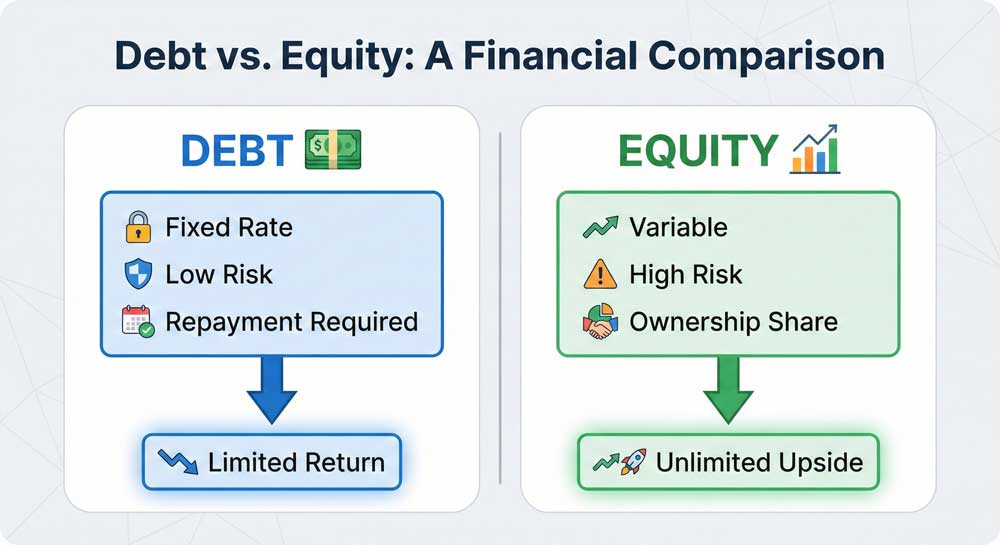
| Feature | Debt (Commercial Banking) | Equity (Venture Capital) |
|---|---|---|
| Capital Source | Commercial banks | VC firms, angel investors |
| Cost of Capital | Fixed interest payments | Ownership dilution |
| Risk to Investor | Lower—secured by collateral | Very high—total loss possible |
| Upside Potential | Capped at interest rate | Unlimited—scales with success |
| Typical Use Cases | Working capital, expansion | Innovation, R&D, disruption |
The Power of Equity: Real-World Examples
Peter Thiel and Facebook: In 2004, Peter Thiel invested $500,000 for 10.2% of Facebook. By 2012, he sold his stake for approximately $1 billion—a 2,000x return over 8 years. Bank deposits wouldn’t even double in that timeframe.
Equity investment unlocks capital for high-risk, high-reward projects that traditional banking cannot support.
Stage 4.0: Investment Banking—Professional Deal-Making at Scale
Sarah’s coffee empire expands rapidly across multiple countries. She now needs hundreds of millions of dollars for global expansion. Finding enough individual equity investors becomes impossible.
Investment banks solve this scalability problem.
What Investment Banks Actually Do
Investment banks are financial intermediaries that facilitate capital markets transactions. Unlike commercial banks that lend their own money, investment banks act as sophisticated matchmakers and service providers.

Core Investment Banking Services:
- Underwriting Securities: Helping companies issue stocks and bonds to raise capital
- Mergers & Acquisitions (M&A) Advisory: Advising on corporate transactions and valuations
- Capital Raising: Connecting companies with institutional investors like pension funds
- Market Making: Providing liquidity in secondary markets by facilitating trades
- Restructuring: Advising distressed companies on debt reorganization
| Aspect | Commercial Banks | Investment Banks |
|---|---|---|
| Primary Function | Deposit-taking and lending | Capital markets facilitation |
| Capital Source | Their own balance sheet | Client capital |
| Revenue Model | Interest rate spreads | Transaction fees |
| Risk Profile | Bear credit risk | Primarily earn fees |
| Clients | Individuals, SMEs | Large corporations, governments |
Major Investment Banks: Goldman Sachs, Morgan Stanley, JPMorgan Chase, Deutsche Bank, Barclays.
For Sarah’s coffee company, an investment bank would package the opportunity, access institutional networks, structure the deal, navigate regulations, and provide market intelligence—charging 3-7% of the transaction value.
Stage 5.0: Public Markets—Democratizing Investment Access
Sarah’s coffee business achieves extraordinary success with $10 billion in annual revenue. Thousands of retail investors want to own shares, and Sarah needs massive capital for continued expansion.
Solution: Initial Public Offering (IPO)—listing shares on a stock exchange.
How Public Markets Work
Stock exchanges (NYSE, NASDAQ) provide:
- Regulated trading platforms: Standardized rules for share transactions
- Price discovery: Market-determined valuations through continuous trading
- Liquidity: Investors can buy and sell shares instantly during market hours
- Transparency: Mandatory disclosure of financial results
- Investor protection: Regulatory oversight against fraud
The IPO Process
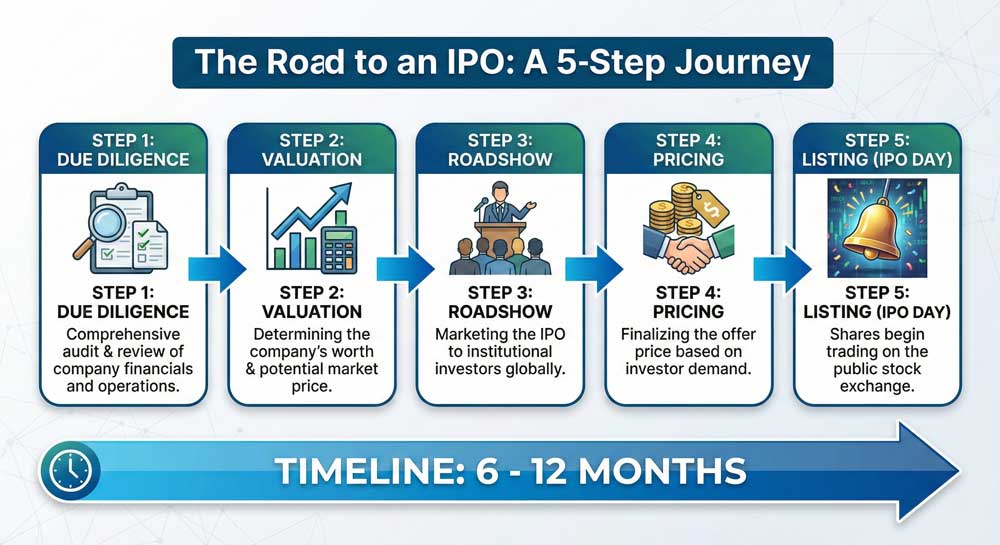
Investment banks facilitate IPOs through a multi-stage process: due diligence, regulatory filings, valuation, roadshow presentations to institutional investors, book building to gauge demand, listing day, and price stabilization.
Primary vs. Secondary Markets
Primary Markets: Where new securities are issued directly by companies. Companies receive the capital raised.
Secondary Markets: Where existing securities trade between investors. Companies receive no new capital; investors trade among themselves.
By Stage 5.0, the financial system achieves full maturity—conservative savers use banks, risk-tolerant investors buy equities, passive investors use mutual funds, and all businesses access suitable financing at every growth stage.
Building Your Finance Career: Choosing Your Path
Understanding the financial system explained through these five stages provides clarity for career planning.
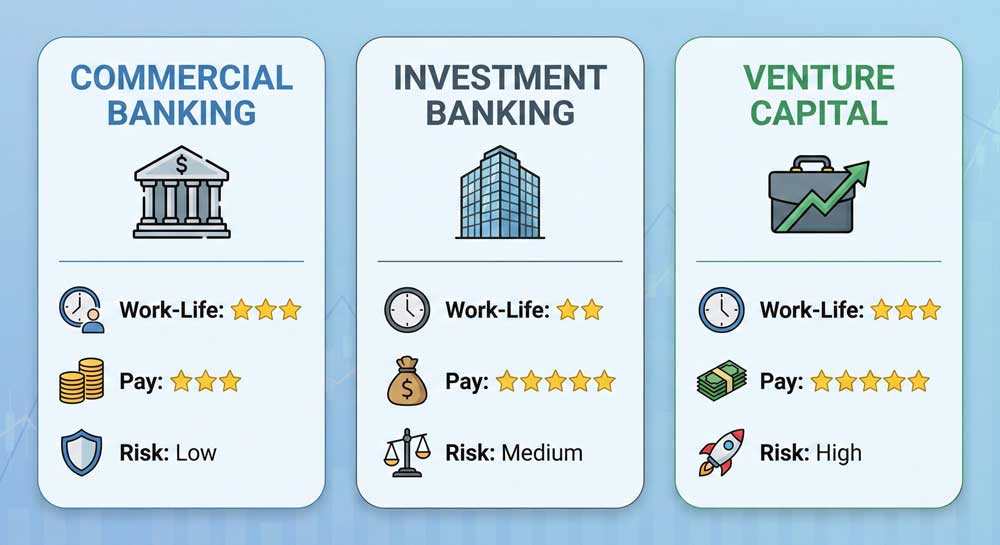
Commercial Banking Careers
- Roles: Relationship managers, credit analysts, loan officers
- Work-Life Balance: Generally standard business hours
- Skills: Credit risk assessment, relationship building, financial statement analysis
Investment Banking Careers
- Roles: Analysts, associates, vice presidents across M&A and capital markets divisions
- Work-Life Balance: Demanding (80-100+ hour weeks at junior levels)
- Skills: Financial modeling, valuation, deal structuring, client management
Venture Capital Careers
- Roles: Analysts, associates, principals, partners
- Work-Life Balance: Better than investment banking but still demanding
- Skills: Company evaluation, due diligence, industry analysis, network building
Asset Management Careers
- Roles: Portfolio managers, research analysts, traders, risk managers
- Work-Life Balance: Generally better than investment banking
- Skills: Investment analysis, portfolio construction, risk management, quantitative skills
Related Resources for Deeper Learning
- Commercial Banker Career Profile
- Investment Banking Recruiting and Interview Preparation
- Venture Capital Investment Strategies
- CFA Program for Asset Management Professionals
- Financial System Modernization Trends 2026
Conclusion: Finance Demystified
The financial system explained through five evolutionary stages reveals a simple truth: finance is fundamentally about moving money to where it creates the most value.
From Sarah borrowing $100 from her neighbor to her coffee company’s multi-billion dollar IPO, each stage builds upon the last, increasing efficiency, scale, and specialization.
Whether you’re depositing money in a savings account, buying a stock, or launching a startup, you’re participating in this system. Understanding how capital flows through these five stages is the first step toward navigating it successfully—whether as a professional, investor, or informed citizen.
Disclaimer: This article is for educational purposes only and does not constitute financial, investment, or career advice. Always conduct thorough research and consult qualified professionals before making financial decisions.
Other Readings: