Stellantis Financial Crisis: $25 Billion Meltdown Exposes Fatal Flaws in World’s 4th Largest Automaker
The world’s fourth-largest automaker, Stellantis, has suffered a catastrophic financial implosion—reporting losses between 19-21 billion euros ($20.8-23 billion USD) in the second half of 2025 alone, with total full-year 2025 losses reaching approximately 175-191 billion RMB ($24-26 billion USD). This devastating Stellantis financial crisis represents more than just quarterly underperformance—it exposes the existential vulnerabilities facing legacy automakers as Chinese electric vehicle manufacturers fundamentally reshape global automotive competition.
The staggering scale becomes clearer through simple mathematics: Stellantis hemorrhaged roughly $140-150 million every single day for six consecutive months. To put this in perspective, the company’s Italian market capitalization lost over €5 billion in a single trading session following the announcement, marking one of the worst days in the automaker’s history.
The “Weak-Weak Alliance”: Understanding Stellantis’ Structural Fragility
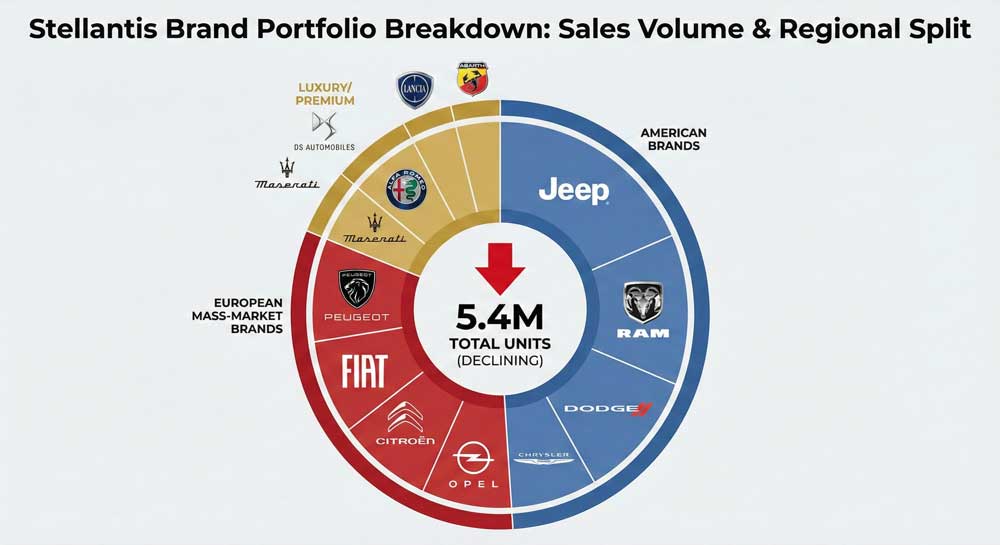
While the Stellantis name remains unfamiliar to most consumers, its 14-brand portfolio reads like an automotive hall of fame: Jeep, RAM, Dodge, Chrysler, Peugeot, Citroën, Fiat, Alfa Romeo, Maserati, Opel, Vauxhall, DS Automobiles, Lancia, and Abarth. Yet this impressive roster masks a fundamental weakness at the core of the Stellantis financial crisis—this conglomerate was born not from strength, but from desperation.
A History of Survival Mergers, Not Strategic Dominance
Stellantis emerged through successive consolidations of struggling brands:
- 2009: Chrysler faced bankruptcy, prompting merger with Italy’s Fiat to form FCA (Fiat Chrysler Automobiles)
- 2021: FCA merged with France’s PSA Group (Peugeot-Citroën) to create Stellantis, acknowledging neither entity could compete independently
- 2024: CEO Carlos Tavares resigned in December amid “different views” with the board about strategy, just months before the financial catastrophe became public
Despite selling 5.4 million vehicles annually and ranking fourth globally, Stellantis lacks a dominant anchor brand. Its best performer, Peugeot, manages only 1.35 million units—a fraction of Toyota’s 11+ million or Volkswagen’s scale. This “weak-weak alliance” strategy relied on aggregating volume from multiple underperforming brands rather than building category leadership.
| Brand Tier | Key Brands | Annual Volume | Strategic Challenge |
|---|---|---|---|
| Mass Market | Peugeot, Citroën, Fiat | 1.35M (Peugeot largest) | Commoditized, low margins, Asia weakness |
| American SUV/Truck | Jeep, RAM, Dodge | Combined ~1.8M | Inventory gluts, dealer conflicts |
| Luxury/Performance | Maserati, Alfa Romeo | <100K combined | Identity crisis, pricing collapse |
| Legacy Brands | Chrysler, Lancia | Minimal | Life support, limited product lines |
The $26.2 Billion Write-Down: Anatomy of the Stellantis Financial Crisis
The second-half 2025 disaster stems from three catastrophic strategic failures that converged simultaneously:
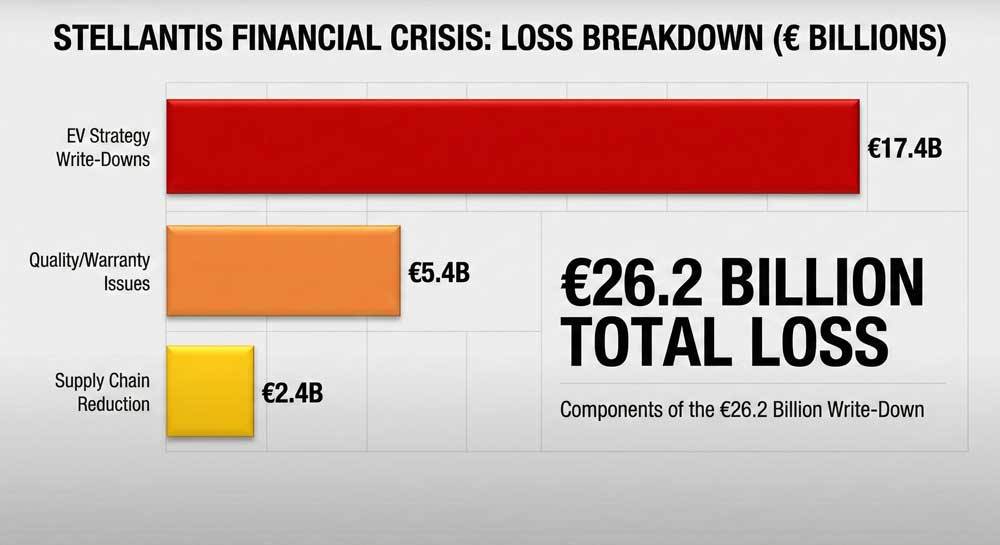
1. Failed EV Strategy: €17.4 Billion Write-Down
Stellantis’ original “Dare Forward 2030” electrification plan promised 100% battery electric vehicle sales in Europe by 2030. This aggressive target drove massive capital investments in EV platforms, battery technology, and manufacturing retooling. However, the company fundamentally “over-estimated the pace of the energy transition,” according to CEO Antonio Filosa.
The reality: consumer demand for Stellantis EVs never materialized at projected levels. Multiple electric models were canceled mid-development, billions in R&D essentially evaporated, and the company was forced to acknowledge its technology lagged competitors by 3-5 years.
2. EV Supply Chain Reduction: €2.4 Billion
The EV pivot required building dedicated battery production facilities, including the ambitious Termoli Gigafactory project in Italy. As EV demand projections collapsed, Stellantis was forced to scale back or mothball these partially-completed facilities, writing off construction costs and purchase commitments to battery suppliers.
3. Quality Crisis & Warranty Provisions: €5.4 Billion
Perhaps most damaging to the brand’s long-term viability, Stellantis disclosed massive warranty provisions addressing “recent increases in cost inflation and a deterioration in quality” under previous management. This admission directly implicates the Tavares era (2021-2024) for prioritizing cost-cutting over product integrity—a strategy that has now exploded catastrophically.
Additional losses included severance costs for thousands of laid-off workers and reduced volume forecasts across the entire portfolio.
The China Collapse: Canary in the Coal Mine
The most glaring symptom of the Stellantis financial crisis appeared first in China—the world’s largest automotive market and the epicenter of EV innovation.
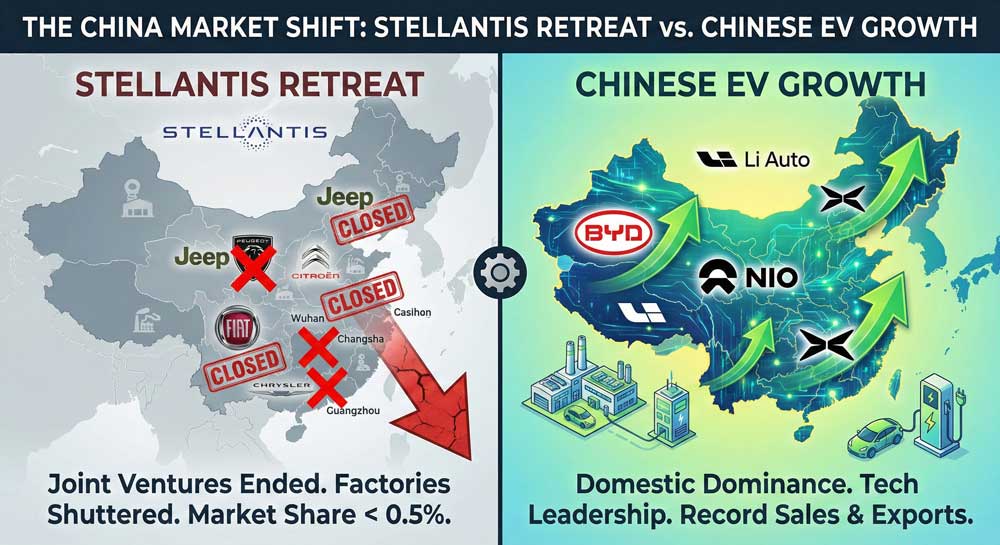
Total Retreat from the World’s Biggest Market
- Manufacturing Shutdown: Joint ventures producing Jeep and Fiat models have been largely shuttered, with production facilities closed or operating at minimal capacity
- Luxury Brand Collapse: Maserati, once commanding ultra-premium pricing, now starts around 360,000 RMB (~$50K USD) in China—less than domestic luxury EVs like the Huawei-backed Aito M9—yet still fails to attract buyers
- French Brand Irrelevance: Peugeot and Citroën survive only through their partnership with Dongfeng Motor, with market share approaching statistical insignificance
| Stellantis Brand | China Market Status | Primary Issue |
|---|---|---|
| Jeep | Production largely ceased | Failed to compete with local SUV brands |
| Chrysler | Completely exited market | No viable product lineup |
| Maserati | Pricing collapsed, minimal sales | Lost luxury positioning to EVs |
| Peugeot/Citroën | Life support via Dongfeng JV | Brand awareness near zero |
| Fiat | Discontinued operations | Technology gap insurmountable |
This China failure is particularly devastating because it foreshadows Stellantis’ fate in other markets as Chinese EV manufacturers expand globally. BYD has already surpassed Tesla in global EV sales, while companies like Nio, Li Auto, Geely, and SAIC rapidly gain market share in Europe and emerging markets.
The Leapmotor Gambit: Admission of Technological Inadequacy
In October 2023, facing existential technology gaps, Stellantis invested €1.5 billion ($1.58 billion) to acquire approximately 21% of Chinese EV startup Leapmotor. The deal included forming Leapmotor International—a 51/49 Stellantis-controlled joint venture with exclusive rights to manufacture and sell Leapmotor vehicles outside Greater China.
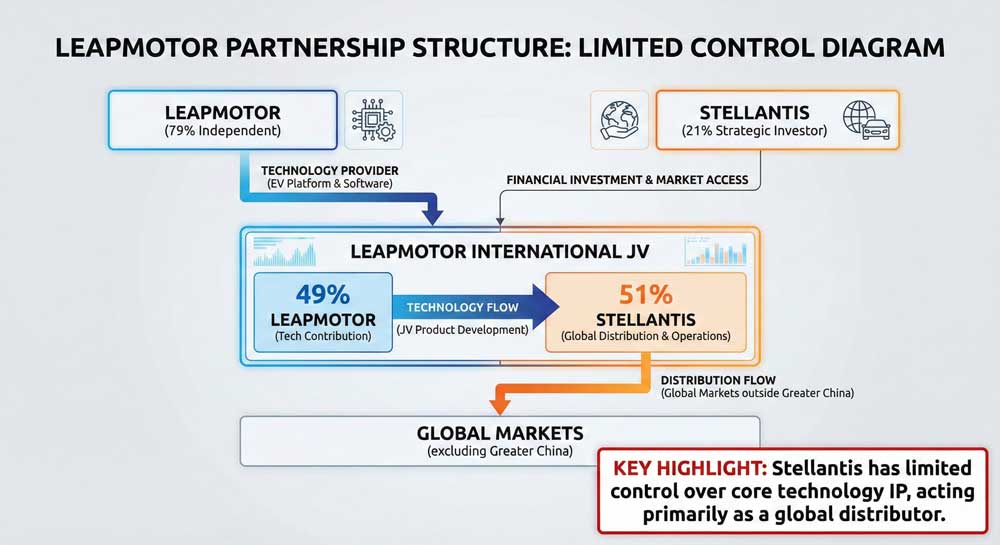
Why This Partnership Reveals Desperation
Rather than demonstrating strategic foresight, the Leapmotor investment exposes three uncomfortable realities driving the Stellantis financial crisis:
- Technology Deficit: Stellantis lacks competitive in-house EV platforms, battery technology, or software capabilities—requiring it to license technology from a second-tier Chinese startup
- Limited Control: With only 21% equity ownership in Leapmotor itself (versus 51% of the export JV), Stellantis has minimal influence over technology roadmap or IP development
- Weak Partner: Leapmotor ranks as a Tier-2 player in China’s brutal EV market, focusing on vehicles under 200,000 RMB (~$28K) without leading autonomous driving or AI capabilities
| Partnership Element | Stellantis Contribution | Leapmotor Contribution |
|---|---|---|
| Technology IP | None (licensing only) | Complete EV platforms, battery tech, software |
| Manufacturing | European facilities, 600+ dealers | Chinese engineering, vertical integration |
| Market Access | European distribution networks | Proven cost-competitive production |
| Strategic Control | 51% of export JV only | 79% of parent company, core IP ownership |
Compare this to Volkswagen’s partnership with XPeng (which involves joint software development and mutual IP sharing) or Mercedes’ direct investment in Chinese battery technology—Stellantis’ approach reveals how far behind it has fallen.
The Chinese EV Juggernaut: Why Legacy Automakers Cannot Compete
The fundamental driver of the Stellantis financial crisis extends beyond one company’s missteps—it represents a systemic disruption as Chinese manufacturers leverage structural advantages legacy automakers cannot replicate:
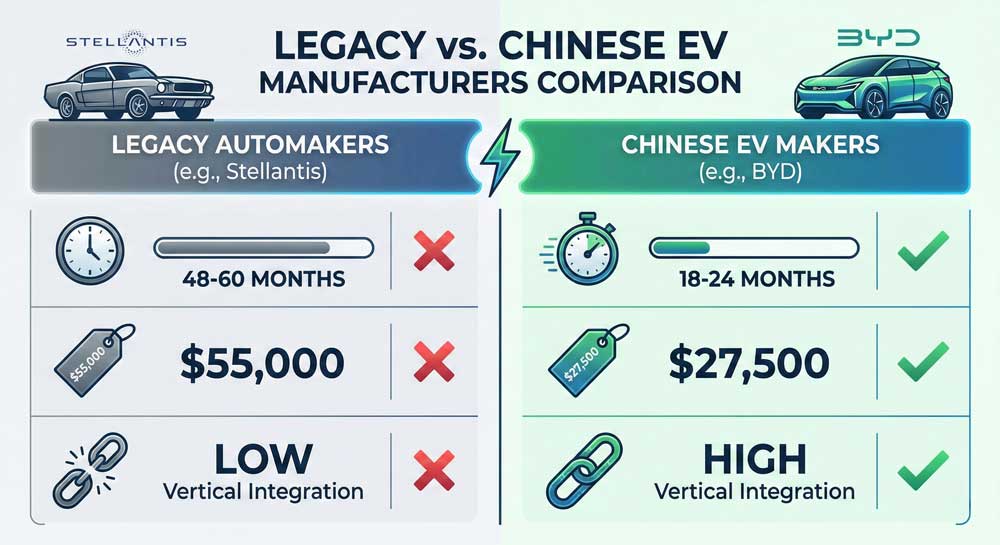
Insurmountable Chinese Competitive Advantages
- Vertical Integration: BYD manufactures nearly all components in-house except glass and tires, maintaining “absolute pricing power” for vehicles under 150,000 RMB
- Cost Leadership: Chinese EVs average $27,500 versus $55,000 for US equivalents—not through subsidies alone, but through manufacturing efficiency
- Technology Supremacy: Homegrown R&D for batteries, autonomous driving, and AI integration surpasses Western capabilities
- Speed to Market: Chinese startups develop and launch new models in 18-24 months compared to 48-60 months for legacy automakers
The impact extends across the entire traditional automotive sector:
- Toyota: Sold 11+ million vehicles in 2025 but saw profits decline 21% due to Chinese EV competition and market pressures
- Volkswagen: Lost its 37-year sales crown in China to BYD, continues hemorrhaging market share despite combustion vehicle leadership
- Ford: Took a $19.5 billion write-down in Q4 2025 related to EV strategy failures
Management Chaos: The Tavares Resignation and Leadership Void
The Stellantis financial crisis was predictable to those watching internal dynamics. CEO Carlos Tavares—architect of both the 2021 FCA-PSA merger and the aggressive electrification strategy—resigned abruptly on December 1, 2024, amid “different views” with the board.
The Leadership Timeline
- 2021-2023: Tavares pursues aggressive EV targets while implementing severe cost-cutting measures across all brands
- September 2024: Stellantis slashes profit forecasts and warns of cash burn, triggering initial market panic
- December 2024: Tavares resigns unexpectedly; board forms interim executive committee under chairman John Elkann
- February 2026: New CEO Antonio Filosa announces preliminary H2 2025 results showing 19-21 billion euro loss
This leadership vacuum during the most critical period of automotive disruption in a century has left Stellantis directionless. The company now promises a new long-term strategy at its May 2026 Capital Markets Day —but investor confidence has evaporated, with shares down 40% in 2024 and an additional 25% in 2025, followed by over 13% decline in early 2026.
North America: Temporary Reprieve Masks Structural Decline
While global operations collapsed, Stellantis’ North American business showed contradictory signals that ultimately reinforce rather than refute the crisis narrative:
- Q1 2025: Shipments dropped 20% (82,000 fewer units) as the company implemented emergency inventory reductions to clear bloated dealer lots
- Q4 2025: Shipments rebounded 43% year-over-year (127,000 additional units) driven by new Ram Heavy Duty models and refreshed Jeep lineup
However, this apparent recovery masks deeper problems. The Q4 rebound reflects comparison against artificially suppressed 2024 Q4 shipments—not genuine demand growth. Orders increased 150% year-over-year largely because 2024 orders were catastrophically low during the inventory crisis.
More troubling: Stellantis survives in North America only through tariff protection preventing Chinese EV manufacturers from directly competing. Once BYD, Nio, or Geely establish Mexican production facilities (avoiding tariffs through USMCA), even this final stronghold becomes vulnerable.
The Brutal Verdict: Only One Path to Survival
For Stellantis and legacy automakers facing similar existential threats, the options have narrowed to a single uncomfortable reality: deeply integrate Chinese technology, manufacturing, and supply chains—or face extinction.
What Survival Requires
- Full Technology Transfer: License comprehensive EV platforms, battery technology, and software stacks from leading Chinese manufacturers (not second-tier partners like Leapmotor)
- Joint Manufacturing with IP Sharing: Establish production facilities combining Chinese engineering efficiency with Western brand equity, accepting Chinese partners as true equals
- Supply Chain Integration: Embed Chinese suppliers at every level, recognizing that “Chinese suppliers are now deeply woven into the supply chains of international OEMs outside China”
- Profit Margin Transfer: Accept that Chinese partners will capture the majority of value-added profits—Western brands survive through volume and distribution, not technology premiums
The Stellantis financial crisis demonstrates what happens when legacy automakers delay these painful decisions. The €1.5 billion Leapmotor investment was too little, too late, with too weak a partner.
2026: Year of Reckoning Across the Industry
New CEO Antonio Filosa has declared 2026 the “year of execution” —but execution of what strategy remains unclear. The company suspended its 2026 dividend and authorized up to €5 billion in hybrid bond issuance merely to maintain liquidity.
The strategic “reset” promises vehicles “that align with consumer demand” while proceeding with electrification “at a pace dictated by demand rather than command”. This pivot toward hybrids and extended combustion production may stabilize short-term cash flow but guarantees permanent technological inferiority.
Who Falls Next?
The Stellantis financial crisis represents the first domino, not an isolated incident:
- Renault-Nissan-Mitsubishi Alliance: Already experiencing similar profitability pressures and brand weakness
- Ford & GM: Survive only through USMCA tariff protection; Mexican Chinese EV production changes everything
- Volkswagen Group: Bleeding market share in China while CARIAD software division fails to deliver competitive technology
Even Toyota—the world’s largest automaker with unmatched quality reputation—saw profits plunge 21-25% as Chinese EVs redefined consumer expectations.
The Inescapable Conclusion
The Stellantis financial crisis—losing $25 billion in six months through failed EV strategy, quality collapse, and Chinese market defeat—illuminates the future of legacy automotive manufacturing. This is not temporary disruption requiring incremental adjustment. This is permanent industry transformation where Western automakers must choose between accepting subordinate positions in Chinese-dominated supply chains or ceasing to exist.
The question is no longer whether the automotive industry transitions to electric vehicles—Chinese manufacturers answered that definitively. The question is whether companies like Stellantis possess the institutional courage to embrace radical change before their $140 million daily losses become mathematically insurmountable.
For Stellantis, time has nearly run out. For the broader industry, the Stellantis financial crisis serves as both warning and preview of the brutal decade ahead.
Related Sources & Deep-Dive References
- Stellantis Reports Net Loss for 2025 Due to $26.2 Billion Charge – Yahoo Finance
- World’s Fourth-Largest Automaker Suffers Electrification Setback – 36Kr
- Stellantis Posts A$35 Billion Loss After Failed EV Push – CarExpert
- Stellantis Plunges on $27 Billion Bill for EV Pullback – Reuters
- Stellantis Slumps as EV Missteps Trigger Record €22B Charge – Yahoo Finance
- Board Accepts Carlos Tavares’ Resignation as CEO – Stellantis
- Stellantis CEO Carlos Tavares Resigns Amid Problems – CNBC
- Stellantis Shipments Drop 9% Amid North American Plant Slowdown – MoparInsiders
- How China’s Electric Vehicle Juggernaut is Reshaping Global Car Market – CNBC
- How Chinese EVs Are Shaking Up the Global Auto Industry – Third Bridge
- Leapmotor International Opens Orders in Europe – Stellantis
- Stellantis Powers Leapmotor’s European Growth – MoparInsiders
- Toyota Claims Global Sales Crown in 2025 – CarExpert
- World’s Biggest Carmaker Sees 21% Profit Decline – CNN
- EV Transition ‘Unraveling’? Legacy Automaker Strategies Are – EVXL
- The $5 Trillion AI Investment Bubble: Can the Boom Outrun Reality?
- STAT News: DeepMind Opens AlphaGenome Source Code
- The Physical Truth Behind the US-China AI Race: Electrons, Not Just Silicon
- Big Tech AI Spending Reaches $670B in 2026: Infrastructure Giants vs. Apple’s Strategic Pivot