Blackstone AI Investment Australia: $15 Billion Bet on Infrastructure vs. Reality of Productivity Crisis
When Blackstone Group committed AU$15 billion to Australian artificial intelligence infrastructure in February 2026, financial markets erupted in celebration. Yet beneath the euphoria lies a troubling paradox that has economists questioning whether massive capital investment can overcome Australia’s deepest economic challenge: the country ranks second-last among OECD nations in productivity growth, ahead of only Mexico.
This Blackstone AI investment Australia represents more than just another deal—it’s a high-stakes test of whether world-class computing infrastructure can transform an economy struggling with structural stagnation.
The 72-Hour Deal That Shocked Markets
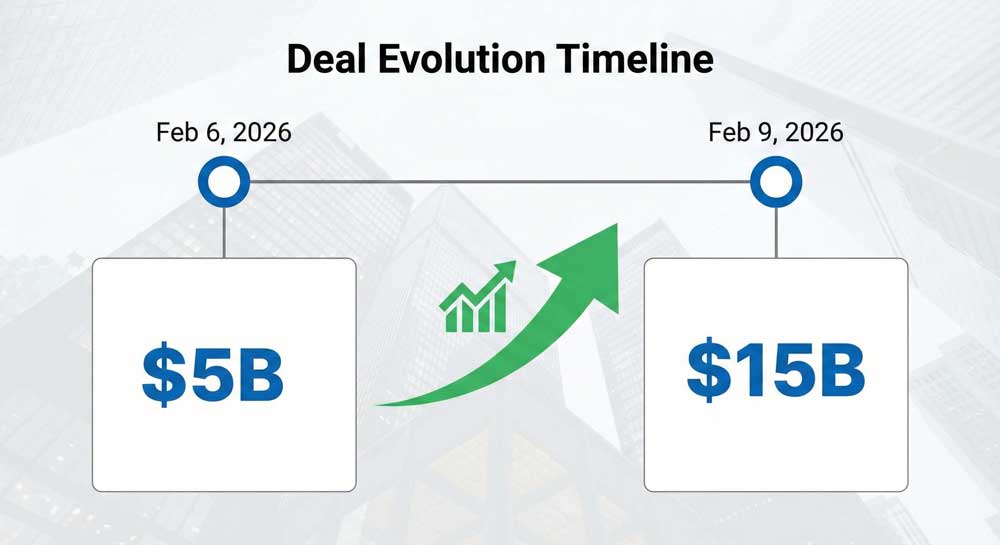
From $5 Billion to $15 Billion in Three Days
The speed stunned even seasoned analysts. On February 6, 2026, Bloomberg reported Blackstone was finalizing a loan exceeding AU$5 billion for Australian AI startup Firmus Technologies. Just 72 hours later, the announcement had transformed dramatically: a US$10 billion (AU$15 billion) debt financing package led by Blackstone and technology investor Coatue Management.
“The picks and shovels powering the AI revolution are one of our highest conviction investment themes,” declared John Watson, Senior Managing Director in Blackstone’s Tactical Opportunities Group.
This marks Blackstone’s second massive Australian data center commitment within 18 months. In December 2024, the firm completed a AU$24 billion acquisition of AirTrunk, the largest data center platform in Asia Pacific—representing both the biggest data center deal globally and Australia’s largest M&A transaction for 2024. Combined, Blackstone has now deployed nearly AU$40 billion into Australian digital infrastructure.
Project Southgate: Building Australia’s AI Factory
The Firmus financing will accelerate Project Southgate, an ambitious initiative to build large-scale “AI Factories” across Australia in partnership with CDC Data Centres and NVIDIA. The first stage, launching within six months, will feature 18,500 of NVIDIA’s latest GB300 GPUs in Tasmania’s Green AI Factory Zone, with NVIDIA signing on as an anchor customer.
The facility utilizes NVIDIA’s DSX reference architecture optimized for AI training and inference workloads, with plans to scale to 36,000 GPUs over two stages. NVIDIA’s participation as both technology partner and customer represents a major vote of confidence in Australia’s AI potential.
| Deal Component | Details |
|---|---|
| Total Financing | AU$15 billion (US$10 billion) |
| Lead Investors | Blackstone, Coatue Management |
| Project Name | Project Southgate |
| Initial Deployment | 18,500 NVIDIA GB300 GPUs |
| Location | Tasmania Green AI Factory Zone |
| Launch Timeline | First stage within 6 months |
| Anchor Customer | NVIDIA |
Australia’s AI Infrastructure Explosion
Why Global Capital is Flooding Into Australia
Australia has emerged as the world’s third-largest destination for AI investment, trailing only the United States and China. The country’s data center capacity is projected to surge from 1,350 megawatts in 2024 to 3,100 megawatts by 2030—more than doubling in just six years and requiring approximately AU$26 billion in infrastructure investment.
Major technology companies are making unprecedented commitments:
- Blackstone (AirTrunk + Firmus): AU$39 billion combined investment
- Amazon Web Services: AU$20 billion through 2029 for AI-powered data centers
- NEXTDC/OpenAI: AU$7 billion computing cluster partnership in Sydney
- Microsoft: Multi-billion dollar data center agreements with Australian providers
Scott Farquhar, co-founder of Atlassian and Chair of Australia’s Tech Council, declared 2026 a “make or break” year determining whether Australia establishes AI leadership or falls permanently behind in the global race.
Market Euphoria: ASX Data Center Stocks Surge
Financial markets responded with explosive enthusiasm. Following the Blackstone-Firmus announcement, Australian data center and infrastructure stocks posted their strongest gains in months:
- Goodman Group (ASX: GMG): Jumped 6.47%, the largest single-day increase since December 23, 2025
- NEXTDC (ASX: NXT): Rose 4.88%, later climbing as high as 7.2%
- Megaport (ASX: MP1): Advanced 5.24% on connectivity demand
- Macquarie Technology Group (ASX: MAQ): Gained 5.02%
The Australian government estimates AI and automation could contribute up to AU$600 billion annually to national GDP by 2030.
The Productivity Paradox: A $15 Billion Solution to the Wrong Problem?
Australia’s Dismal Economic Performance
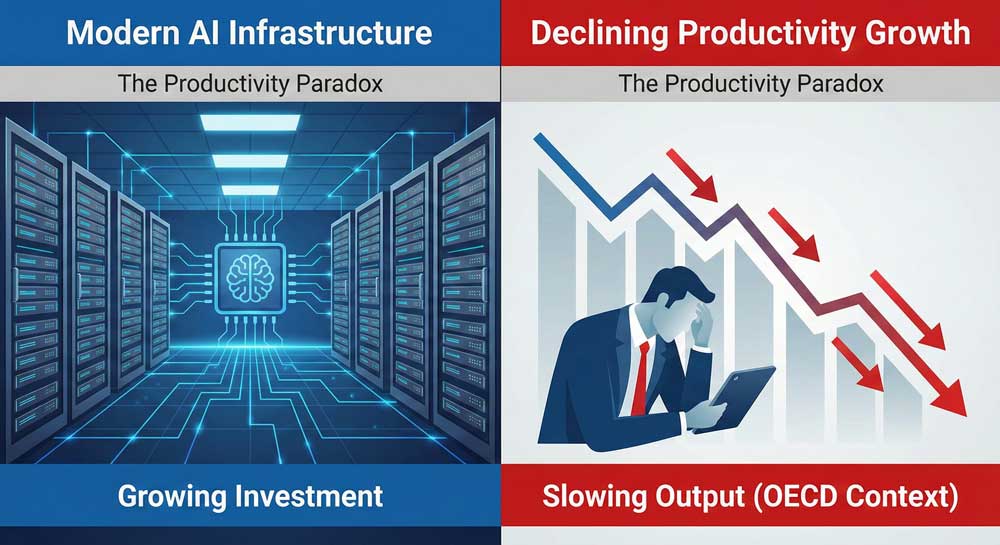
Despite the investment tsunami, Australia’s economic fundamentals tell a sobering story. The country ranks second-last among 38 OECD nations in productivity growth since the COVID-19 pandemic, outperforming only Mexico.
The OECD’s January 2026 Economic Survey confirmed that “Australia’s productivity is below pre-pandemic levels and has underperformed peers”. Current productivity sits 16th among OECD countries, far behind frontier economies like the United States.
Commonwealth Bank Chief Economist Luke Yeaman projects AI could boost productivity by 0.8 to 1.0 percentage points annually, potentially lifting Australia’s growth rate to 3%. However, CBA’s research includes a critical caveat: “Australia is not the United States”.
Why Capital Doesn’t Equal Capability
The Capex vs. Output Gap
Data centers and GPU clusters represent capital expenditure (capex)—the prerequisite for productivity, not productivity itself. Historical evidence shows that massive infrastructure investments require years of complementary development before generating broad-based Total Factor Productivity (TFP) improvements.
Companies must transform business processes, retrain workforces, establish data governance frameworks, and fundamentally redesign operations. Having computing power available doesn’t automatically translate to using it effectively.
The Diffusion Problem: Technology Concentration Risk
Current AI investments concentrate in a handful of mega-scale facilities and platform enterprises: major cloud providers, limited data center operators, and large financial service corporations. Even if these generate enormous efficiency gains, national productivity may stagnate if small and medium enterprises cannot access or absorb these technologies.
Two-thirds of Australian SMEs are not yet using AI tools. According to MYOB research, the main barriers are cost (21%), understanding implementation (18%), and time constraints (17%). Budget constraints (28%) and security concerns (29%) create additional obstacles.
Alarmingly, 57% of SMEs focus AI initiatives exclusively on cost-cutting and efficiency, while only 25% pursue revenue growth applications. Most businesses adopt AI tools without clear strategies, treating artificial intelligence “as an expense to manage rather than an engine for growth”.
| Productivity Factor | Current State | Requirement for Success |
|---|---|---|
| Capital Investment | High (AU$15B+ in 2026) | Sustained long-term funding |
| Computing Hardware | NVIDIA GB300/H100 clusters | Widespread cloud access for SMEs |
| Workforce Skills | Acute shortage (32% cite as critical) | Massive retraining programs |
| SME AI Adoption | 66% not using AI tools | Practical implementation support |
| Government AI Funding | AU$300M over 5 years | 10x increase to match global leaders |
| National Productivity | 2nd-last in OECD | Structural economic reform |
The Government Investment Gap
While Blackstone deploys billions, the Australian government invested only AU$300 million in AI over the past five years—one-tenth the amount committed by leading nations. This investment chasm may explain why Australia lags in AI application and productivity conversion despite world-class infrastructure.
The Australian Academy of Technological Sciences and Engineering warns this disparity creates a dangerous imbalance: private capital builds capacity while public sector support for adoption, skills development, and regulatory frameworks remains inadequate.
What Needs to Happen: Beyond Infrastructure
The Missing Pieces for Productivity Transformation
For Australia to convert the Blackstone AI investment into genuine economic gains, several complementary elements must align:
Business Process Redesign: Companies must fundamentally restructure workflows to leverage AI capabilities, not simply add AI to existing processes.
Workforce Retraining: Employees need skills to work effectively alongside AI systems. A 2025 survey found 93% of Australian executives believe the country is not effectively addressing productivity decline, with 32% citing scarcity of qualified AI personnel as critical.
Competitive Pressure: Australia faces long-standing structural challenges including lower competitive intensity, slower technology diffusion, and uneven adoption among enterprises. Market competition drives technology uptake; relatively protected sectors may resist change.
Capital Shallowing: EY Chief Economist Cherelle Murphy identified “capital shallowing”—where the ratio of capital to labor diminishes—as a key factor in productivity decline. Despite strong labor markets, business investment and innovation haven’t kept pace.
CBA’s research emphasizes that economic reforms boosting competitiveness and dynamism are crucial for Australia to match AI-leading nations.
The Measurement Challenge
Even when AI significantly improves output within individual enterprises, these micro-level gains typically take years to appear in macro statistics like GDP growth and national productivity. Other variables—population aging, inflation, interest rates, supply-demand imbalances—can mask improvements in aggregate data.
Sustainable increases in long-term potential growth require technology diffusion, institutional support, education investment, and competitive environments working together—not merely temporary capital influx.
The Verdict: Productivity Mirage or Transformation Catalyst?

Across Sydney and Melbourne, workers install NVIDIA’s latest chips around the clock in facilities funded by the largest Blackstone AI investment Australia has ever witnessed. The infrastructure buildout is undeniably real, creating immediate opportunities in construction, employment, and industrial development.
However, the critical question remains unanswered: Will AU$15 billion in computing infrastructure overcome structural barriers preventing Australia from translating capacity into capability?
The investment represents global capital’s strong confidence in Australia’s AI potential. But transforming physical infrastructure into measurable productivity gains requires addressing deeper challenges: skills shortages affecting two-thirds of SMEs, government funding gaps ten times smaller than competitor nations, and structural issues limiting technology diffusion.
Australia stands at a crossroads. The next few years will determine whether the Blackstone AI investment catalyzes genuine economic transformation or simply builds world-class data centers that primarily serve foreign AI companies while domestic productivity stagnates at second-last in the OECD.
The answer depends less on how many GPU clusters get installed and more on whether Australia can finally address the unglamorous fundamentals: education, competition policy, business innovation support, and the practical barriers preventing 66% of small businesses from accessing the AI revolution happening in their own backyard.
Sources and Further Reading
- Firmus Secures US$10 Billion Financing Led by Blackstone and Coatue
- Australian AI Infrastructure Developer Firmus Lands $10 Billion Debt Package – Reuters
- Blackstone Announces AU$24 Billion AirTrunk Acquisition
- Driving Australia’s AI Future with CDC, Firmus, and NVIDIA
- OECD Economic Surveys: Australia 2026
- AI Adoption in Australian SMEs 2026 – ScaleSuite
- Australia’s Productivity Collapses to Zero – MacroBusiness
- Amazon Spending $20 Billion on AI Data Centres in Australia – Forbes
- The Physical Truth Behind the US-China AI Race: Electrons, Not Just Silicon
- Beyond the Model: How Google’s Ecosystem Strategy is Outmaneuvering OpenAI
- SpaceX xAI Merger: 7 Shocking Facts Behind Elon Musk’s $1.25 Trillion Gamble