7 Shocking Truths: How Peter Thiel & Palantir Influence Is Reshaping Global Power
The Peter Thiel Palantir influence is quietly rewriting the operating code of American power — and by extension, global geopolitics. While Elon Musk dominates headlines with public spectacles and chainsaw metaphors, Peter Thiel operates differently: no official title, no press conferences, no Twitter outbursts. He rewrites the source code from the shadows. That asymmetry, say analysts who study modern power structures, makes him the more consequential — and potentially more dangerous — figure in American life today.
This article unpacks seven dimensions of the Peter Thiel Palantir influence across AI warfare, Silicon Valley politics, and the architecture of the future itself.
Table of Contents
1. Palantir as the “Wartime Brain”
To grasp the full scope of the Peter Thiel Palantir influence, start with the company’s role in modern warfare. Defense analysts describe a scenario already being operationalized: rather than human generals processing scattered intelligence, an AI platform fuses satellite imagery, geolocation data, signals intercepts, and behavioral patterns to identify and track high-value targets in real time. Palantir doesn’t just assist in this process — it is the process.
The company’s documented track record of state collaboration is extensive:
- 2011: Palantir’s data integration tools were reportedly instrumental in locating Osama bin Laden’s compound in Abbottabad ahead of Operation Neptune Spear
- 2024: The U.S. Army awarded Palantir a $480 million contract for the Maven Smart System — an AI platform that scans battlespace data to automatically detect enemy systems across five combatant commands
- 2025: The Pentagon raised Palantir’s Maven contract ceiling by a further $795 million, citing “growing demand” from military users
- 2025: Palantir landed a separate $10 billion Army software and data contract
- Ongoing: ICE awarded Palantir $30 million to build “ImmigrationOS” — a surveillance platform providing near-real-time tracking of deportees, visa overstays, and self-deporting individuals
The name “Palantir” itself is a deliberate signal. In Tolkien’s The Lord of the Rings, a palantír is a seeing stone — a magical crystal that lets its wielder observe events across vast distances, including the past and possible futures. Thiel clearly understood the implications of claiming that name.
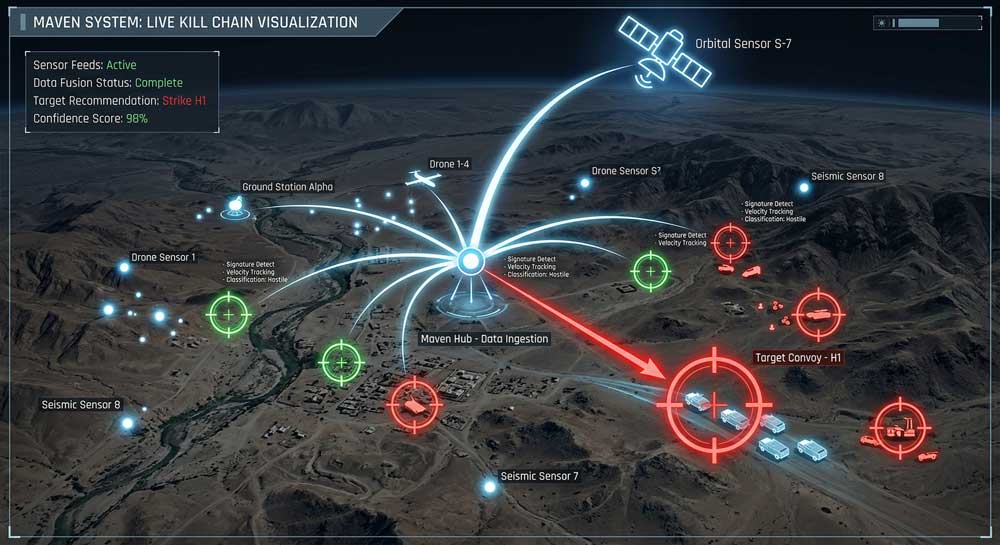
Palantir’s Government Contract Portfolio
2. The Ethical AI Showdown: Palantir vs. Silicon Valley
The Peter Thiel Palantir influence has never been more visible than in the fault line it exposed between military AI and ethical AI. While companies like Anthropic push strict guardrails — prohibiting their language models from autonomous weapons systems or mass surveillance of citizens — Palantir openly embraces the military-industrial complex.
Thiel and Palantir CEO Alex Karp have consistently attacked what they call Silicon Valley’s “woke” ethical posturing. Their position is philosophically clear: technology is never neutral. If American tech companies enjoy the protections and market advantages of the U.S. legal system, they bear a duty to function as the nation’s digital arsenal. As Karp bluntly stated: “If you want an AI that writes poetry, go to Anthropic. If you want one designed to win wars, only Palantir is willing to carry that moral burden.”
This tension came to a head in 2025, when Anthropic’s Claude became the first commercial large language model integrated into the Pentagon’s highest-classified networks — but with hard contractual limits: no mass surveillance of U.S. citizens, no fully automated lethal decision-making. The Pentagon pushed back forcefully, and the contract was ultimately terminated. Palantir stepped in, swapping Claude out for OpenAI’s ChatGPT. Anthropic filed two federal lawsuits.
“Peter isn’t seeking power. He is seeking order. His ability to identify systemic logic is irreplaceable.” — Elon Musk
3. From PayPal Mafia to Defense Contractor
The roots of the Peter Thiel Palantir influence trace back to the late 1990s and the founding of PayPal — a company Thiel initially envisioned, under “sovereign individual” philosophy, as a stateless monetary system beyond government control.
The rivalry with Elon Musk crystallized during this period. When PayPal merged with Musk’s X.com in 2000, Musk became CEO. In September of that year, while Musk was on his honeymoon flight to Sydney, Thiel and co-founder Max Levchin orchestrated a boardroom coup — convening an emergency vote in the CEO’s absence, removing Musk, and reinstating Thiel. By the time the plane landed in Australia, Musk had been fired. He flew back immediately, was furious — admitting later he had darker thoughts — but ultimately chose not to sue, continuing as the company’s largest shareholder.
PayPal sold to eBay in 2002 for $1.5 billion. Thiel’s 3.7% stake yielded ~$55 million; Musk, as largest shareholder, received ~$180 million — the seed capital for SpaceX and Tesla.
Thiel vs. Musk: Two Models of Power
| Dimension | Elon Musk — The Bulldozer | Peter Thiel — The Architect |
|---|---|---|
| Operating style | Front-stage, chaotic, instinct-driven | Backstage, strategic, secretive |
| Political approach | Direct public lobbying; led DOGE | Long-term proxy placement; ideological seeding |
| Business focus | Hardware, physics, consumer attention | Data infrastructure, intelligence contracts, algorithms |
| Vision | Multi-planetary humanity | Rigidly ordered, technologically supreme society |
| 2024 Trump support | ~$300M direct spend + DOGE leadership | Indirect — through JD Vance and network |
The alumni of that PayPal team went on to build YouTube, LinkedIn, Tesla, SpaceX, and Yelp — a network christened the “PayPal Mafia,” with Thiel as its godfather. It operates less like a social club and more like a high-trust venture syndicate: cross-shareholdings, mutual endorsements, and a shared ideological DNA of libertarianism, techno-supremacy, and elite meritocracy.

4. Thiel as Political Architect
The most sophisticated dimension of the Peter Thiel Palantir influence is not technological — it is political. Thiel concluded early that direct involvement with volatile populist leaders was inefficient. His model evolved into something closer to venture capital: find, fund, and install ideological proxies in seats of structural power.
He wrote in 2009 that he no longer believed “freedom and democracy are compatible” — framing modern democracy as a mass vote-purchasing scheme that systematically kills innovation through taxation and over-regulation. He relocated Palantir’s headquarters to Denver partly to escape San Francisco’s dominant progressive culture.
In 2016, Thiel became virtually the only Silicon Valley figure to publicly back Donald Trump, speaking at the Republican National Convention and coming out simultaneously as gay and pro-Trump. He joined the presidential transition executive committee and used that role to place loyalists across Pentagon and intelligence leadership. Palantir’s government contract pipeline expanded dramatically.
By Trump’s second term, the relationship had cooled — Thiel declined a personal request from Trump for a $10 million 2024 campaign donation. He had found a more durable vehicle for his ideology.
5. JD Vance — Thiel’s Greatest Political Investment
The most tangible proof of the Peter Thiel Palantir influence on Washington is Vice President JD Vance.
The relationship began in 2011 when Vance, then a Yale Law student, attended a Thiel lecture attacking elite lawyers and financiers for engaging in “pointless competition” rather than building real things. Vance reached out directly. Thiel hired him at Mithril Capital. He then seeded Vance’s own venture firm with $93 million from his Silicon Valley network, and in 2022 donated $15 million to Vance’s Ohio Senate Super PAC — the largest single donation to a Senate candidate in American history.
Before Thiel’s sustained influence, Vance had privately called Trump “America’s Hitler” and was a vocal Never Trumper. Thiel reframed the calculus: if Vance genuinely wanted to help the working-class communities of Hillbilly Elegy, the only viable political vehicle was populist nationalism. In 2021, Thiel personally escorted Vance to Mar-a-Lago to vouch for his transformation. Vance won his Senate seat; in 2024, he became the 47th Vice President of the United States.
Vance’s Policy Agenda as “Thielism” in Practice
| Policy Area | Vance’s Position | Thiel’s Ideological Root |
|---|---|---|
| Tech regulation | Break up Google and Meta; clear space for startups | Anti-monopoly for incumbents; protect his own portfolio |
| Trade & industry | Aggressive economic nationalism; high tariffs | Tech sovereignty; onshore critical supply chains |
| Foreign policy | Oppose unlimited Ukraine aid | “Realist retreat”; concentrate resources on AI/biotech |
| AI governance | Dismantle “woke AI” ethical guardrails | Anti-ethical-constraints on military AI |
| Immigration | Strict ICE enforcement | Algorithmic border surveillance via Palantir |
Thiel no longer needs to visit Washington. His most carefully cultivated proxy is already seated in the West Wing — and as Trump ages into his late 70s, Vance’s name grows louder as a future presidential candidate. The long game is working.
6. The Biological Endgame: Living to 500
The Peter Thiel Palantir influence does not stop at national borders or political cycles. It extends into biology itself.
Thiel has stated publicly that “death is a solvable engineering problem.” He has donated millions to the SENS Research Foundation and the Methuselah Foundation, both focused on reversing biological aging. He is a documented supporter of cryonics — preserving bodies at ultra-low temperatures after death for potential future revival.
The philosophical logic is internally consistent: if you believe the compounding value of a brilliant, well-positioned individual over centuries dwarfs any societal redistribution, then eliminating death becomes the highest-ROI investment possible.
The dystopian downstream of this worldview is a world where:
- Biological inequality becomes permanent — the wealthy extend healthy lifespans past 120 via gene editing and anti-aging medicine; everyone else ages normally
- AI eliminates average labor — if your skills can be automated, no social contract requires the state to maintain your living standard
- Competition is a design flaw — as Thiel argues in Zero to One, monopoly is the reward for genuine innovation; competition is what losers do
7. The Doomsday Fortress at the End of the World
If the algorithms fail and the system collapses, Thiel has a plan.
In 2011, he was granted New Zealand citizenship after spending just 12 days in the country — far below the standard 1,350-day residency requirement — under a rarely invoked “exceptional circumstances” clause. The decision ignited a parliamentary controversy about whether New Zealand citizenship was effectively for sale to foreign billionaires.
He subsequently purchased extensive land near Lake Wānaka on New Zealand’s South Island with plans for a high-tech secure compound. In 2022, the Queenstown Lakes District Council formally rejected the building application on environmental and landscape impact grounds. An appeal also failed. The compound remains unbuilt — but the intent has not changed.
New Zealand has become the preferred refuge for Silicon Valley billionaires planning for civilizational disruption, valued for its geographic isolation, political stability, and distance from every major nuclear target.
There is a pointed irony here: the man whose surveillance systems help governments track and control populations across the globe has quietly secured a bolt-hole in a remote valley, insulated from the consequences of the world his algorithms help create.
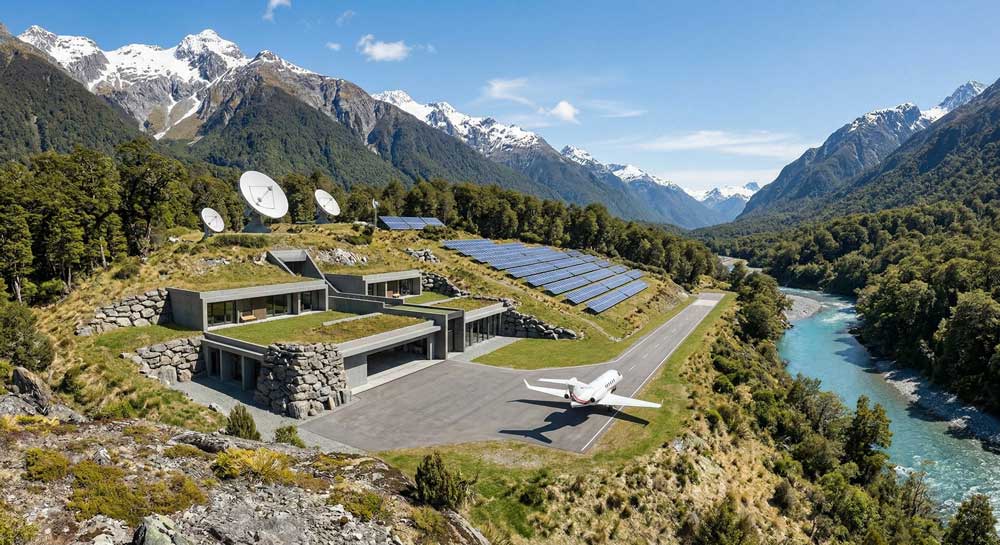
The Verdict: Shadow Architecture vs. Visible Power
Peter Thiel is not merely an investor or entrepreneur. He is an ideological force methodically installing his worldview into the hardware of American governance — through Palantir’s battlefield AI, through Vance’s White House positioning, through longevity research that would make his influence potentially multigenerational.
If Elon Musk is the figure swinging a wrecking ball at the facade, Peter Thiel is the one quietly replacing the foundation while no one is watching.
Authoritative Sources & Further Reading
- DefenseScoop — Palantir’s $480M Maven Smart System Army contract (2024): https://defensescoop.com/2024/05/29/palantir-480-million-army-contract-maven-smart-system-artificial-intelligence/
- DefenseScoop — Pentagon raises Maven contract ceiling by $795M (2025): https://defensescoop.com/2025/05/23/dod-palantir-maven-smart-system-contract-increase/
- Wired — ICE pays Palantir $30M to build ImmigrationOS surveillance platform: https://www.wired.com/story/ice-palantir-immigrationos/
- CBS News — The billionaire who fueled JD Vance’s rise to Vice President: https://www.cbsnews.com/news/jd-vance-trump-vp-peter-thiel-billionaire/
- Reuters — Peter Thiel’s New Zealand citizenship controversy: https://www.reuters.com/article/world/peter-thiels-new-zealand-citizenship-stokes-political-debate-idUSKBN15H0I2/
- Alcor Life Extension Foundation — Thiel’s $3.5M anti-aging research pledge: https://www.alcor.org/resources/blog/peter_thiel_pledges_35_million/
- ABC Australia — Silicon Valley doomsday preppers and New Zealand bunkers: https://www.abc.net.au/news/2022-10-20/tech-billionaires-are-planning-for-the-apocalypse/101546216
- Business Insider — Thiel’s $10M initial donation backing Vance’s Senate bid: https://www.businessinsider.com/peter-thiel-donated-10-million-pac-jd-vance-senate-bid-2021-3
- ElevenLab — The Physical Truth Behind the US-China AI Race: Electrons, Not Just Silicon
- ElevenLab — Beyond the Model: How Google’s Ecosystem Strategy is Outmaneuvering OpenAI
- ElevenLab — Chinese AI Models: 7 Powerful Ways They’re Dominating the Global Developer Market in 2026