Strait of Hormuz Shipping Volume Hits an Incredible 7-Day High
Strait of Hormuz shipping is showing its most encouraging signs of recovery since the outbreak of US-Iran hostilities — but the real story isn’t just the ships moving through. It’s how they’re being allowed to move, and who’s deciding the rules.
According to industry-compiled vessel tracking data, the seven-day rolling average of transits through this critical maritime chokepoint has reached its highest level since the conflict began on February 28, 2026. Here’s everything you need to know.
Table of Contents
The Scale of the Disruption
To grasp the recovery, you first need to understand how catastrophic the initial shock was. Under normal conditions, the Strait of Hormuz handles roughly 138 commercial vessels per day — carrying approximately 20 million barrels of crude oil and petroleum products, representing about 25% of all seaborne oil trade on Earth.
When US and Israeli forces struck Iran on February 28, that flow collapsed almost overnight. Within days, daily transits had fallen from ~100 vessels to just six per day on average during the first week of March — a decline of over 94%.
Strait of Hormuz Shipping: Pre-War vs. Now
| Metric | Pre-War Normal | Early March (Peak Disruption) | Recent 36-Hour Window |
|---|---|---|---|
| Daily vessel transits | ~138 ships/day | ~6 ships/day | 13 vessels (36 hrs) |
| Oil throughput | ~20 million bbl/day | Near zero | Severely reduced |
| LNG/gas share | ~20% of global supply | Blocked | Minimal, recovering |
| Primary route available | Open navigation | Restricted | Iran-controlled North Route |
| Western-linked vessels | Regular | Zero | First transits since war |
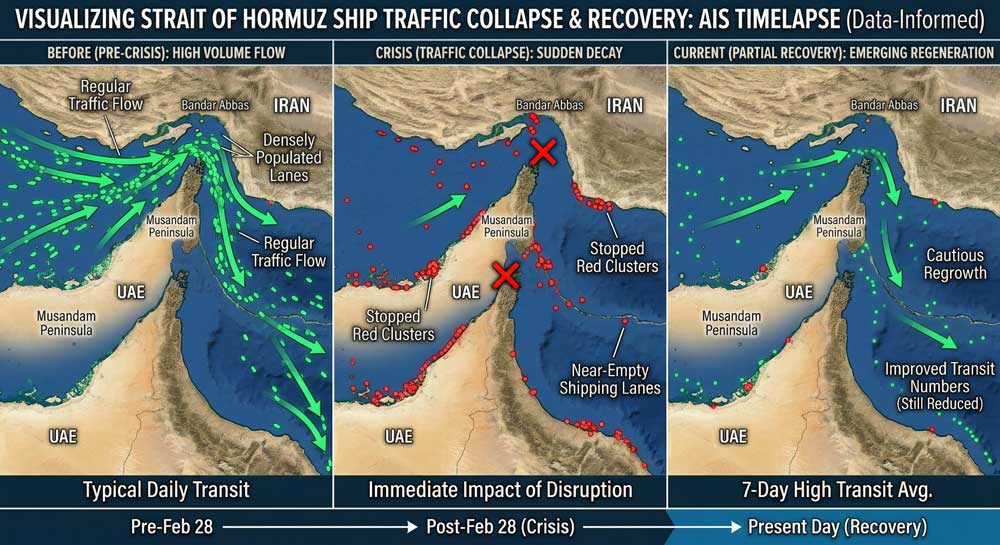
The 13 vessels recorded between Friday morning and Saturday evening — 10 outbound from the Persian Gulf, 3 inbound from open sea — represent a meaningful uptick. Still, even at this improved rate, current volumes are roughly 5–10% of pre-war norms.
Landmark Transits: France, Japan, and Turkey
The most significant development in Strait of Hormuz shipping this week isn’t the volume — it’s the flags. Previously, almost every vessel making the crossing had direct ties to Iran or explicitly aligned nations. That has now changed.
| Vessel | Type | Operator | Significance |
|---|---|---|---|
| CMA CGM Kribi | Container ship (~5,000 TEU) | CMA CGM (France, Malta-registered) | First Western European-linked vessel since war began |
| Sohar LNG (MOL-affiliated) | LPG/LNG carrier | Mitsui O.S.K. Lines (Japan) | First Japanese LPG vessel; second Japan-linked ship overall |
| Undisclosed vessel | General cargo | Turkish operator | First confirmed Turkish departure post-blockade |
The CMA CGM Kribi made a calculated diplomatic signal before entering Iranian waters — it updated its AIS destination field to read “Owner French,” openly broadcasting its nationality to Iranian maritime authorities. It then hugged the Iranian coastline through the narrow channel between Qeshm Island and Larak Island — the route explicitly sanctioned by Iran.
Mitsui O.S.K. Lines confirmed the safe passage of its affiliated LPG carrier, stating the crew was safe — though the company declined to clarify whether the transit resulted from direct government diplomacy or commercial intermediary arrangements. Turkey confirmed a national vessel departure later the same Friday.
The timing of the French transit was striking: it occurred the same day French President Emmanuel Macron publicly declared that only diplomacy — not military force — can reopen the Strait of Hormuz. Whether coordinated or coincidental, the pairing suggests back-channel engagement between Paris and Tehran.
Iran’s New Tiered Transit System
To understand the future of Strait of Hormuz shipping, you need to understand the framework Iran is now building around it. Iran’s parliament has formally approved a comprehensive Hormuz management plan that institutionalizes control over the waterway.
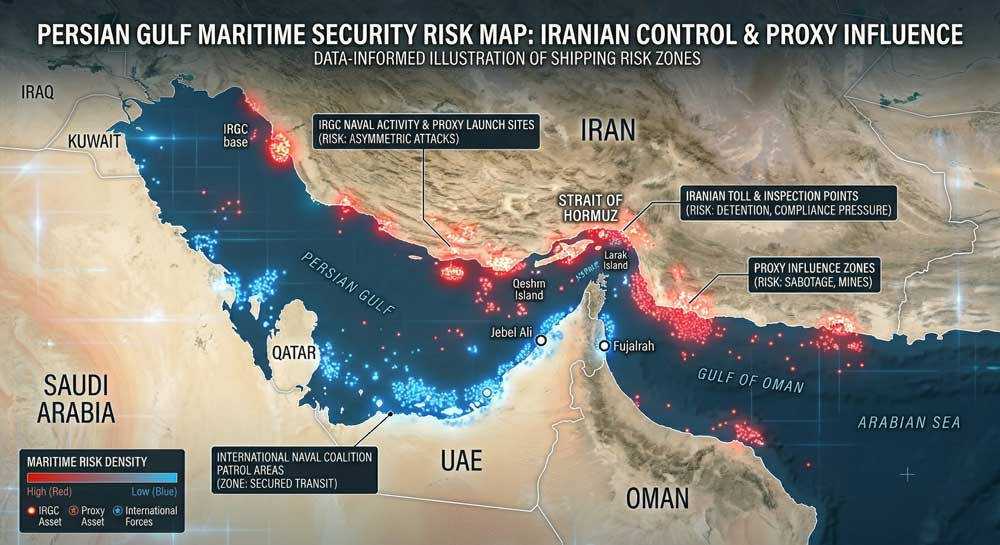
The plan includes eight key elements:
- Security screening for all transiting vessels
- Safe navigation protocols under Iranian supervision
- Environmental compliance requirements
- A rial-based toll system (informal collection in Chinese yuan and crypto stablecoins already underway)
- Explicit ban on US and Israeli vessel passage
- Restrictions on countries participating in sanctions against Iran
- Strengthened IRGC sovereign military role
- A cooperative legal framework with Oman
Crucially, sources indicate Iran has already been operating an informal five-tier geopolitical classification system, determining transit conditions based on how closely a flag state aligns with Tehran:
| Tier | Country Profile | Transit Conditions |
|---|---|---|
| 1 | Close allies (China, Russia) | Streamlined; minimal fees |
| 2 | Friendly neutrals (Pakistan, Oman) | Bilateral agreements; managed transit |
| 3 | Commercial negotiators | Per-voyage intermediary arrangements |
| 4 | Non-aligned / ambiguous | High scrutiny; case-by-case |
| 5 | Adversarial states (US, Israel) | Effectively prohibited |
To enter the system, operators must contact IRGC-linked intermediaries and provide vessel ownership details, crew manifests, and live AIS data — raising serious compliance and intelligence concerns for Western shipping firms. A single VLCC tanker could face transit fees of up to $2 million per crossing.
Two Routes Through the Strait
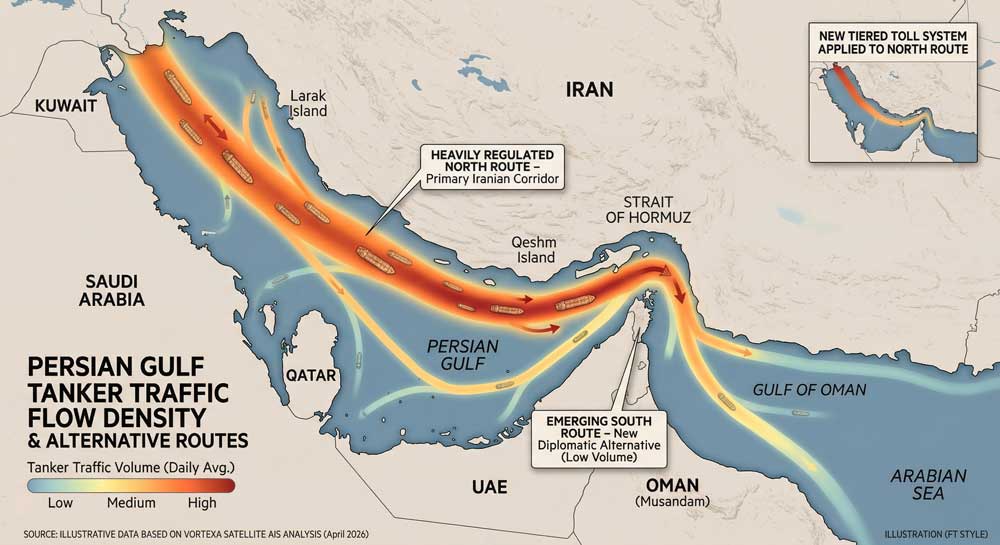
Vessel tracking data has revealed a geographic split in how ships are actually navigating the strait:
| Route | Path | Who’s Using It |
|---|---|---|
| North Route (Iran-sanctioned) | Narrow channel between Larak Island and Qeshm Island, hugging the Iranian coast | Majority of all recent transits, including CMA CGM Kribi |
| South Route (emerging) | Along the Omani coastline | At least 3 vessels observed recently — potentially Oman-facilitated |
The dominance of the North Route is deliberate — it maximizes Iranian visibility and leverage over every vessel in transit. The emergence of South Route transits may signal Oman’s quiet facilitation of an alternative corridor.
Oman’s Critical Diplomatic Role
The push for a formalized mechanism is not entirely unilateral. Oman, which shares the strait, is positioning itself as an indispensable broker.
Omani Foreign Minister Badr has publicly announced that his country is accelerating efforts to establish a unified, safe transit mechanism. Iran has proposed co-managing the new toll system with Oman — a proposal that would lend international legitimacy to what is currently a unilateral Iranian enforcement regime. Muscat has not yet made a definitive public commitment, but its strategic silence speaks volumes: Oman has historically maintained diplomatic ties with both Iran and the West, making it uniquely positioned to broker a durable arrangement.
What to Watch Next
The trajectory of Strait of Hormuz shipping over the coming weeks will hinge on several key variables:
- Will EU-flagged vessels follow France’s lead? Legal, insurance, and sanctions compliance barriers remain steep for most European operators.
- Will Oman formally endorse Iran’s co-management proposal, lending multilateral legitimacy to the toll framework?
- How will Washington respond to allied-nation ships transiting under Iranian-controlled conditions — a politically sensitive issue the US has been quiet on.
- AIS dark shipping — as commercial negotiations intensify, expect increased use of transponder manipulation and flag-of-convenience vessels to obscure transits.
For businesses reliant on Gulf energy exports, adapting to these new transit realities is no longer optional — it is a strategic imperative.
Further Reading
- World Oil Transit Chokepoints
- What is the Strait of Hormuz and why is it so important for oil?
- French and Japanese Ships Make First Hormuz Crossings
- Hormuz ship traffic down 94% since Iran conflict began
- Three Weeks Into the Iran War: Maritime Trade Disruption Analysis
- Iran Panel Approves Hormuz Toll Plan
- CMA CGM Vessel Is First Major Carrier Through Strait of Hormuz
- Transit Passage Rights Through International Straits
- 5 Crucial Reasons the Gold Safe Haven Fails During Oil Crisis Shocks
- Cyrus the Great: 7 Timeless Leadership Lessons Iran Urgently Needs Today
- 5 Harsh Realities of the US Oil Price Impact: Why Energy Independence Isn’t Enough