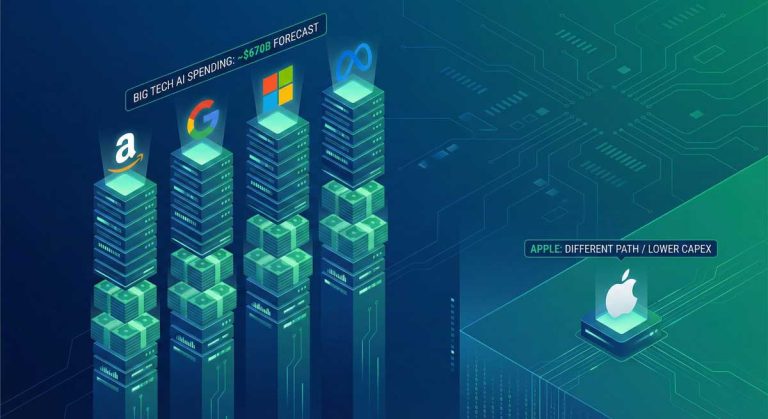
Storage Chip Prices Are Exploding: 3 Shocking Reasons Your Next SSD Will Cost More
Storage chip prices are rising faster than gold, oil, or almost any commodity you can name right now. That portable SSD you bought for $60 last year? It’s sitting on shelves at $120 or more today — and the pain is far from over.
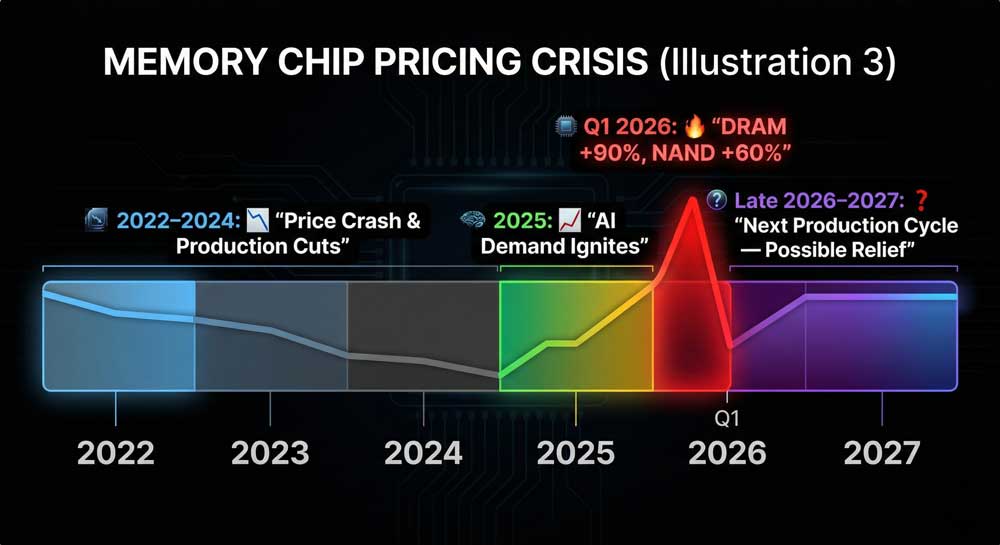
From USB flash drives and camera SD cards to laptop RAM and flagship smartphone price tags, consumers worldwide are feeling the squeeze. But the real shock is the scale: according to TrendForce, DRAM contract prices surged 90–95% in Q1 2026 alone, while NAND flash jumped 55–60% in the same quarter — revisions that analysts themselves described as historic.
The root cause of all of it? A single, crucial component inside nearly every piece of technology you own.
Table of Contents
What Are Storage Chips?
To understand the surge in storage chip prices, you need to know what these components actually do. At their core, all microchips (integrated circuits) pack billions of transistors onto a silicon wafer to perform specific functions. They generally fall into two categories:
- Logic Chips: The “brain” of your device — CPUs and GPUs built on advanced 2nm, 3nm, or 5nm nodes. They handle computation and determine performance.
- Storage Chips: The “warehouse” — their mission is to hold your digital data (binary 0s and 1s) reliably, without performing general computation.
Within storage chips, two dominant families power virtually every device you use:
| Chip Type | Technical Name | Function | Data Retention | Common Examples |
|---|---|---|---|---|
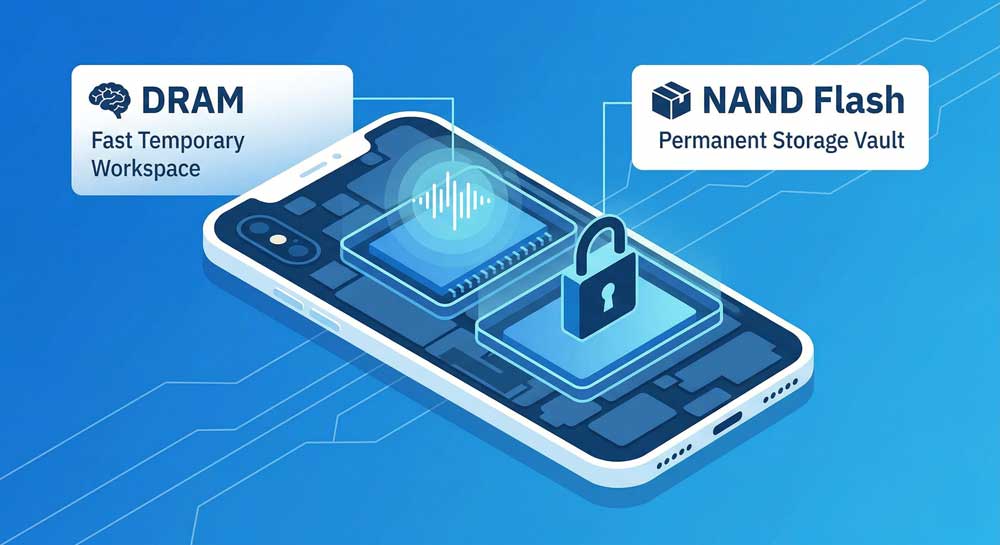
| Flash Memory | NAND Flash | Permanent storage | Survives power-off | SSDs, USB drives, SD cards, the “512GB” in your phone |
| System Memory | DRAM | Temporary workspace for CPU/GPU | Wiped on power-off | The “16GB RAM” in your laptop or PC |
When you buy a phone listed as “12GB + 256GB”, the 12GB is DRAM and the 256GB is NAND Flash. Both are experiencing brutal storage chip price increases right now — but for interconnected reasons.
3 Shocking Reasons Storage Chip Prices Are Surging
This isn’t a matter of chips becoming harder to manufacture. Instead, a perfect storm of industry economics, artificial intelligence, and geopolitics has collided to create the worst storage shortage in recent memory.
1. Manufacturers Deliberately Slashed Production
It sounds counterintuitive: if storage chip prices are this high, shouldn’t manufacturers be working overtime to cash in?
The answer lies in what happened just two years ago. Between 2022 and 2024, the industry suffered a catastrophic post-pandemic demand crash. Overexpansion met collapsing consumer demand, sending storage chip prices to rock bottom and causing severe financial losses across the board. To survive, industry giants like Samsung, SK Hynix, and Micron collectively slashed output and froze capital expenditure plans for 2025–2026.
Now that those lean inventories have dried up, manufacturers are keeping a deliberately tight grip on low-end storage production. They’d rather sustain higher margins than risk another oversupply collapse. The result: NVMe and SATA SSD prices are now more than double their early 2025 levels, and standard DDR4/DDR5 memory has risen up to 200% since late 2025.
2. The AI Boom Is Consuming the Entire Supply Chain
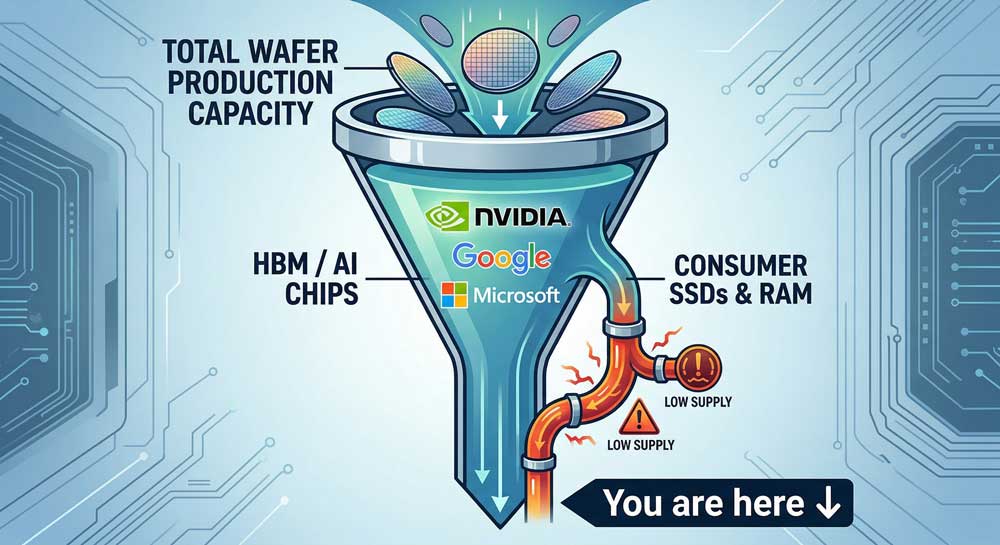
This is the single biggest structural shift reshaping storage chip prices — and it’s not going away. Training Large Language Models (LLMs) like GPT-4 or Gemini requires not just powerful GPUs, but a premium, specialized memory type: High Bandwidth Memory (HBM).
HBM is extraordinarily profitable for manufacturers, and AI giants — Nvidia, Google, Microsoft, and others — are outbidding the entire consumer market for it. The consequence is stark: Samsung, SK Hynix, and Micron are actively redirecting wafer capacity away from consumer DRAM and NAND toward AI-oriented HBM and LPDDR production.
| Memory Type | Primary Use | Demand Driver | Consumer Market Impact |
|---|---|---|---|
| HBM (High Bandwidth Memory) | AI model training & inference | AI hyperscalers (Nvidia, Google, Microsoft) | Squeezes out consumer chip capacity |
| Standard DRAM (DDR4/DDR5) | PCs, laptops, smartphones | General consumers | Prices up ~90–95% QoQ in Q1 2026 |
| NAND Flash | SSDs, USB drives, phones | Enterprise + AI data centers | Prices up ~55–60% QoQ in Q1 2026 |
HBM shipments are projected to grow 70% year-over-year in 2025, and SK Hynix has already confirmed its HBM supply is sold out well into 2026. The global NAND flash market alone is forecast to reach $65 billion in 2026 and $70 billion in 2027, with AI-related demand claiming an ever-larger share. Every wafer shifted toward AI is one less wafer available to keep your SSD affordable.
3. Geopolitics, Raw Materials, and the 1–2 Year Lag Problem
The third driver compounds the first two. Manufacturing storage chips requires highly specialized chemicals, rare gases (including helium), and precision silicon wafers — all of which have become more expensive and harder to source.
Geopolitical tensions, including ongoing Middle East conflicts affecting shipping through the Strait of Hormuz, have disrupted the transport of critical semiconductor gases. Combine that with semiconductor export controls and broader supply chain friction, and the baseline cost to produce every chip rises.
Perhaps most critically, there’s an inescapable structural time lag built into the semiconductor industry:
| Production Phase | Typical Timeline |
|---|---|
| Decision to expand capacity | Immediate, but dependent on market confidence |
| Equipment procurement & fab construction | 12–18 months |
| Yield testing & qualification | 6–12 months |
| New chips reaching retail shelves | 18–24 months total minimum |
Manufacturers who froze expansion budgets in 2023–2024 simply cannot respond to 2026 demand in time — even if they started building today.
How Long Will Storage Chip Prices Stay High?
The honest answer, backed by current analyst data: at least through 2026, and likely into 2027.
DRAM contract prices were projected to more than double quarter-over-quarter in Q1 2026 — what TrendForce called a new quarterly record. One forecast puts 16GB DDR5 modules at approximately $30 by mid-2026, up from under $10 in September 2025. That’s a 3× increase in under a year.
Meanwhile, consumer demand is simultaneously growing. Smartphones that shipped with 128GB standard have moved to 256GB or 512GB as baseline. Laptops increasingly default to 32GB RAM. The more storage per device, the more chip supply is consumed, even if unit sales stay flat.
There is a potential silver lining: some spot price momentum may moderate in late 2026 as the new production cycles begin to mature and AI demand normalizes. But a return to the historic lows of 2022–2023 is almost certainly not on the near-term horizon.
Should You Buy Now or Wait?
The market reality is clear. If you have a genuine need — a PC build, a failing SSD, a RAM upgrade for work — buy now. Waiting another month or two hoping for 2023-era prices is likely a losing strategy.
If it’s a discretionary upgrade with no urgency, joining the “wait-and-see” crowd until the next full production cycle (likely late 2026 or 2027) is a reasonable approach. The key is making purchase decisions based on actual need, not speculation about a price floor that may still be 12–18 months away.
Further Reading & Authoritative Sources
- TrendForce: Memory Price Outlook for Q1 2026 — DRAM and NAND Sharply Upgraded
- Tom’s Hardware: Memory Spot Prices Climbed Again in February — NAND Wafer Costs Surge 25%
- The Register: DRAM Prices Expected to Nearly Double in Q1 2026
- TechInsights: 2025 Memory Outlook Report — HBM and AI Demand
- Intuition Labs: RAM Shortage 2025 — How AI Demand Is Raising DRAM Prices
- BaCloud: When Will RAM Prices Drop? Global Memory Market Outlook 2024–2026
- Nvidia supplier SK Hynix says HBM chips almost sold out for 2025
- Tesla Inventory Crisis: 5 Shocking Reasons Why Buyers Win in 2026
- Nvidia H200 Chips China Sales Hit Zero: 7 Shocking Reasons Trump’s Strategy Backfired
- Blackstone AI Investment Australia: $15 Billion Bet on Infrastructure vs. Reality of Productivity Crisis