Cerebras IPO: The AI Inference Chip That Cracked Nvidia’s 7 Monopoly Stranglehold
The Cerebras IPO is more than a headline-grabbing stock debut — it is the first time the public market has put a price tag on the AI inference chip revolution. On May 14, 2026, Cerebras Systems (NASDAQ: CBRS) surged 68% on its first trading day, closing at $311.07 against an IPO price of $185, raising $5.55 billion in the largest U.S. technology IPO since Uber’s 2019 listing.
That single session told the market something unmistakable: the era of inference-first AI computing has arrived, and investors are willing to pay a steep premium for the company leading the charge.
Table of Contents
From Rejection to Record-Breaking Debut
The road to Nasdaq was anything but smooth. Cerebras first filed its S-1 in 2024, only to withdraw after regulators at CFIUS — the Committee on Foreign Investment in the United States — flagged a national security concern: its largest customer, UAE-based AI company G42, was contributing over 85% of revenue, with sovereign Gulf capital indirectly holding equity in U.S. AI infrastructure.
The regulatory logjam broke in March 2025 when G42 converted its shares to non-voting stock and signed a U.S. national security agreement. What followed was a deliberate and successful reinvention of Cerebras’s customer story. In January 2026, OpenAI signed a multi-year compute contract worth over $10 billion for 750 megawatts of AI inference capacity, with options extending to 2030. In March 2026, AWS announced a strategic partnership integrating Cerebras hardware with Amazon’s Trainium3 infrastructure.
By April 2026, when Cerebras re-filed its S-1, the company had transformed from a Gulf-dependent single-customer risk into a credible multi-cloud inference platform. The IPO pricing was raised three times in ten days before settling at $185 — and demand still exceeded supply by over 20 times.
This experience carries a broader lesson for the industry: regulatory compliance, customer diversification, and geopolitical optics are no longer soft considerations for technology companies — they are hard prerequisites for access to U.S. public capital markets.
What Makes the WSE-3 Chip Structurally Different
To understand why this company attracts such intense attention, you need to understand what a wafer-scale engine actually does — and why it matters for inference specifically.
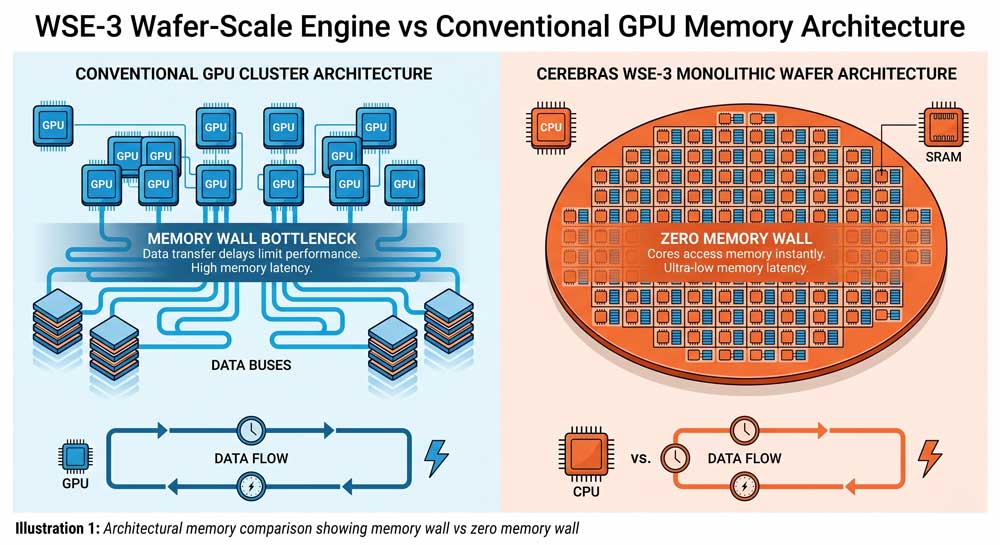
Traditional semiconductor manufacturing cuts a 300mm silicon wafer into hundreds of individual dies, which are then separately packaged. Cerebras does the opposite: the entire wafer becomes a single chip. The result is the WSE-3, which integrates 44GB of on-chip SRAM directly alongside compute cores, eliminating the physical gap between processing and memory that creates the “memory wall” bottleneck in conventional GPU architectures.
In practical terms, this architectural choice produces performance characteristics that are genuinely difficult for GPU clusters to match in low-latency inference scenarios.
WSE-3 vs. Nvidia H100/B200 — Inference Performance Snapshot
| Metric | Cerebras WSE-3 | Nvidia H100 (single) | Advantage |
|---|---|---|---|
| On-chip SRAM | 44 GB | ~50 MB L2 cache | WSE-3 |
| Inference latency (typical) | ~50 ms | ~800 ms | WSE-3 (~16x faster) |
| Inference throughput | 1,200–2,000 tokens/sec | 100–150 tokens/sec | WSE-3 (~10–15x higher) |
| Multi-chip cluster scaling | Not supported (single die) | Full NVLink/InfiniBand | Nvidia |
| Training suitability | Limited | Dominant | Nvidia |
Sources: Cerebras S-1/A, Nvidia product specifications.
The trade-off is deliberate and consequential. WSE-3 cannot scale across thousands of chips the way Nvidia’s NVLink ecosystem can, which means it is structurally excluded from large-scale model training. Cerebras has accepted that constraint in exchange for superior performance in the inference lane — the workload where AI products actually interact with users in real time.
The analogy to SSD versus HDD storage is apt: SSDs did not kill hard drives, but they captured the highest-value performance use cases and steadily expanded from there. Cerebras is making the same calculated bet that inference will grow into a large enough market to justify a single-purpose architecture.
The Financials: Explosive Growth, Visible Risks
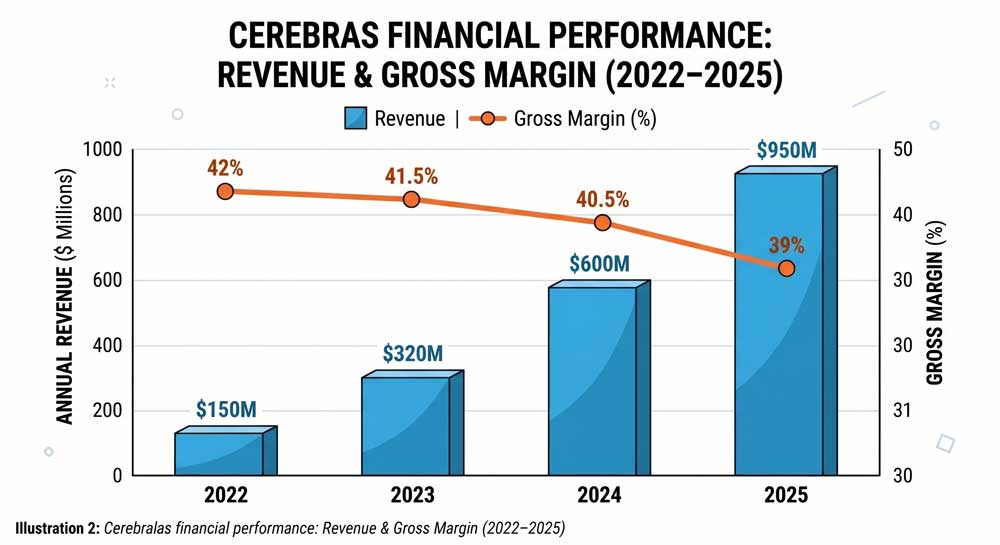
Revenue growth at Cerebras has been aggressive. From $24.6 million in 2022, annual revenue reached $290 million in 2024 (a 268% year-on-year increase) and $510 million in 2025 — with backlogged orders of $24.6 billion, of which the OpenAI contract accounts for over $20 billion.
The 2025 fiscal year also marked the first time Cerebras reported a GAAP net profit, at $237.8 million, a significant milestone for a company that had accumulated hundreds of millions in losses in prior years.
Cerebras Revenue & Profitability Trend (2022–2025)
| Year | Revenue | YoY Growth | GAAP Net Income/(Loss) | Gross Margin |
|---|---|---|---|---|
| 2022 | $24.6M | — | Negative | — |
| 2023 | ~$79M | ~222% | Negative | — |
| 2024 | $290M | +268% | -$481.6M | 42.3% |
| 2025 | $510M | +76% | +$237.8M | 39.0% |
Source: Cerebras S-1/A filing.
Despite the headline profitability, several structural risks remain visible and should not be minimised.
Customer concentration is the most glaring. In 2025, the top two customers — MBZUAI (62%) and G42 (24%) — accounted for 86% of revenue combined. The OpenAI contract, which represents the majority of the $24.6 billion backlog, had not yet contributed meaningful revenue as of year-end 2025. The entire bull case for Cerebras rests on that contract executing on schedule.
Gross margins are compressing. The decline from 42.3% in 2024 to 39.0% in 2025 reflects volume discounts given to large customers and the inherently high cost of wafer-scale chip packaging and testing. For a capital-intensive infrastructure company, a downward gross margin trajectory is a flashing yellow light.
Operating cash flow remains negative. Despite GAAP profitability, operating cash flow was approximately -$10.1 million in 2025. GAAP net income was boosted by one-time items; the underlying cash generation story has not yet been written.
Customer Revenue Concentration (2025)
| Customer | Revenue Share | Notes |
|---|---|---|
| MBZUAI | ~62% | Abu Dhabi university; related-party history |
| G42 | ~24% | UAE AI company; converted to non-voting shares |
| Other (incl. OpenAI) | ~14% | OpenAI contract revenue not yet recognised |
Source: Cerebras S-1/A filing.
The OpenAI Deal: A Three-Way Binding Bet
The $10–20 billion OpenAI contract is not a standard procurement arrangement. It is a three-layered financial and strategic entanglement that reshapes the risk profile of both companies simultaneously.
OpenAI is simultaneously Cerebras’s largest commercial customer, a prospective equity holder through 33.4 million warrants exercisable at near-zero cost, and a debt provider through a $1 billion operating credit line at 6% annual interest. If the 2-gigawatt deployment milestone is reached, OpenAI’s equity stake would approach 10% of Cerebras.
From OpenAI’s perspective, the logic is straightforward: reduce single-supplier dependency on Nvidia, lower inference cost per token to improve its own unit economics, and gain equity upside in a partner whose IPO valuation has already generated over $10 billion in paper gains on those warrants.
The risks run in both directions, however. If OpenAI eventually builds proprietary inference chips — a well-established pattern among hyperscalers — or if contract deployment milestones slip, Cerebras loses its anchor customer and its anchor shareholder simultaneously. Conversely, when OpenAI itself eventually pursues an IPO, institutional investors will scrutinise this circular relationship closely: a supplier that is also an equity holder and creditor creates potential conflicts of interest that complicate clean valuation.
What this deal signals to the broader market is arguably more important than the contract itself. OpenAI is the world’s most closely watched AI company, and it chose to commit billions in compute spending to a non-Nvidia architecture. That vote of confidence redefines what “credible AI infrastructure” means in 2026.
Nvidia’s Moat: Cracking, Not Broken
Cerebras is not positioned to displace Nvidia — at least not in the near term. Nvidia’s data centre GPU market share exceeds 80%, its market capitalisation has surpassed $5.5 trillion, and its CUDA software ecosystem represents perhaps the most formidable switching-cost moat in the history of enterprise technology.
Nvidia has also moved directly into inference territory. Its Blackwell B200 architecture is actively narrowing the performance gap in latency-sensitive workloads, and the Rubin architecture — projected for 2027 production — is explicitly targeted at inference performance. Once the performance gap narrows to within a defensible threshold, the architectural advantage that justifies Cerebras’s premium pricing will face direct pressure.
That said, the Cerebras IPO has validated a proposition that was previously theoretical: alternative AI chip architectures can attract enterprise-scale commercial contracts and public market capital. Google’s TPU has now reached its eighth generation, Amazon has deployed over 500,000 Trainium2 chips, and Tenstorrent — led by legendary chip architect Jim Keller — is pursuing an open RISC-V roadmap.
The AI chip market is evolving from a GPU monoculture into a multi-architecture ecosystem where the optimal solution depends on workload type, latency requirement, and cost structure. The inference segment alone is projected to grow from approximately $125.8 billion in 2025 to $536.9 billion by 2034, at a CAGR of 17.5%. That is a large enough market to support multiple successful architectures simultaneously.
Valuation Reality Check: 186x Revenue Multiple
At the closing price of $311.07 on debut day, Cerebras traded at approximately 186 times its 2025 revenue of $510 million. That multiple demands scrutiny.
AI Chip Valuation Benchmarks (as of May 14, 2026)
| Company | Price-to-Sales (P/S) | Notes |
|---|---|---|
| Cerebras (CBRS) | ~186x (at close) / ~110x (at IPO price) | Pre-revenue recognition from OpenAI contract |
| Nvidia | ~24x | Dominant GPU incumbent |
| Broadcom | ~31x | Diversified chip + networking |
| AMD | ~9x | GPU competitor to Nvidia |
Sources: Company filings and IPO prospectus, as of May 14, 2026.
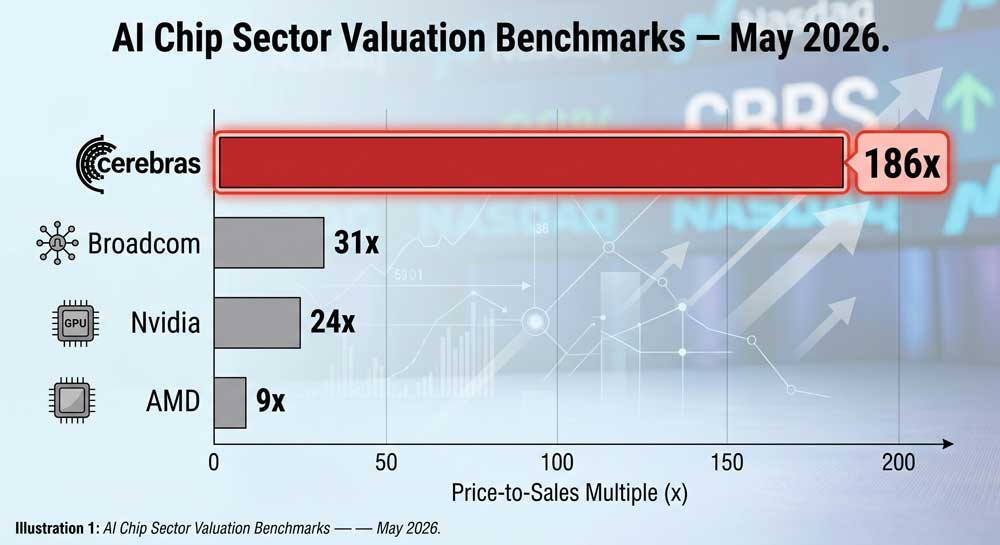
A 186x revenue multiple is only defensible under a specific set of assumptions: the OpenAI contract executes fully and on schedule, gross margins recover above 45% as WSE-3 yields improve, AWS and other hyperscaler partnerships convert into recurring revenue, and Cerebras retains its “first pure-play AI inference chip” pricing premium through at least 2028.
Under a more conservative scenario — delayed contract execution, continued margin compression, or an accelerated Rubin launch from Nvidia — the valuation compresses significantly. Investors treating the debut-day closing price as a stable floor should track several concrete milestones: quarterly gross margin trajectory, operating cash flow inflection, OpenAI deployment confirmation reports, and independent customer revenue as a percentage of total bookings.
The first earnings report after IPO will be the moment of truth. A debut-day pop of 68% is exciting; a second consecutive quarter of gross margin decline is disqualifying at these multiples.
The Bigger Picture: Inference as the New Battleground
The Cerebras IPO is best understood not as the story of one company, but as a market-structure event. It is the moment the public equity market established a pricing benchmark for the AI inference chip category — a category that did not have one before May 14, 2026.
The shift from training-centric to inference-centric AI computing is fundamental. According to Deloitte’s TMT Predictions 2026 report, inference is projected to account for two-thirds of all AI computing by 2026. The economics follow: training is a one-time or periodic cost, but inference is the continuous, recurring cost of operating every AI product at scale. Whoever controls low-latency, cost-efficient inference infrastructure controls the margin structure of the entire AI application layer.
That is the thesis Cerebras is selling. Whether the WSE-3 architecture, the OpenAI relationship, and the wafer-scale manufacturing process are durable competitive advantages — or a first-mover position that larger, better-capitalised players will replicate — is the central question for investors over the next 12 to 24 months. For a deeper technical analysis of the WSE-3 architecture, Cerebras’s official research publications offer primary-source detail. Investors seeking regulatory context should review the CFIUS guidelines on foreign investment published by the U.S. Treasury.
The inference era has opened. The pricing is aggressive, the risks are real, and the market opportunity is enormous. How Cerebras performs against its own backlog over the next four quarters will determine whether this IPO is remembered as the launch of a generational company — or as the peak of a well-timed capital market narrative.
Reference URLs
- Yahoo Finance — Cerebras Jumps 69% on Nasdaq Debut as AI IPO Market Roars Back
- TechCrunch — Cerebras Raises $5.5B, Then Stock Pops 108%, in the First Huge Tech IPO of 2026
- CNBC — Cerebras Opens at $350 on Nasdaq, Topping $100 Billion Market Cap After Blockbuster IPO
- TechCrunch — OpenAI Signs Deal Worth $10B for Compute from Cerebras
- Reuters — Nvidia Bets on AI Inference as Chip Revenue Opportunity Hits $1 Trillion
- Research and Markets — AI Inference Market Outlook 2026–2034: Market Share and Growth Forecast
- Forbes — Cerebras Pockets $1 Billion to Challenge Nvidia in AI With 20x Faster Chip
- ElevenLab — 5 Critical Reasons Why OpenAI’s $750B IPO Could Reshape AI Economics by 2027
- ElevenLab — AI Token Economy: 7 Brutal Truths That Will Redefine Who Gets Wealthy in the Next Decade
- ElevenLab — Personal Superintelligence Revealed: Inside Meta’s Unbelievable 5-Year Plan for Billions