5 Critical Reasons Why OpenAI’s $750B IPO Could Reshape AI Economics by 2027
OpenAI IPO plans for late 2026 face mounting scrutiny as experts predict the company could exhaust cash reserves within 18-24 months [web:1][web:6]. The artificial intelligence pioneer that revolutionized chatbots with ChatGPT now confronts a stark reality: mounting losses reaching $74 billion by 2028, intense competition from Google Gemini, and infrastructure costs hitting $792 billion through 2030. With a staggering 56x price-to-sales ratio at $750 billion valuation, the OpenAI IPO represents either the largest tech opportunity of the decade—or a catastrophic bubble waiting to burst.
OpenAI’s $207 Billion Funding Gap Before IPO
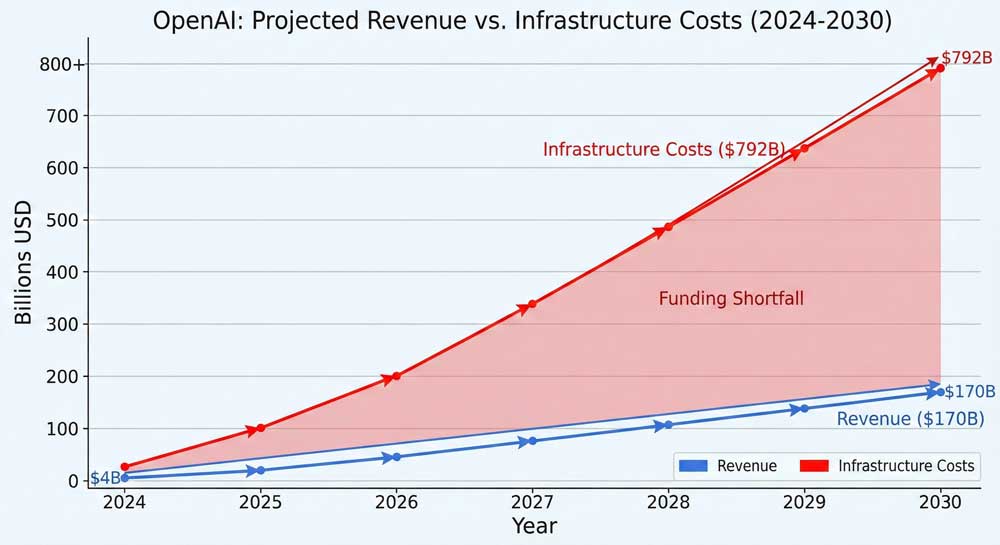
HSBC Global Investment Research analyst Nicolas Cote-Colisson projects that OpenAI will face a cumulative funding shortfall of $207 billion by 2030, even after accounting for projected revenues and existing capital commitments. This deficit emerges from the company’s unprecedented infrastructure spending: $620 billion in data center rental costs alone, with total cloud and AI infrastructure expenses reaching $792 billion between 2025 and 2030.
Unsustainable Cash Burn Trajectory
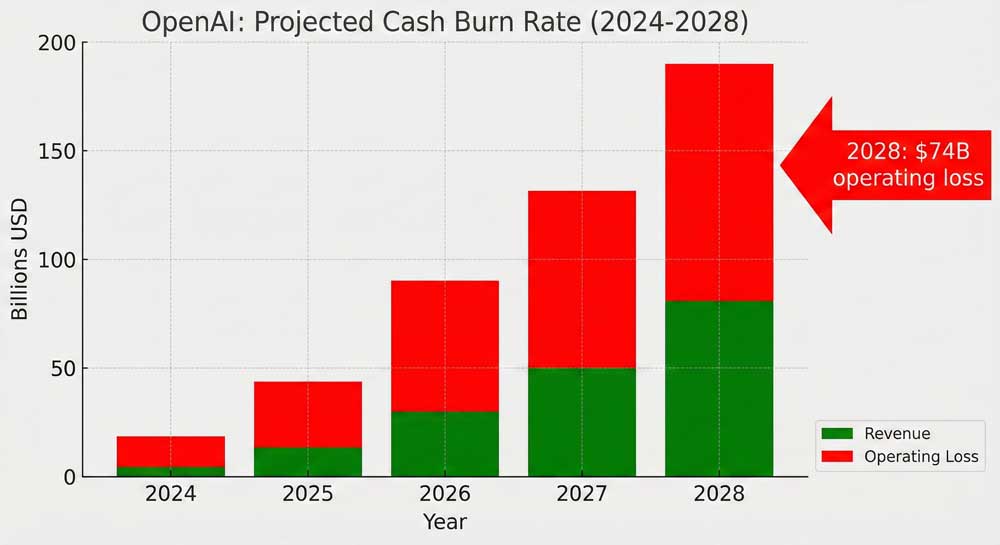
OpenAI generated $13 billion in actual revenue during 2025—far below the $20 billion annualized run rate (ARR) reported in January 2026. The company burned through $2.5 billion in cash during the first half of 2025 against $4.3 billion in revenue, translating to a 58% burn rate. Financial documents obtained by The Wall Street Journal reveal that OpenAI expects operating losses to balloon to $74 billion by 2028 alone.
Deutsche Bank estimates OpenAI’s 2026 cash consumption will reach $17 billion. At current spending velocity, the company could deplete its $41 billion Series F funding within two years without securing additional capital.
| Financial Metric | 2024 | 2025 | 2026 (Projected) | 2028 (Projected) |
|---|---|---|---|---|
| Revenue | $6B | $13B actual / $20B ARR | ~$30-40B | ~$80-100B |
| Cash Burn | ~$5B | $5B (H1 only) | $17B | Unknown |
| Operating Loss | ~$5B | ~$9B | ~$20-30B | $74B |
| Burn Rate % | ~83% | 58% | 57% | 75% |
OpenAI Market Share Erosion Threatens IPO Growth Targets
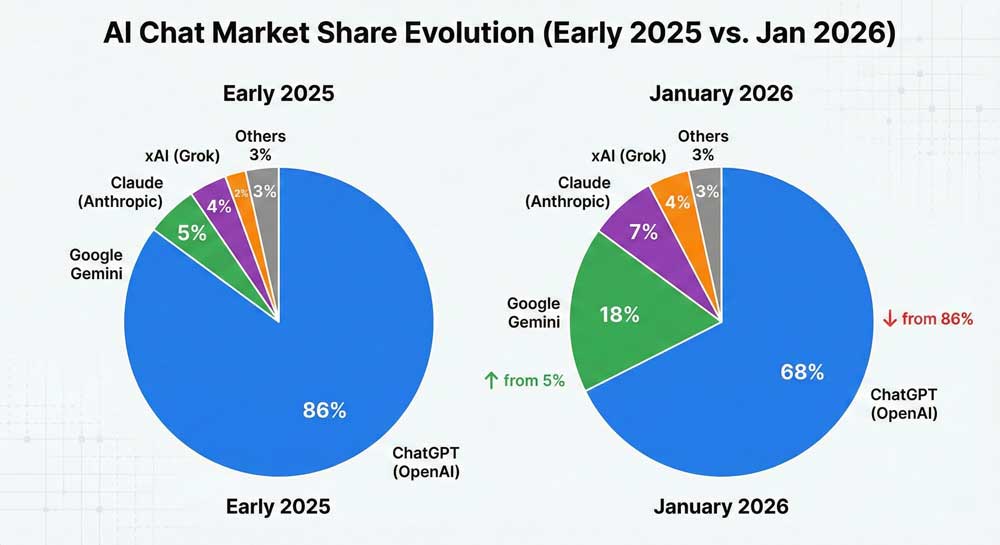
ChatGPT’s once-dominant market position is rapidly deteriorating. According to Similarweb’s Global AI Tracker released in January 2026, ChatGPT’s market share plummeted from 86% in early 2025 to 68% by January 2026—a 22-percentage-point collapse in just 12 months.
Google Gemini’s Strategic Assault
Google Gemini quadrupled its market share from 5.4% to 18.2% during the same period, leveraging deep integration across Android devices, Gmail, Google Docs, and the broader Google Workspace ecosystem. Gemini’s monthly active user base surged from 450 million in July 2025 to 650 million by October—44% growth in three months compared to ChatGPT’s modest 5% expansion.
More alarming for OpenAI: Gemini’s referral traffic to external websites grew 388% year-over-year versus ChatGPT’s 52% increase, indicating deeper user engagement and trust. Google also began offering Google Cloud credits to Gemini Pro users ($10 monthly) and Ultra users ($100 monthly), directly subsidizing competition against OpenAI.
The Impossible User Growth Challenge
HSBC’s analysis reveals that OpenAI must achieve extraordinary user conversion to avoid insolvency. The company currently serves approximately 800 million weekly active users, but only 5% (40 million) pay for subscriptions. To cover infrastructure costs through 2030, OpenAI needs to reach 3 billion weekly active users with a 10% paid conversion rate—translating to 300 million paying subscribers.
This requires OpenAI to:
- Increase total users by 275% (from 800 million to 3 billion)
- Boost paying subscribers by 650% (from 40 million to 300 million)
- Compete against Google, Anthropic, xAI, and Chinese AI leaders like DeepSeek simultaneously
Industry analysts project that by 2027-2028, the AI chatbot market will consolidate into a duopoly with ChatGPT holding 50-55% share and Gemini capturing 25-30%, leaving minimal room for growth.
Revenue Diversification Falls Short
OpenAI’s revenue structure remains dangerously concentrated. Consumer subscriptions (ChatGPT Plus at $20/month and ChatGPT Pro at $200/month) account for 55-60% of revenue, while API services and enterprise licensing contribute the remainder.
Subscription Economics Under Pressure
Even if OpenAI achieves 200-300 million paid subscribers by 2030, subscription revenue would generate only $48-72 billion annually—leaving a $100-150 billion annual revenue gap against the company’s $170 billion target. This deficit must be filled through:
Advertising revenue: OpenAI recently introduced ads for free and ChatGPT Go users to offset the unsustainable cost of subsidizing 700+ million free users. However, effectively integrating advertising into conversational AI interfaces remains an unsolved challenge across the industry.
Consumer hardware: Reports suggest OpenAI may launch a pen-shaped device in late 2026, with OEM orders reaching 40-50 million units. Success is uncertain given the crowded smart device market and OpenAI’s lack of hardware experience.
API commoditization risk: Unlike ChatGPT with its memory capabilities and user lock-in, API services are easily interchangeable when performance and pricing align. Anthropic’s Claude API already generates $3.1 billion compared to OpenAI’s $2.9 billion, with major clients like Cursor and GitHub Copilot contributing $1.4 billion to Anthropic.
Enterprise licensing plateau: While companies like Perplexity license OpenAI models, this B2B revenue stream faces limited growth potential. Apple’s recent decision to add Google Gemini as a Siri AI provider—even partially—demonstrates the fragility of OpenAI’s enterprise relationships.
Infrastructure Costs Spiral Beyond Control
OpenAI’s infrastructure obligations have reached economically catastrophic levels. The company committed to achieving 36 gigawatts of AI computing power by 2030—equivalent to the electricity consumption of Florida. CEO Sam Altman has outlined a $1.4 trillion compute investment plan through 2033.
The 5x Compute Problem
Training next-generation AI models now requires 5x the computational resources to achieve just 2x performance improvements—a clear signal of diminishing returns from scaling laws. GPT-4.5 (Orion), released in February 2025 and retired by August, delivered only marginal gains over GPT-4o despite massive compute and cost increases, earning the derisive nickname “lemon” among critics.
AI researchers acknowledge that traditional scaling approaches are hitting fundamental limitations:
- Diminishing returns: Each additional compute unit delivers smaller capability gains
- Data saturation: High-quality training data is nearly exhausted; synthetic data introduces bias
- Economic ceilings: Training and inference costs demand unprecedented energy and hardware budgets
- Reasoning brittleness: Even at massive scale, models struggle with long-horizon reasoning and factual reliability
Data Center Economics
AI-ready data centers now cost 7-10% more to build than traditional facilities, with construction costs rising 5.5% annually for conventional centers and higher premiums for AI-specific infrastructure. Tokyo, Singapore, and Zurich rank as the most expensive markets globally, with Tokyo exceeding $15 per watt.
The primary bottleneck is no longer physical space—it’s electrical grid capacity. Over 80% of industry experts report that current supply chains cannot support the specialized liquid cooling systems AI workloads demand. Securing timely, large-scale grid access has become the critical constraint for data center expansion.
The $100 Billion Funding Round
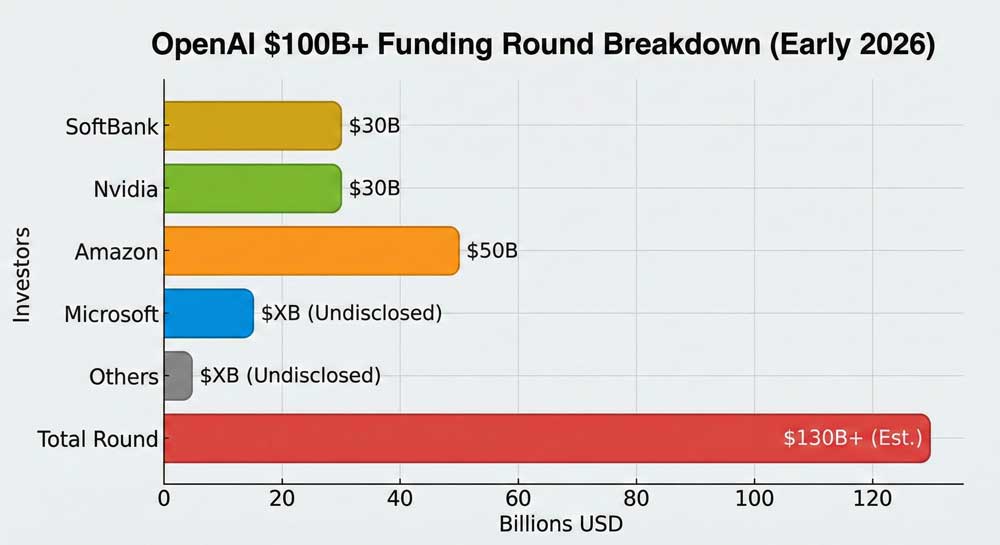
OpenAI is reportedly pursuing a $100 billion funding round—potentially the largest private financing in technology history. The round would occur in two phases:
Phase 1 – Strategic Partners: Nvidia ($30B), Amazon (up to $50B), Microsoft (multi-billion), and other cloud/chip providers
Phase 2 – Financial Investors: SoftBank ($30B additional to its $41B Series F investment), sovereign wealth funds, and institutional capital
Valuation Concerns
The funding round values OpenAI at $730-750 billion pre-money. Against 2025’s $13 billion actual revenue, this translates to a 56x price-to-sales ratio—dramatically higher than profitable tech giants:
- Nvidia: 24.5x P/S ratio with strong profitability
- Microsoft: 12x P/S ratio with consistent earnings
- Typical mature tech companies: 10-15x P/S ratio
Among S&P 500 companies, only Palantir exceeds OpenAI’s valuation multiple at over 100x. Critically, Palantir is profitable and benefits from global geopolitical instability, while OpenAI faces existential financial risk if the AI bubble deflates.
Capital Circulation or Ponzi Economics?
The funding structure reveals concerning dynamics. OpenAI’s largest creditors—cloud infrastructure providers like Microsoft, Amazon, and Oracle—are simultaneously becoming its largest shareholders. This “left-hand-to-right-hand” capital recycling creates a complex interdependency where:
- OpenAI receives investment capital from infrastructure providers
- The same capital immediately flows back as payment for data center rentals, GPU access, and cloud services
- Infrastructure providers book revenue while holding equity in an unprofitable company
Microsoft’s latest financial results illustrate the strain: cloud computing backlog shows 45% of orders coming from OpenAI, while Microsoft’s capital expenditure surged 89%—completely breaking its 10-year CAPEX trend. Microsoft’s stock dropped 10% following the disclosure.
The OpenAI IPO Timeline: Late-2026 Last Exit Before Crisis
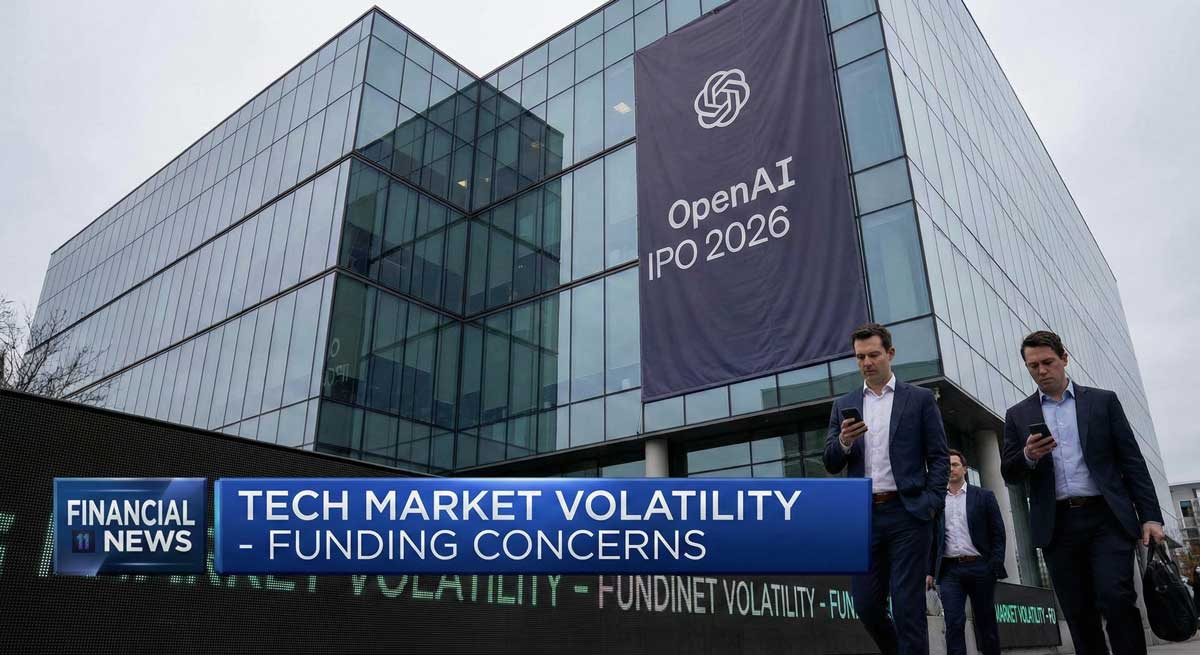
The Wall Street Journal reported on February 3, 2026, that OpenAI plans to complete its initial public offering by Q4 2026. The company has held informal discussions with multiple investment banks and recently hired Ajmere Dale as chief accounting officer to prepare for public markets.
Timing Is Everything
An IPO in late 2026 allows OpenAI to capitalize on remaining public enthusiasm for AI before inevitable disillusionment sets in. HSBC’s analysis warns that OpenAI currently operates as a relatively “asset-light” business, but if the Stargate project proceeds, the company will transform into a capital-intensive operation burdened with hundreds of billions in hardware depreciation by 2030. Going public after that transition would substantially increase investor risk and likely result in lower valuations.
Structural Obstacles
OpenAI’s path to IPO faces significant hurdles:
Corporate structure: The hybrid “nonprofit + capped-profit” model conflicts with public market regulations and must be restructured—a process likely to generate controversy and legal challenges.
Elon Musk litigation: Musk’s lawsuit demanding billions in damages will complicate due diligence and add uncertainty.
Related-party transactions: The complex web of capital agreements with Microsoft, Nvidia, Oracle, Amazon, and other investors must be fully disclosed, potentially revealing unfavorable terms or inflated revenue figures.
Profitability timeline: Financial documents show OpenAI won’t achieve positive cash flow until 2029-2030 at the earliest. Public market investors typically demand clearer paths to profitability, especially at these valuation levels.
Government Bailout Probability
Michael Burry, the investor famously portrayed in “The Big Short” who predicted the 2008 housing crisis, warns that the AI bubble will burst and necessitate government intervention. Burry argues that AI has become so deeply integrated into the broader economy that authorities will have no choice but to provide bailouts, mirroring the 2008 financial crisis response.
Strategic National Asset Status
OpenAI has effectively achieved “military-industrial complex” status as a cornerstone of American AI supremacy. With Chinese AI companies like DeepSeek, Qwen, Kimi, and GLM rapidly closing the capability gap, U.S. policymakers view OpenAI as strategically indispensable. This creates an implicit government backstop that could manifest through:
- Low-interest federal loans to bridge liquidity gaps
- Tax credits and R&D incentives to reduce operational costs
- Government procurement contracts providing stable revenue streams
- Direct equity investment through sovereign wealth funds or defense-related agencies
- Emergency bailout authorization if OpenAI faces imminent insolvency
However, government intervention carries significant costs. Federal involvement would likely impose operational restrictions, strategic direction constraints, and transparency requirements that limit OpenAI’s flexibility. In the current politically polarized environment, bailing out a private AI company would become intensely controversial, particularly given the company’s $750 billion valuation and billionaire investors.
The “Too Big to Fail” Doctrine
Hundreds of venture capital firms, private equity funds, major banks, and technology giants have material exposure to OpenAI. A bankruptcy or forced fire-sale liquidation would trigger cascading losses across the financial system. The interconnected investment structure means that OpenAI’s failure could impair balance sheets at Microsoft, SoftBank, Nvidia, and dozens of other systemically important institutions.
Prediction markets on Polymarket reflect this uncertainty, with active betting on whether the U.S. government will bail out OpenAI before July 2026, what valuation OpenAI will achieve at IPO, and whether the company will be acquired before 2027.
Industry-Wide AI Bubble Dynamics
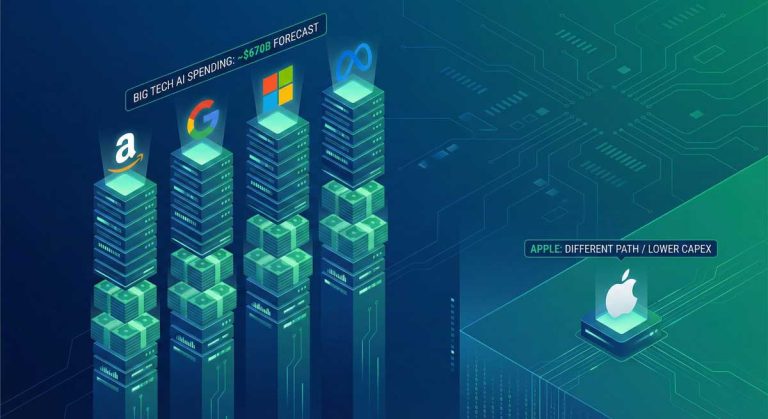
OpenAI’s challenges mirror broader artificial intelligence investment dynamics. The four major cloud providers—Amazon, Microsoft, Alphabet, and Meta—spent over $300 billion on AI infrastructure in 2025 alone. UBS estimates global enterprise AI infrastructure spending will reach $500 billion annually in coming years.
Thermodynamic Economics vs. Software Economics
AI fundamentally differs from traditional software. Conventional applications scale with minimal marginal cost—once code is written, serving additional users requires trivial incremental resources. AI models, by contrast, must generate intelligence in real-time for each query, consuming GPU compute and electricity proportional to usage.
As Vaclav Smil, the energy systems expert frequently cited by Bill Gates, notes: energy is the universal currency of civilization. Every AI inference converts electricity into structured probability—meaning operational costs rise linearly with scale rather than approaching zero. This creates what some analysts call “thermodynamic inflation”: the physical cost of producing intelligence on demand.
Critics like Michael Burry view this as evidence of an unsustainable bubble driven by speculation and cheap capital. Defenders argue that AI represents genuine infrastructure transformation comparable to the electrification of industry or the internet buildout—expensive in the short term but economically foundational over decades.
The Diminishing Returns Crisis
Evidence of scaling law limitations is mounting across the industry:
- GPT-4.5 underperformance: Marginal improvements despite massive cost increases
- Training efficiency plateau: 5x compute investment yields only 2x performance gains
- Data quality exhaustion: High-quality text corpora approaching saturation
- Inference cost persistence: Per-query expenses remain stubbornly high despite optimization efforts
Anthropic projects it will break even by 2028 and expects to surpass OpenAI in revenue by 2029, partly by focusing on inference-time compute optimization and specialized vertical applications like Claude for coding. The Information reports that Anthropic has dramatically reduced its burn rate to 33% of revenue in 2026 and projects just 9% by 2027—compared to OpenAI’s sustained 57% burn rate.
Five Scenarios for OpenAI’s Future
Scenario 1: Successful IPO and Long-Term Scaling
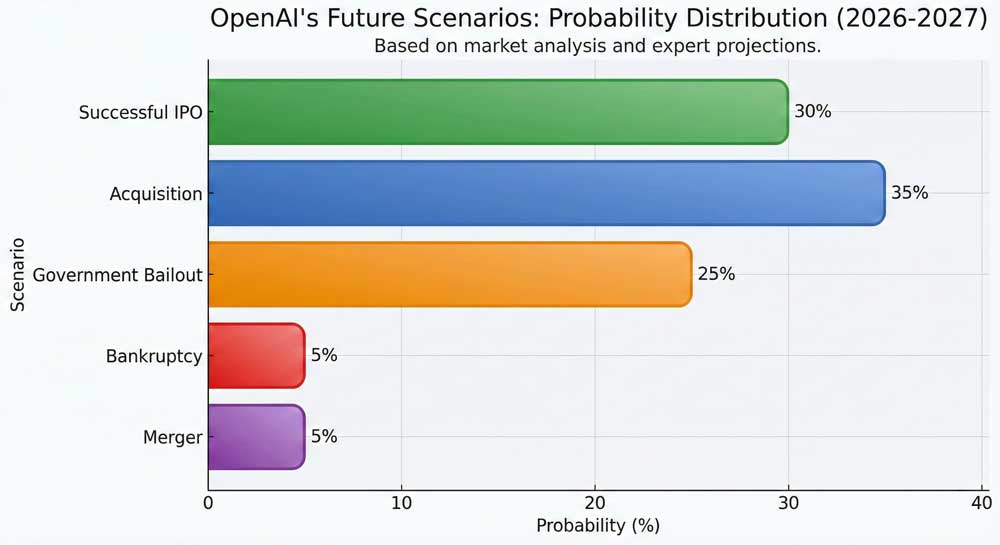
OpenAI completes its Q4 2026 IPO at a $700-850 billion valuation, raises $100 billion in the concurrent pre-IPO round, and uses public market capital to sustain operations through 2030. The company achieves breakthrough improvements in model efficiency, reduces infrastructure costs through proprietary chip development, and successfully diversifies revenue across subscriptions, APIs, advertising, and hardware.
Probability: Low-to-moderate. Requires multiple optimistic assumptions aligning simultaneously.
Scenario 2: Acquisition by Tech Giant
OpenAI is acquired by Microsoft, Amazon, Alphabet, or a consortium before or shortly after IPO. The acquirer absorbs OpenAI’s losses while gaining exclusive access to frontier AI capabilities and eliminating a competitive threat. This consolidation mirrors historical technology cycles where initial innovation leaders are acquired by distribution powerhouses.
Probability: Moderate. Prediction markets show significant activity betting on pre-2027 acquisition. Regulatory scrutiny of big tech mergers represents the primary obstacle.
Scenario 3: Government Bailout / Nationalization
The AI bubble bursts in 2027-2028, and OpenAI faces imminent bankruptcy. Citing national security and economic systemic risk, the U.S. government provides emergency financing, potentially taking equity stakes or converting the company into a public-private partnership resembling Palantir’s defense contractor model.
Probability: Moderate-to-high if OpenAI approaches insolvency. Political controversy would be intense but likely insufficient to prevent intervention given strategic AI importance.
Scenario 4: Managed Bankruptcy and Asset Sale
Unable to secure sufficient additional funding and failing to achieve IPO, OpenAI declares bankruptcy in 2027-2028. Assets—including model weights, training data, customer contracts, and talent—are liquidated to creditors or sold to competitors. Microsoft, as the largest creditor and investor, likely receives the most valuable assets.
Probability: Low-to-moderate. The interconnected investor base has strong incentives to prevent outright failure, but cash depletion could force this outcome if alternatives fail.
Scenario 5: Merger with AI Competitor
OpenAI merges with Anthropic, xAI, or another major AI company to pool resources, eliminate duplicate infrastructure spending, and create a more sustainable combined entity. The merged company leverages complementary strengths—OpenAI’s consumer reach with Anthropic’s enterprise credibility, for example—to improve unit economics.
Probability: Low. Significant regulatory barriers, cultural differences, and conflicting strategic visions make large-scale AI mergers exceptionally difficult.
Conclusion: The Money Pit with a Website
Financial Times Alphaville coined the phrase “a money pit with a website” to describe OpenAI’s economic reality. The company has achieved genuine technological breakthroughs and built the fastest-growing consumer application in history. Yet technical excellence hasn’t translated into financial sustainability.
OpenAI must navigate an extraordinarily narrow path: maintain technological leadership requiring ever-increasing capital while simultaneously growing paying users 650%, diversifying revenue streams, restructuring corporate governance, and executing a flawless IPO—all before cash reserves deplete in 18-24 months.
The broader implications extend beyond a single company. OpenAI’s struggle reveals fundamental tensions in the AI economy: infrastructure costs that scale linearly with usage, diminishing returns from traditional scaling approaches, aggressive competition from well-capitalized rivals, and uncertain monetization paths for conversational AI.
Whether OpenAI survives as an independent entity or becomes a cautionary tale in technology history will likely determine the trajectory of AI development for the next decade. The answer depends not on technology—but on whether money can flow fast enough to keep the machine running until profitability finally arrives.
Related Resources:
- https://www.fortunebusinessinsights.com/ai-infrastructure-market-110456
- https://au.investing.com/news/stock-market-news/nvidia-microsoft-amazon-in-talks-for-60-bln-openai-funding–the-information-4228512
- https://www.theinformation.com/articles/openais-first-half-results-4-3-billion-sales-2-5-billion-cash-burn
- https://www.wsj.com/tech/ai/openai-ipo-anthropic-race-69f06a42
- https://fortune.com/2025/11/12/openai-cash-burn-rate-annual-losses-2028-profitable-2030-financial-documents/
- https://fortune.com/2025/11/26/is-openai-profitable-forecast-data-center-200-billion-shortfall-hsbc/?utm
- https://www.similarweb.com/top-websites/ai-chatbots-and-tools/
Other Readings: