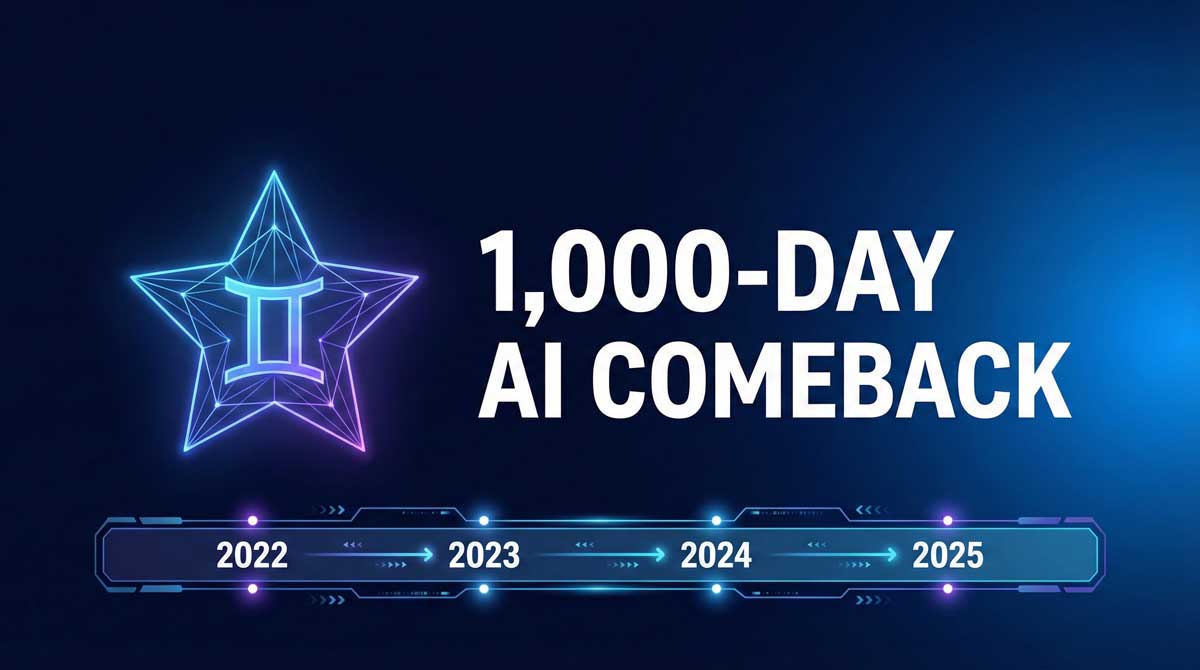
Google Gemini Comeback: 1,000 Days of Incredible Triumph in the AI War
The Google Gemini comeback is one of the most dramatic corporate reversals in tech history. In late 2022, ChatGPT’s sudden rise made Google — the undisputed king of search — look sluggish and unprepared, wiping hundreds of billions from its market cap overnight. By November 2025, the story had completely flipped: Gemini 3’s explosive launch sent Alphabet’s valuation to a record-breaking $3.8 trillion, and industry analysts were declaring Google firmly back in the AI driver’s seat.
This wasn’t luck. The Google Gemini comeback was the result of a Nobel Prize-winning scientist handed unprecedented authority, a ruthless internal restructuring, a billion-dollar bet on context window size, and a decade-long hardware investment that quietly became the industry’s most formidable cost moat.

Table of Contents
The Architect of the Google Gemini Comeback
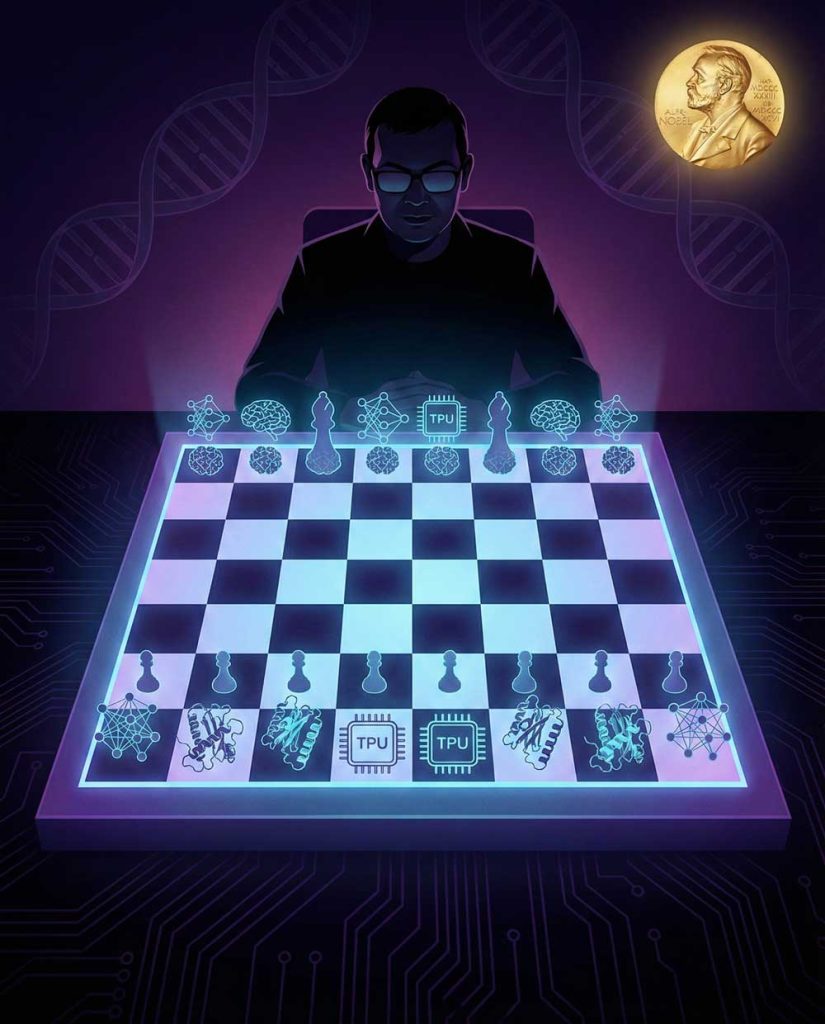
The driving force behind Google’s recovery is Sir Demis Hassabis, CEO of Google DeepMind. Born in London to a Greek-Cypriot father and Singaporean mother, Hassabis was a chess prodigy — rated FIDE 2,300 at just 13 years old, second globally only to Judit Polgár. He later earned a PhD in cognitive neuroscience and founded DeepMind in 2010, attracting early backing from tech luminaries before Google acquired the company for approximately £400–500 million in 2014.
Under Hassabis, DeepMind delivered two landmark scientific achievements: AlphaGo, which defeated world Go champion Lee Sedol in 2016, and AlphaFold, which solved the 50-year-old protein-folding problem — earning Hassabis the 2024 Nobel Prize in Chemistry. Yet for years, DeepMind remained more academic lab than product engine. The ChatGPT moment shattered that arrangement permanently.
“AI is ready for primetime in terms of products — powering pretty much all things at Google.”
— Demis Hassabis, Google DeepMind CEO
The Merger That Unlocked the Google Gemini Comeback
Google’s AI problem wasn’t a lack of talent — it was a lack of cohesion. Two world-class labs, Google Brain and DeepMind, were operating in silos, competing for resources and unable to agree on even their core technical frameworks. Google Brain built on TensorFlow; DeepMind championed JAX. This internal fragmentation produced Bard — Google’s rushed ChatGPT response — which embarrassed the company with a factual error on its very first public demo.
In April 2023, CEO Sundar Pichai executed the most consequential restructuring in Google’s AI history: merging both labs into a single entity, Google DeepMind, with Hassabis in full command. Hassabis made the bold call to abandon TensorFlow entirely and standardize on JAX, accepting short-term technical growing pains to build a unified, high-performance foundation for everything that followed.
| Lab | Pre-2023 Focus | Framework | Post-Merger Role |
|---|---|---|---|
| Google Brain | Search integration, Transformers | TensorFlow | Merged → Google DeepMind |
| DeepMind | AGI research, AlphaGo, AlphaFold | JAX | Merged → Google DeepMind |
| Google DeepMind | Unified commercial AI | JAX | Gemini product leadership |
The Context Window Bet That Won the War
Rather than competing benchmark-by-benchmark with GPT-4, Hassabis identified a strategic gap: context window size — the AI’s working memory. Early GPT-4 handled roughly 32,000–128,000 tokens. But enterprise clients — law firms, financial analysts, software engineers — needed to process entire document archives, full codebases, and long-form video in a single session.
Gemini 1.5 Pro launched in February 2024 with a groundbreaking 1-million-token context window, passing complex “Needle in a Haystack” retrieval tests and proving the capability at scale. Google had even tested 10 million tokens internally. Gemini 3, released in November 2025, pushed further with dynamic, uncapped context that adapts to workload demands — processing entire enterprise data ecosystems in a single inference pass.
![Google Gemini comeback — context window comparison chart]
| Model | Context Window | Real-World Equivalent |
|---|---|---|
| Early LLMs (2022) | ~8,000 tokens | A few short articles |
| GPT-4 Turbo (2023) | ~128,000 tokens | A 300-page book |
| Gemini 1.5 Pro (2024) | 1,000,000 tokens | ~8 novels or 50,000 lines of code |
| Gemini 3 Pro (2025) | Dynamic / 2M+ tokens | Full enterprise codebases, 2-hr video |
This wasn’t just an engineering achievement — it was a product philosophy. Long-context AI changes what enterprise software looks like, and Gemini had the market largely to itself in that space throughout 2024.
The Secret Hardware Weapon: Google’s TPU Moat
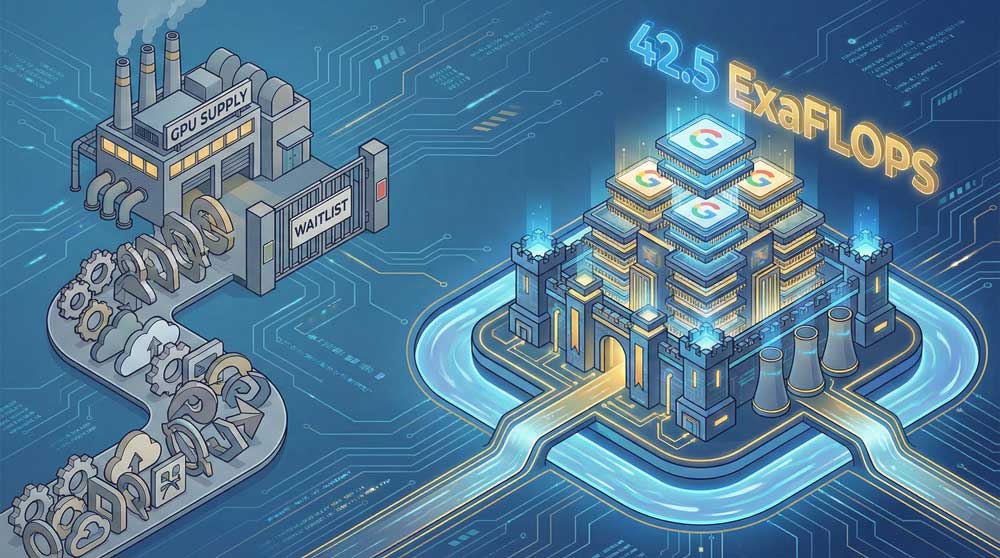
While rivals lined up for NVIDIA H100 and Blackwell GPUs at premium prices, Google was quietly harvesting a decade of strategic hardware investment. In 2013, Chief Scientist Jeff Dean recognized that Google’s computational costs would spiral out of control as ML scaled — and championed the in-house development of Tensor Processing Units (TPUs).
By April 2025, Google unveiled Ironwood — its 7th-generation TPU, purpose-built for the inference era of AI. Here’s what makes it a game-changer:
- Each chip delivers 4.6 petaFLOPS of dense FP8 performance — on par with NVIDIA’s flagship B200
- A full 9,216-chip Ironwood pod delivers 42.5 exaFLOPS of compute
- 192 GB HBM memory per chip (up from 95 GB in the prior v5p generation), with 7.4 TB/s memory bandwidth
- Nearly 30× more power-efficient than the first-gen Cloud TPU from 2018
- Fully integrated with Google’s Pathways ML runtime for orchestrating tens of thousands of chips as a single logical unit
| Chip | Vendor | FP8 Performance | Memory | Key Advantage |
|---|---|---|---|---|
| NVIDIA B200 | NVIDIA | 4.5 petaFLOPS | 192 GB HBM3e | Best third-party GPU |
| NVIDIA GB200 | NVIDIA | ~5 petaFLOPS | 192 GB HBM3e | High power, top raw perf |
| Google Ironwood (TPU v7) | 4.6 petaFLOPS | 192 GB HBM | Scales to 9,216 chips per pod |
The critical difference isn’t raw specs — it’s economic control. OpenAI, Anthropic, and Meta all pay NVIDIA’s premium. Google runs on chips it owns, at cost, at any scale. That vertical integration — talent, algorithms, data, and silicon — is the silent engine behind every dollar of the Google Gemini comeback.
Gemini 3: State of the Art Arrives
Gemini 3 launched on November 17, 2025, dropping the “.0” naming convention as a deliberate signal of maturity. It introduced a suite of capabilities that genuinely outperformed competitors across multiple dimensions:
- Deep Think mode — achieves 41.0% on Humanity’s Last Exam and 93.8% on GPQA Diamond benchmark
- 45.1% on ARC-AGI (with code execution), a test of novel reasoning rarely breached by any model
- Generative UI — builds interactive tools like mortgage calculators or physics simulations in response to natural language queries
- Antigravity IDE integration and improved coding that raised SWE-bench scores to 76.2% (vs. GPT-5.2’s 80%)
- Deep Search integration with multi-step “query fan-out” within Google Search AI Mode
OpenAI responded with GPT-5.2 in December 2025 — a release that PCMag’s review called “rushed,” noting that Gemini 3’s improvements were “much more noticeable” to real-world users. On SWE-bench coding, GPT-5.2 narrowly leads (80% vs. 76.2%), but in everyday usability and enterprise integration, Gemini 3 holds a commanding position.
| Benchmark | Gemini 3 | GPT-5.2 | Edge |
|---|---|---|---|
| GPQA Diamond | 93.8% | ~87% | Gemini |
| ARC-AGI | 45.1% | — | Gemini |
| SWE-bench (Coding) | 76.2% | 80% | GPT-5.2 |
| Context Window | 2M+ tokens | ~128K | Gemini |
| Inference infrastructure | Custom TPU Ironwood | NVIDIA / Azure | Gemini (cost) |
What This Means for the AI Industry
The Google Gemini comeback has redefined the AI competitive landscape. The war has moved beyond raw benchmarks into a second phase: total cost of ownership, ecosystem depth, and infrastructure control. Google’s tightly integrated stack — from Google Search to YouTube to Android — gives Gemini a distribution surface no standalone AI company can match.
For developers and businesses evaluating AI platforms, the key considerations now are:
- Context needs — Gemini leads significantly for document-heavy and long-form enterprise workflows
- Cloud ecosystem — Google Cloud + Vertex AI vs. Microsoft Azure OpenAI Service carries long-term lock-in implications
- Cost per inference — Google’s TPU ownership advantage translates to more competitive API pricing at scale
- Search integration — only Gemini is natively embedded in the world’s most visited website
Sources and Further Readings
- CNBC — How Google Put Together the Pieces for Its AI Comeback — In-depth investigation of Google’s strategic reversal
- Google Blog — Gemini 3 Official Announcement — Official launch details, capabilities, and benchmarks
- 9to5Google — Google Launches Gemini 3 with SOTA Reasoning, Generative UI — Technical breakdown of Gemini 3 features
- Google Blog — Ironwood: The First Google TPU for the Age of Inference — Official Ironwood TPU specification and design philosophy
- The Register — Google’s 7th-Gen Ironwood TPUs Promise 42 AI ExaFLOPS Pods — Independent technical analysis of Ironwood vs. NVIDIA
- Google Blog — Gemini 1.5: Our Next-Generation Model — The 1M-token context window breakthrough
- Google Blog — Google DeepMind: Bringing Together Two World-Class AI Teams — Official announcement of the Brain + DeepMind merger
- NYT — Can OpenAI Respond After Google Closes the AI Technology Gap? — Industry analysis of the competitive shift
- PCMag — I Tested GPT-5.2 — It Just Can’t Compete With Google Gemini 3 — Real-world user testing comparison
- Google DeepMind CEO Demis Hassabis’s Q&A With Big Technology on AI and Google’s Future
- 7 Reasons Why Silicon Valley Pivots to Natural Gas Investment for AI Power
- 5 Brutal Truths the Clawdbot AI Assistant Reveals About Siri’s Future in 2026
- Blackstone AI Investment Australia: $15 Billion Bet on Infrastructure vs. Reality of Productivity Crisis