5 Crucial Reasons the Gold Safe Haven Fails During Oil Crisis Shocks
The gold safe haven is one of investing’s most durable myths — and in certain crises, it fails spectacularly. When war erupts, oil markets seize, and volatility spikes, conventional wisdom says gold should surge. Instead, recent high-stress scenarios have produced the opposite: gold prices plunging 14% and silver collapsing nearly 28% in under three weeks.
Understanding why requires stepping away from headlines and looking at the plumbing of global sovereign liquidity. The gold safe haven hasn’t disappeared — but it now behaves very differently than most retail investors expect.
Table of Contents
1. The Gold Safe Haven Has Structurally Changed
For years, the case for holding gold rested on three macro pillars:
- Unprecedented monetary expansion by developed-market central banks post-2008 and post-pandemic
- Rising global inflation eroding the purchasing power of fiat currencies
- Accelerating de-dollarization as nations diversified away from US dollar reserves
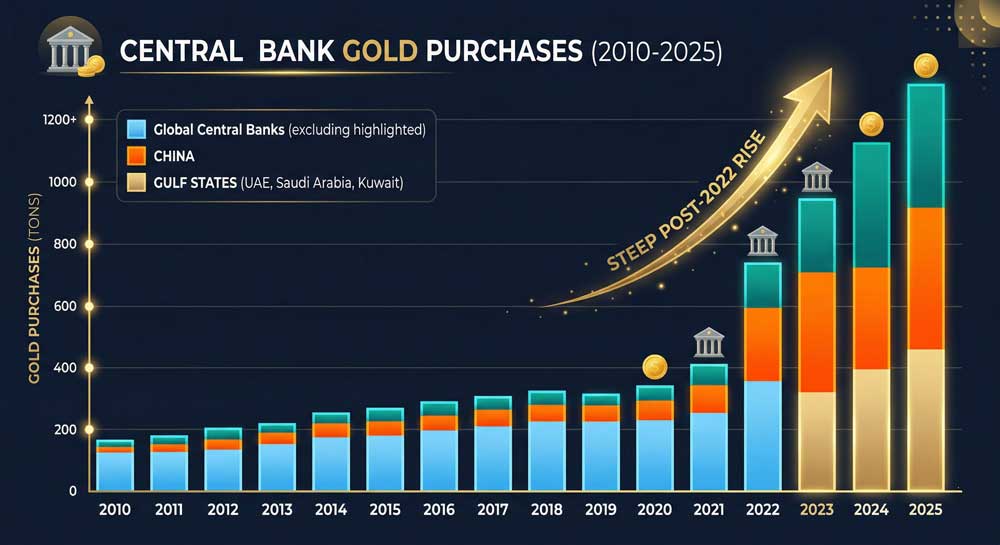
Central banks — particularly across the Global South and Gulf states — aggressively reduced US Treasury holdings and replaced them with physical gold. This shift transformed gold from a panic-button asset into a primary reserve liquidity asset.
| Era | Gold’s Primary Role | Key Buyers |
|---|---|---|
| Pre-2010 | Inflation hedge / panic asset | Retail, hedge funds |
| 2010–2020 | Portfolio diversifier | Institutions, ETFs |
| 2020–present | Sovereign reserve asset | Central banks, SWFs |
This structural shift matters because it changed who is buying gold and why — which determines how gold behaves when stress hits.
2. Oil Shocks Sever the Sovereign Liquidity Pipeline
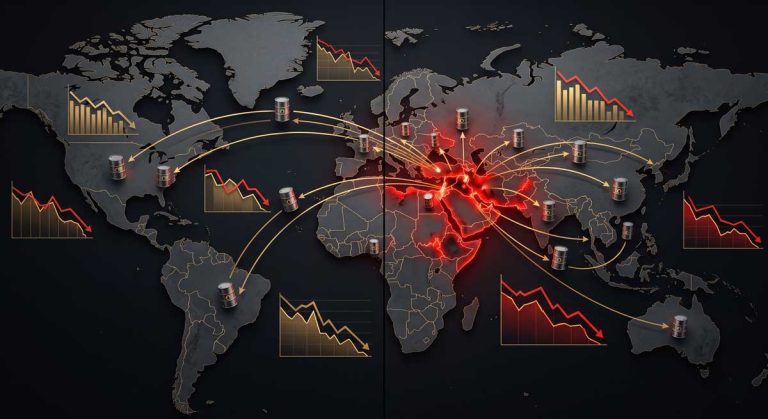
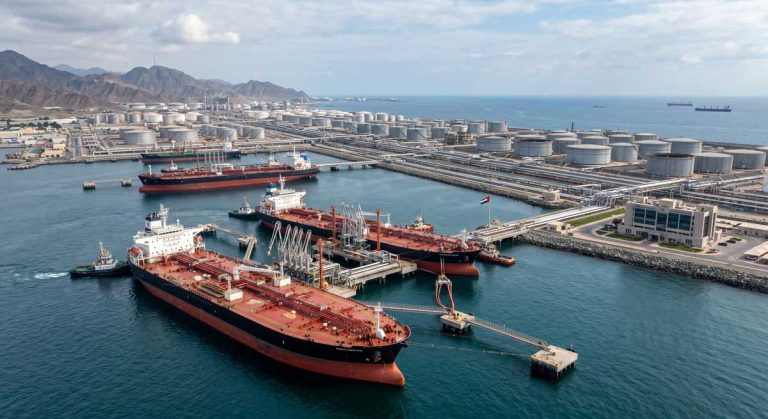
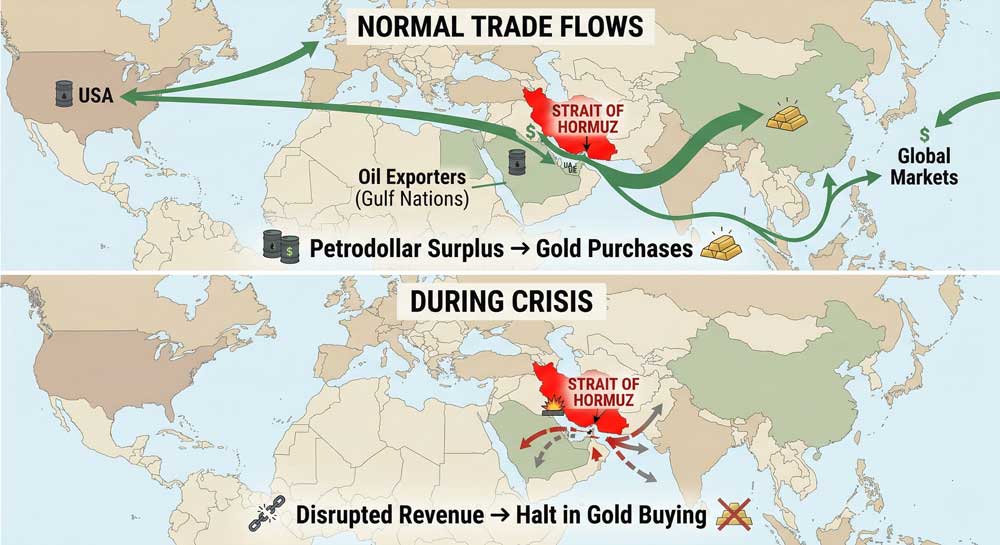
To understand why a geopolitical crisis can crash gold prices, you have to follow the money to its source. The largest marginal buyers in recent years have been Sovereign Wealth Funds (SWFs) from oil-exporting nations: Saudi Arabia, the UAE, and Kuwait. These funds are built on petrodollar surpluses — the excess revenues generated when oil flows freely and prices are high.
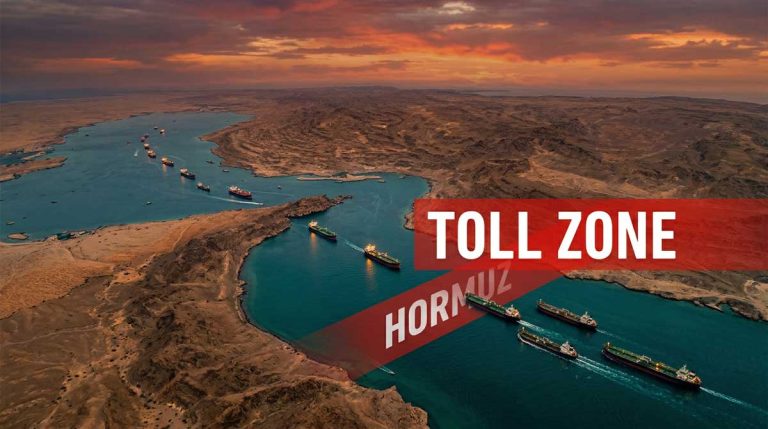
A Strait of Hormuz-style disruption doesn’t just spike oil prices. It chokes off export volumes for the very nations funding gold purchases.
| Market Condition | Sovereign Wealth Income | Gold Market Impact |
|---|---|---|
| Normal trade operations | High petrodollar surplus | Steady buying pressure |
| Shipping disruption | Revenue collapse | Buyers step back or liquidate |
| Prolonged blockade | Fiscal stress | Forced gold selling to cover domestic obligations |
When their primary income stream is severed, these nations don’t just stop buying gold — they may become net sellers to meet domestic fiscal obligations. The crisis directly destroys the purchasing capacity of gold’s most important marginal buyers.
“Gold didn’t react to the news cycle. It reacted to the sovereign balance sheets of its most important buyers — which were under acute pressure.”
3. The China Factor Amplifies the Pressure
China compounds the problem significantly. As the world’s largest oil importer, China faces a severe terms-of-trade shock when energy prices spike. Rising import costs squeeze domestic growth, compress current account surpluses, and slow the pace of foreign reserve accumulation.
The result: the People’s Bank of China, one of the world’s most consistent gold accumulators, reduces the pace of purchases precisely when geopolitical stress is highest. Two of gold’s biggest structural buyers are simultaneously impaired — Gulf exporters from revenue collapse, China from import cost shock.
4. Silver Takes a Double Hit
If gold’s gold safe haven status fails during an oil-driven liquidity crunch, silver suffers twice as hard — and the math is straightforward.
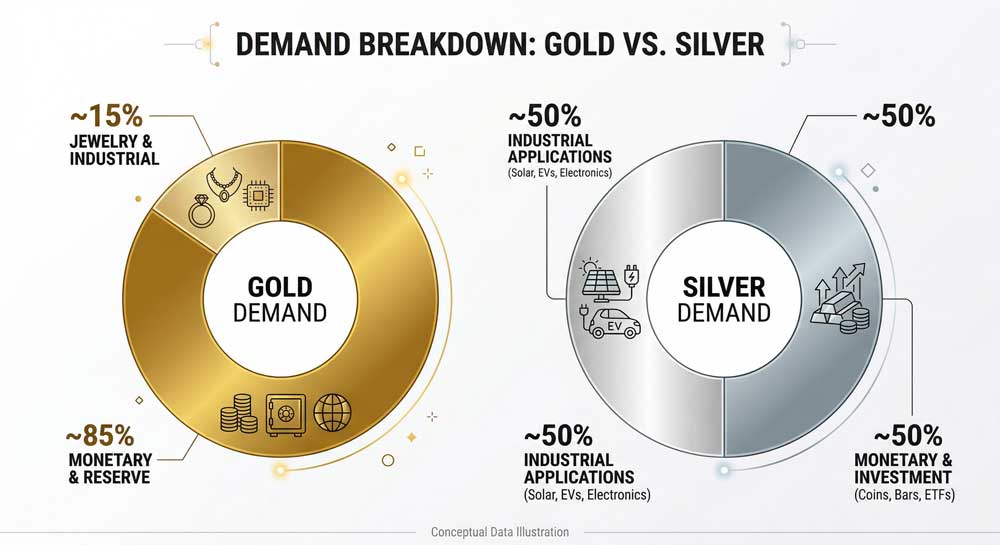
Unlike gold, which functions almost entirely as a monetary and reserve asset, roughly 50% of silver demand is industrial: electronics, solar panels, electric vehicles, and semiconductors.
- Strike one: Sovereign liquidity dries up, removing the monetary premium (same headwind as gold)
- Strike two: An energy crisis signals global manufacturing slowdown, instantly compressing industrial demand
| Metal | Monetary/Reserve Demand | Industrial Demand | Crisis Vulnerability |
|---|---|---|---|
| Gold | ~85% | ~15% | Medium |
| Silver | ~50% | ~50% | High — dual demand collapse |
This dual exposure explains why silver’s drawdowns are nearly always larger than gold’s during liquidity-driven selloffs.
5. The Retail Speculative Bubble Provides the Accelerant
Before any crisis forces a liquidity crunch, precious metals typically experience a momentum-driven run-up. The structural de-dollarization thesis is real and well-founded — but it attracts a second, less stable wave of capital.
Retail investors, trend-following funds, and leveraged ETF buyers poured into gold and silver at record speeds in the months preceding recent conflicts. Gold ETFs recorded some of their largest single-week inflows on record. Silver, cheaper per unit and more volatile, became the high-beta vehicle of choice.
When sovereign buyers step back and prices dip, this speculative overhang unwinds violently:
- Leveraged positions hit stop-losses
- Margin calls force liquidation regardless of conviction
- Trend-following algorithms reverse direction en masse
The geopolitical crisis acts as the pin. The over-leveraged long positions provide the explosive downward momentum. Gold trust ETFs recorded their largest single-month outflows since April 2013 — not because the long-term case broke down, but because late-arriving retail capital exited fast.
Will the Gold Safe Haven Return?
Yes — and the structural case remains intact. Monetary debasement is a multi-decade trend. De-dollarization doesn’t pause for quarterly results. Central banks won’t abandon gold accumulation strategies over a short-term revenue gap.
Once shipping lanes normalize, Gulf surpluses recover, and China stabilizes, structural gold buying should reassert itself. But markets don’t trade on decade-long logic — they trade on today’s marginal buyer and seller.
Key takeaways for investors:
- The gold safe haven works best in financial panics and currency crises — not all geopolitical events
- Short-term gold prices follow sovereign liquidity flows, not fear
- Silver’s industrial exposure makes it a higher-risk expression of the same thesis
- Speculative positioning amplifies moves in both directions — understand what you own
“In the short run, gold follows liquidity and reserve capital — not news and panic. The structural bull case remains; the marginal buyer has temporarily stepped away.”
Further Reading — Authoritative Sources
- BIS Quarterly Review on central bank gold reserves: https://www.bis.org/publ/qtrpdf/r_qt2312b.htm
- World Gold Council — Central Bank Gold Reserves report: https://www.gold.org/goldhub/research/central-bank-gold-reserves-survey-2024
- IMF Working Paper on de-dollarization and reserve diversification: https://www.imf.org/en/Publications/WP/Issues/2023/03/30/Geoeconomic-Fragmentation-and-Foreign-Asset-Portfolios
- EIA — Strait of Hormuz oil flow data: https://www.eia.gov/international/analysis/regions-of-interest/Strait_of_Hormuz
- Federal Reserve — History of QE and balance sheet expansion: https://www.federalreserve.gov/monetarypolicy/bst_recenttrends.htm
- Bloomberg Intelligence — Gold ETF flow tracker: https://www.bloomberg.com/professional/blog/gold-etf-flows-tracker/
- ElevenLab: 5 Powerful Reasons BlackRock’s Bond Market Strategy Warns of US Labor Market Weakness in 2026
- ElevenLab: 5 Epic Reasons the Hong Kong Safe Haven Thrives After Dubai’s Collapse
- ElevenLab: Alarming Pattern: Gold Price Crash in January Revealed (3 Historical Lessons)