How the US-Israel-Iran Conflict Is Crushing the Global Economy — 7 Critical Facts
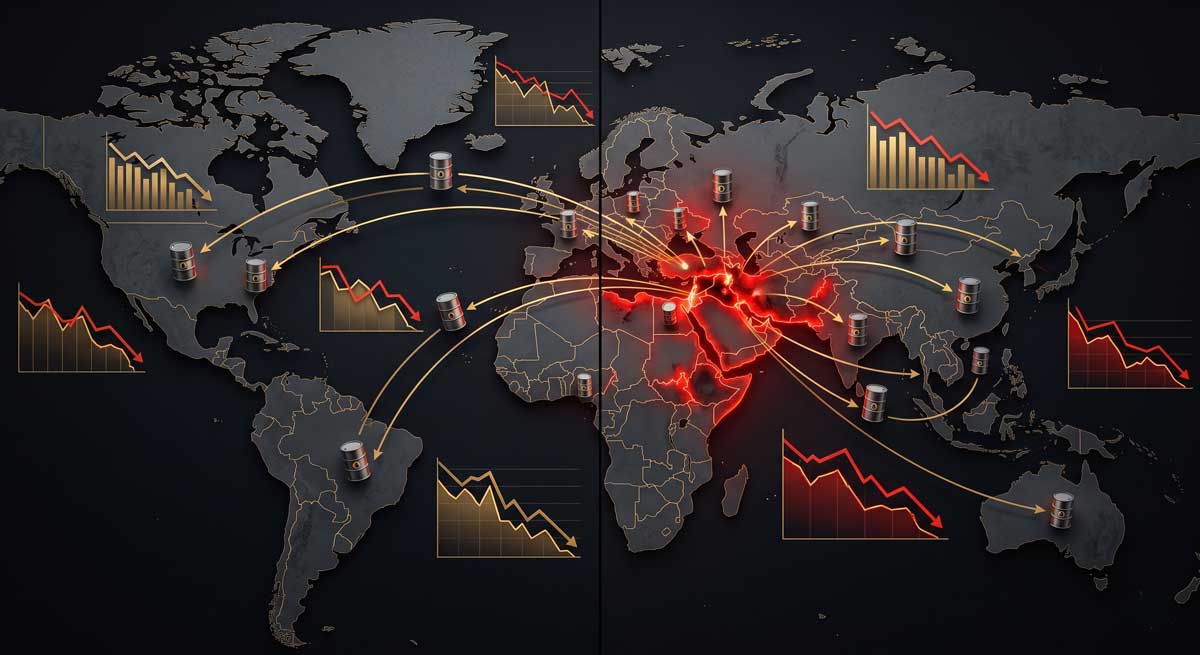
The US-Israel-Iran conflict global economic impact is now impossible to ignore. Nearly two months into active hostilities, the ripple effects have spread well beyond the Middle East — disrupting energy markets, inflating consumer prices, and forcing downward revisions to growth forecasts on every inhabited continent.
The numbers are stark. The United States alone has spent an estimated $42 billion on military operations against Iran — a burn rate of roughly $41 million per hour, or $11,400 every single second. Meanwhile, ordinary households from London to Manila are paying more for fuel, food, and basic goods, with no clear end in sight.
Table of Contents
The $42 Billion Question: What This War Is Actually Costing
The financial arithmetic of this conflict is staggering. Based on reported total costs exceeding $42 billion, the US military expenditure calculates to approximately $41 million per hour — or around $11,400 per second. Shortly after hostilities began, the Pentagon made an emergency request for $200 billion in supplemental budget authority, and the White House has since proposed a record $1.5 trillion defence budget for the next fiscal year.
These figures have real consequences for fiscal sustainability. Analysts widely expect the expanded military spending to push US national debt higher, compounding long-term concerns about the country’s debt trajectory. For an economy already dealing with post-pandemic fiscal pressures, adding a multi-hundred-billion-dollar war premium to the defence budget is a structural risk that extends far beyond the battlefield.
Europe: Recovery Momentum Interrupted
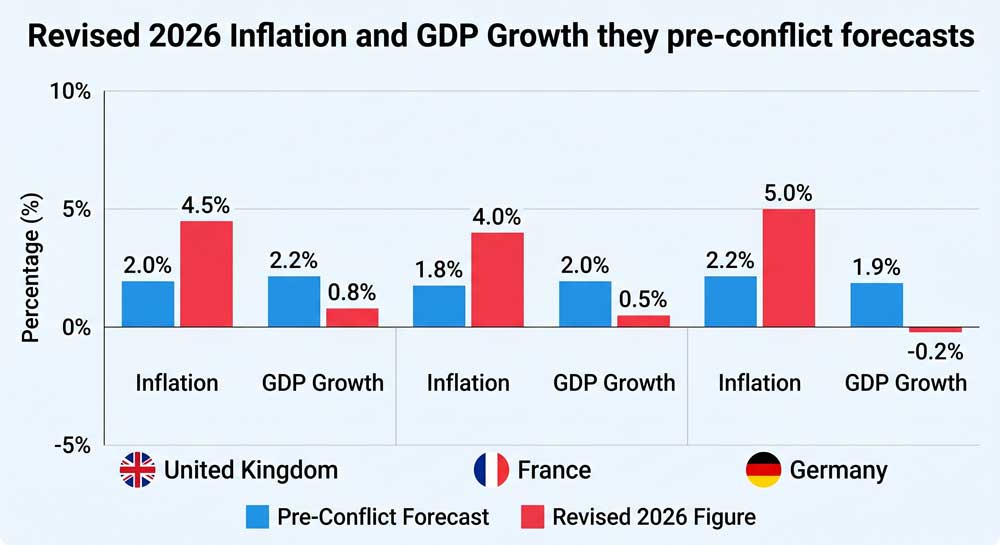
Europe’s fragile economic recovery has taken a direct hit. The UK’s Office for National Statistics reported that inflation climbed to 3.3% in March, up sharply from 3.0% in February — a direct consequence of rising oil and gas prices driven by the conflict and disruptions to the Strait of Hormuz. The Bank of England, which had anticipated inflation falling below 2% by April, now projects the rate could reach 3.5% between July and September.
France has absorbed losses estimated at €4–6 billion, according to its Economy and Finance Minister. The Banque de France has trimmed its 2026 growth forecast from 1.0% to 0.9%, citing geopolitical-driven energy price pressures as a key drag. Germany, meanwhile, is contending with what its Chamber of Commerce has described as “significant knock-on effects” and “enormous cost increases” for German businesses.
European Economic Snapshot
| Country | Key Impact | Updated 2026 Forecast |
|---|---|---|
| United Kingdom | CPI rose to 3.3% (March); BoE projects 3.5% by Q3 | Below prior targets |
| France | €4–6 billion in losses; government freezing spending | GDP growth cut to 0.9% |
| Germany | Significant cost increases for firms; export pressures | Q1 GDP due April 30, expected +0.2% |
The broader point is this: Europe entered 2026 with genuine momentum after years of stagnation. The conflict has fractured that momentum across three simultaneous dimensions — economic costs from energy, social tensions in cities with large Jewish and Muslim communities, and deepening transatlantic political friction between Washington and European capitals. That combination of pressures, rather than any single factor, explains why the recovery narrative has been so thoroughly disrupted.
Asia: Near-Catastrophic Disruption, Especially for Southeast Asia
Since the main theatre of conflict sits in Asia’s western flank, Asian economies have absorbed the earliest and sharpest blows. Liquefied natural gas (LNG) imports across the region have fallen to their lowest level in nearly six years. Japan has been forced to cut output at gas-fired power plants, while South Korea has lifted restrictions on coal-fired generation specifically to reduce LNG dependency — a stark reversal of environmental policy driven by energy security necessity.
The IMF’s April 2026 Regional Economic Outlook projects growth across the Middle East, North Africa, Afghanistan and Pakistan at just 1.4% for 2026 — a downward revision of 2.3 percentage points from its October 2025 estimate. Among the eight oil-exporting nations in that grouping, five — Iran, Iraq, Qatar, Kuwait, and Bahrain — are expected to post negative real GDP growth in 2026.
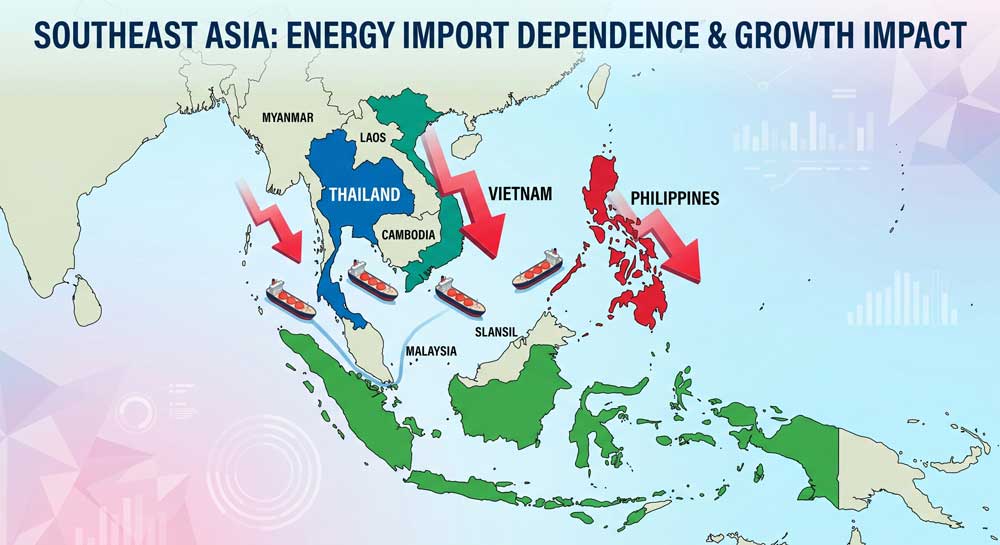
In Southeast Asia, Maybank Investment Bank has downgraded its 2026 growth outlook for the six major ASEAN economies — Indonesia, Malaysia, the Philippines, Singapore, Vietnam, and Thailand — from 4.8% to 4.5%. Regional inflation is now forecast at 2.7%, up from a prior projection of 2.2%, with Thailand facing the steepest upward revision at 0.8 percentage points.
The impact has even reached consumer goods. Karex Bhd, the world’s largest condom manufacturer, headquartered in Malaysia, has announced plans to raise prices by 20–30% due to supply chain disruption, with the possibility of further increases if conditions worsen. This is a useful illustration of how conflict-driven supply shocks move through supply chains in unexpected directions.
I consider the situation in Southeast Asia the most alarming from a near-term humanitarian standpoint. Countries like Thailand, Vietnam, and the Philippines have high import energy dependency and limited fiscal buffers. If the conflict persists, the downstream effects — including returning overseas workers, shrinking remittance flows, and social instability — could compound the immediate economic pain significantly.
ASEAN Growth & Inflation Revisions (2026)
| Country | Growth Revision | Inflation Revision |
|---|---|---|
| Thailand | Downward | +0.8 pp |
| Philippines | Downward | +0.5 pp |
| Indonesia | Downward | +0.5 pp |
| Vietnam | Downward | Upward |
| Malaysia | Downward | Upward |
| Singapore | Downward | Upward |
The United States: Burning Money Abroad, Paying More at Home
The war is costing Americans on two fronts simultaneously. US consumer prices rose 3.3% year-on-year in March, up from 2.4% in February and the highest reading since June 2024 — driven primarily by the energy price surge. That means the US is both bankrolling the conflict at $11,400 per second and absorbing the inflationary consequences domestically.
The proposed $1.5 trillion defence budget for the next fiscal year — a record figure — reflects the scale of the fiscal commitment involved. If enacted, this would represent a structural shift in US government spending, with compounding effects on deficit levels and long-term debt servicing costs. The risk is not hypothetical: markets are already pricing in higher Treasury yields in anticipation of increased borrowing.
Latin America: Indirect but Real Consequences
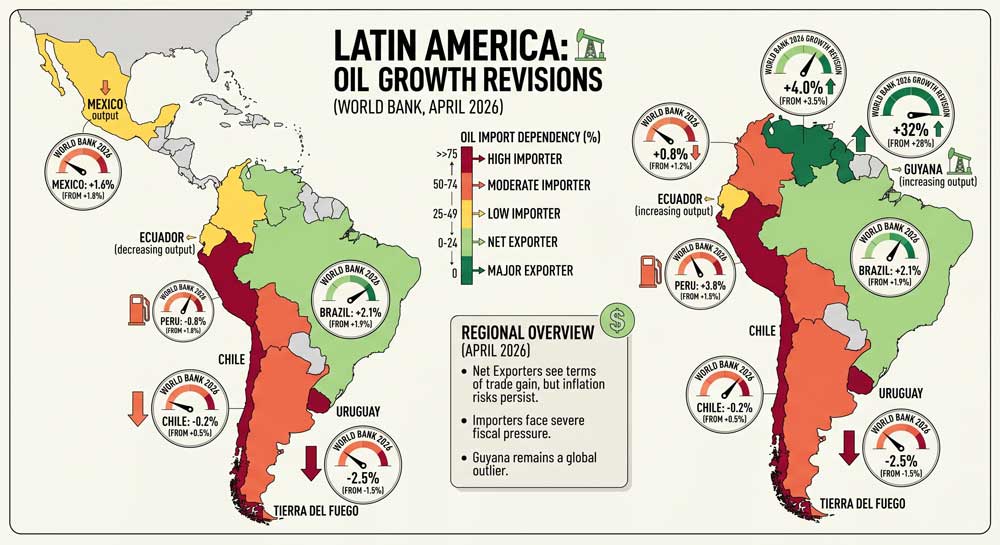
Latin America’s exposure to this conflict operates through indirect channels rather than direct proximity, but the damage is accumulating. The World Bank revised its 2026 growth forecast for Latin America and the Caribbean down to 2.1%, from 2.4% in 2025, citing structural challenges compounded by high borrowing costs, weak external demand, geopolitical tensions, and persistent inflation.
The primary transmission mechanism is energy prices. Most Latin American economies, particularly Chile, Peru, and much of Central America and the Caribbean, are significant oil importers. Higher global energy prices directly increase operating costs across those economies, reducing competitiveness and squeezing household purchasing power.
Cuba occupies a particularly complex position. With US attention and resources redirected toward the Middle East, direct pressure on Havana has marginally eased in diplomatic terms. However, the core constraint — Cuba’s difficulty accessing oil supplies — has not changed. The conflict has not prompted any relaxation of restrictions on Cuba’s ability to import petroleum, so the practical economic improvement for ordinary Cubans is essentially zero.
Regional Economic Damage Overview
| Region | Primary Channel | 2026 Growth Revision | Key Risk |
|---|---|---|---|
| Europe | Energy prices, trade disruption | France: 1.0% → 0.9% | Prolonged inflation, social tension |
| Middle East / North Africa | Direct conflict, oil disruption | -2.3 pp to 1.4% | 5 major oil exporters in contraction |
| Southeast Asia | LNG shortage, supply chains | 4.8% → 4.5% | Energy import dependency, social unrest |
| United States | Military spending, energy costs | CPI at 3.3% (March) | Deficit expansion, debt trajectory |
| Latin America & Caribbean | Indirect via oil, trade | 2.4% → 2.1% | Import cost inflation, reduced commodity demand |
The Broader Picture: A Conflict with No Contained Costs
What makes the US-Israel-Iran conflict economically distinctive is the breadth of its transmission mechanisms. Unlike localised conflicts that primarily affect neighbouring states, this one is operating simultaneously through energy markets, shipping routes, supply chains, currency dynamics, and fiscal policy across every major economic region.
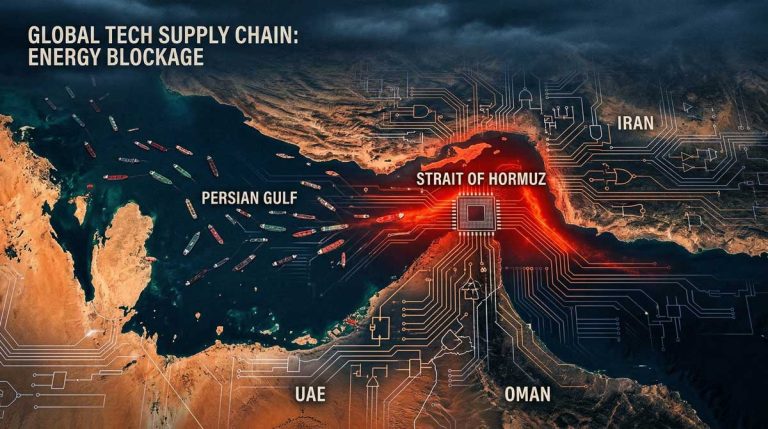
The Strait of Hormuz disruption alone is sufficient to generate global consequences, given that a significant share of global LNG and crude oil transits through that chokepoint. Add to that the US military’s direct fiscal commitment — now running at nearly $11,400 per second — and you have a conflict that is reshaping economic conditions from Southeast Asian manufacturing floors to European supermarket aisles.
For investors, policymakers, and businesses navigating this environment, the key variables to watch are: the duration and geographic scope of hostilities; the extent of Strait of Hormuz disruption; US fiscal policy responses; and whether central banks can contain second-round inflation effects without triggering recessions. None of those questions have clear answers right now — which is itself a significant economic risk factor.
Reference Sources
- World Bank — Latin America and the Caribbean Economic Update — April 2026
- IMF — Regional Economic Outlook: Middle East and Central Asia, April 2026
- Global Americans — The Economic Implications of the Iran War for Latin America
- Trends Research — The War in the Gulf: Its Impact on Latin America
- International Banker — The 2026 Economic Outlook for Latin America
- Goldman Sachs — Latin America Predicted to Post Modest Growth Amid Regional Upheaval
- DNV — Latin America Energy Transition Outlook 2025
- ElevenLab — Strait of Hormuz Shipping Volume Hits an Incredible 7-Day High
- ElevenLab — Strait of Hormuz Control: 7 Shocking Reasons Iran Lost Its Ultimate Strategic Card
- ElevenLab — 5 Devastating Realities of the Middle East Energy Crisis Destroying Global Markets