CPU AI Data Center Demand Powers Intel’s Stunning Record High — 5 Reasons the CPU Is Back
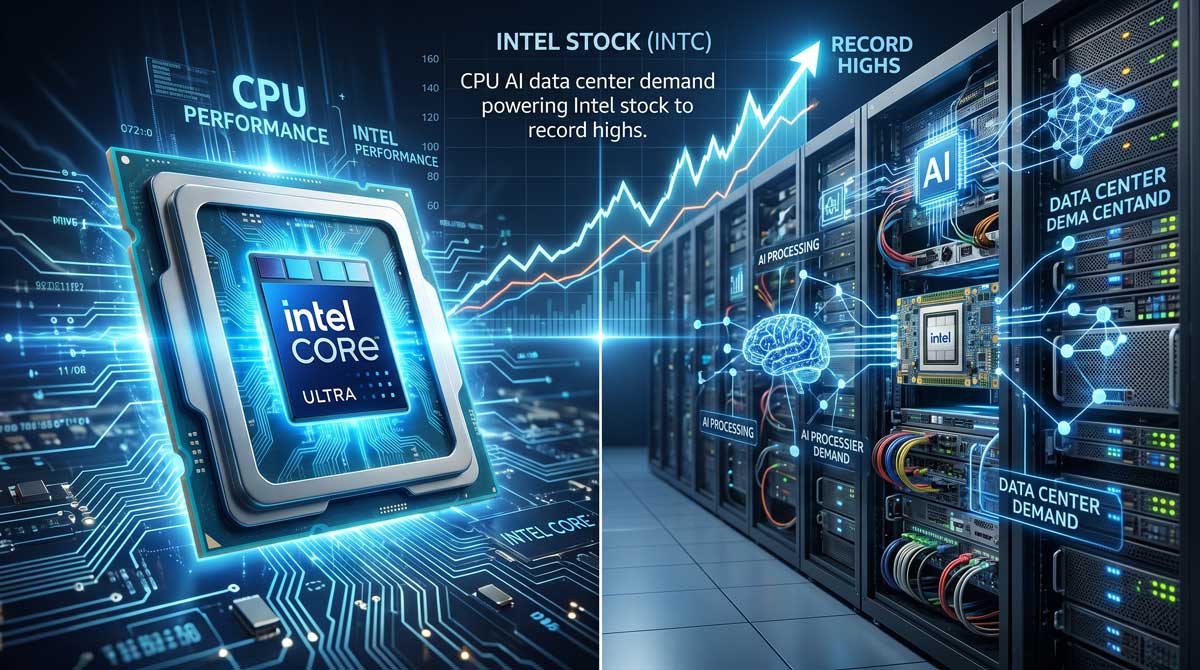
CPU AI data center demand is no longer a footnote — it is the defining hardware story of 2026. Intel’s stock surged over 27% in a single trading session last Friday, breaking through a price ceiling that had stood for 26 years, and the move was not driven by nostalgia. It was driven by a structural shift in how artificial intelligence actually works.
For years, the prevailing wisdom was simple: AI runs on GPUs. Buy Nvidia, buy more GPUs, repeat. That logic made Jensen Huang one of the most powerful figures in tech and sent Nvidia’s market cap to the top of the global rankings. But in 2026, the narrative is cracking open — and the humble CPU is staging one of the most remarkable comebacks in semiconductor history.
Table of Contents
Why CPUs Never Really Left AI
It is easy to forget that before GPUs dominated AI workloads, CPUs were the only tool available. Back in 1998, researchers training early convolutional neural networks (CNNs) had to run jobs for two to three days on a single CPU just to get results. That was not a hardware luxury — it was the only option.
The GPU revolution arrived publicly in 2012, when a small team using two consumer-grade GTX 580 graphics cards entered the ImageNet competition and improved image recognition accuracy by ten percentage points over the previous best. From that point, GPUs became the shovels in an AI gold rush, and CPUs were quietly demoted to background utilities — managing memory, routing requests, and keeping the lights on.
That era is now ending, and the transition is happening faster than most analysts anticipated.
The Agentic AI Shift: Why CPU AI Data Center Demand Is Exploding
The key driver behind the CPU renaissance is the rise of agentic AI — systems like Claude Code, autonomous coding assistants, and multi-step AI agents that do not simply respond to prompts but plan, reason, call external tools, verify outputs, and iterate.
Think about what happens when an AI agent is asked to complete a purchase on your behalf. It must first identify the item, search multiple platforms via API calls, compare prices and seller ratings, validate the data, and then surface a recommendation — all without human input at each step. That workflow is fundamentally different from a chatbot predicting the next token.
The technical distinction matters. GPU workloads are optimised for massive parallel matrix computations — ideal for model training and simple inference. But agentic workflows are dominated by serial logic, conditional branching, and tool orchestration — tasks that are squarely in the CPU’s wheelhouse and among the GPU’s weakest areas.
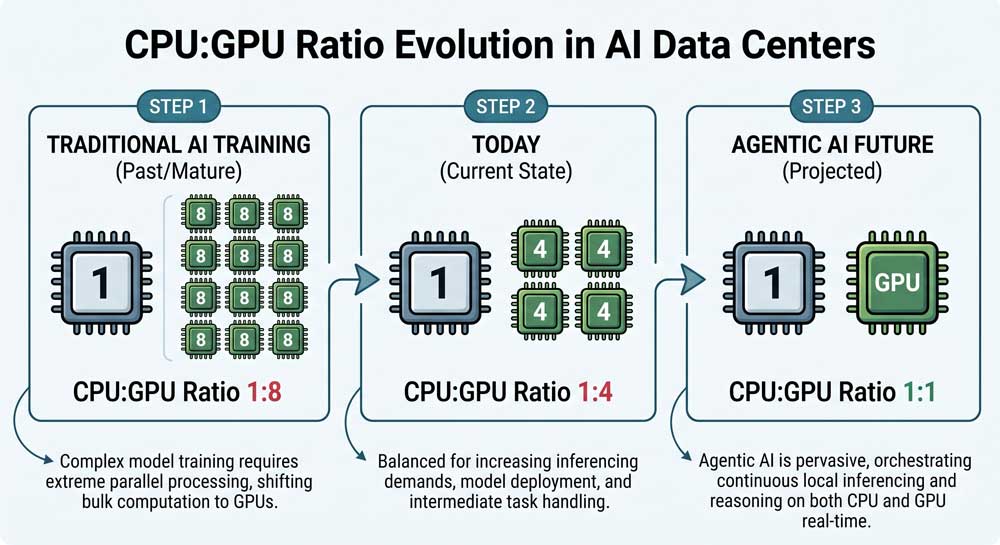
According to TrendForce, the CPU-to-GPU ratio in traditional AI data centers currently sits between 1:4 and 1:8. In agentic AI deployments, that ratio is expected to shift dramatically toward 1:1 to 1:2. Arm has estimated that while conventional AI data centers require roughly 30 million CPU cores per gigawatt of capacity, the agentic AI era will demand 120 million CPU cores per gigawatt — a fourfold increase.
CPU:GPU Ratio Evolution in AI Data Centers
| Deployment Era | CPU:GPU Ratio | Primary Workload |
|---|---|---|
| Traditional AI Training | 1:8 | Matrix computation, model training |
| Current AI Inference | 1:4 | Token prediction, LLM serving |
| Agentic AI (Projected) | 1:1 to 1:2 | Task planning, tool calling, evaluation |
Intel CEO Lip-Bu Tan confirmed the shift on the company’s Q1 2026 earnings call, noting that the CPU-to-GPU ratio had already moved from 1:8 to 1:4 and was trending toward 1:1. Whether or not he is talking his own book to some degree, the underlying logic holds up across multiple independent data sources.
Reinforcement Learning: The Hidden CPU Bottleneck
Beyond agentic AI, there is a second structural force pushing CPU demand higher: reinforcement learning (RL), which has become the dominant technique for improving large language model quality at the frontier.
Models like DeepSeek R1, OpenAI’s o-series, and Google’s Gemini family all rely heavily on RL to move beyond rote pattern matching. Instead of learning from static datasets, RL-trained models are tested in live scenarios — they generate outputs, those outputs are evaluated, and the model is adjusted based on whether it succeeded or failed.
That evaluation step — running generated code, checking mathematical proofs, scoring answers — requires CPU-based compute infrastructure. Every training cycle for a frontier model now involves banks of CPUs acting as judges, simulators, and validators alongside the GPU clusters doing the heavy lifting. In practice, the CPU has become the most demanding trainer in the room.
Intel’s Q1 2026 Earnings: The Numbers Behind the Rally
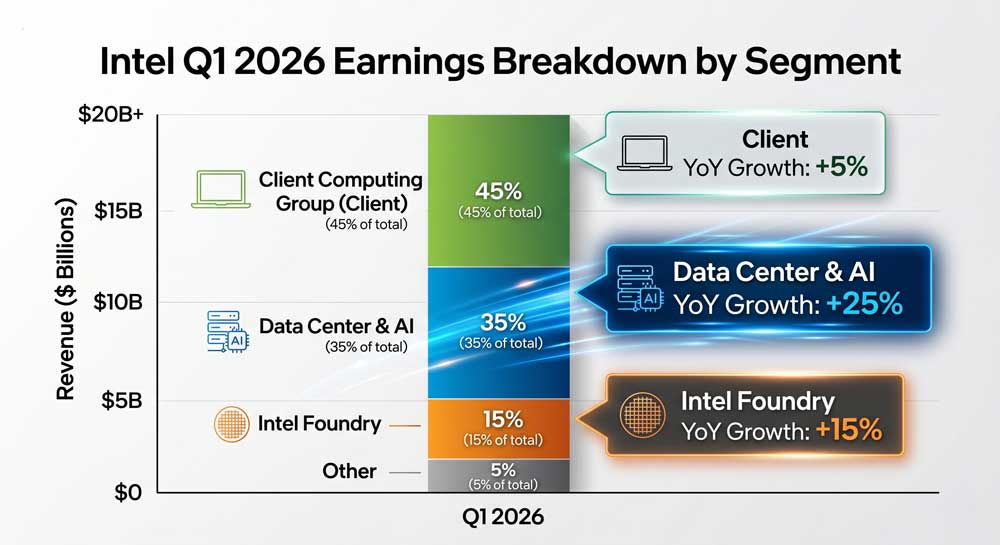
Intel’s Q1 2026 results provided the concrete evidence investors had been waiting for. The company reported revenue of $13.6 billion, up 7% year-over-year, with the most impressive growth coming from its Data Center and AI segment.
Intel Q1 2026 Revenue by Segment
| Business Segment | Q1 2026 Revenue | YoY Growth |
|---|---|---|
| Client Computing (PC CPUs) | $7.7 billion | +1.3% |
| Data Center & AI | $5.05 billion | +22% |
| Foundry Services | $5.42 billion | +16% |
The data center and AI segment’s 22% growth rate signals that Intel is capturing real, not speculative, demand. Management also disclosed that capacity constraints caused the company to miss additional revenue that, in their words, could be measured in the billions. Intel has since begun redirecting production capacity away from consumer CPUs toward server-grade Xeon chips to meet that demand. Server CPU prices have risen by as much as 20% since March as a result.
Intel’s Manufacturing Comeback: 18A, 14A, and TeraFab
The earnings story would be incomplete without Intel’s foundry progress. Management confirmed that its 18A process node — equivalent to approximately 1.8nm — has achieved yield improvements ahead of schedule, with targets originally set for year-end now expected to be met by mid-year.
More significantly, Intel announced that its next-generation 14A process (roughly 1.4nm equivalent) is already demonstrating better yield and performance metrics than 18A did at the same stage of development. Intel claims 14A will deliver a 15–20% performance improvement over 18A, 30% higher transistor density, and 25–35% lower power consumption.
For context, TSMC — the undisputed leader in contract chip manufacturing — currently mass-produces at 3nm, began volume production of 2nm in Q4 2025, and has its 1.6nm node scheduled for 2027. Intel, after years of process delays, is now credibly competing in the same technology tier.
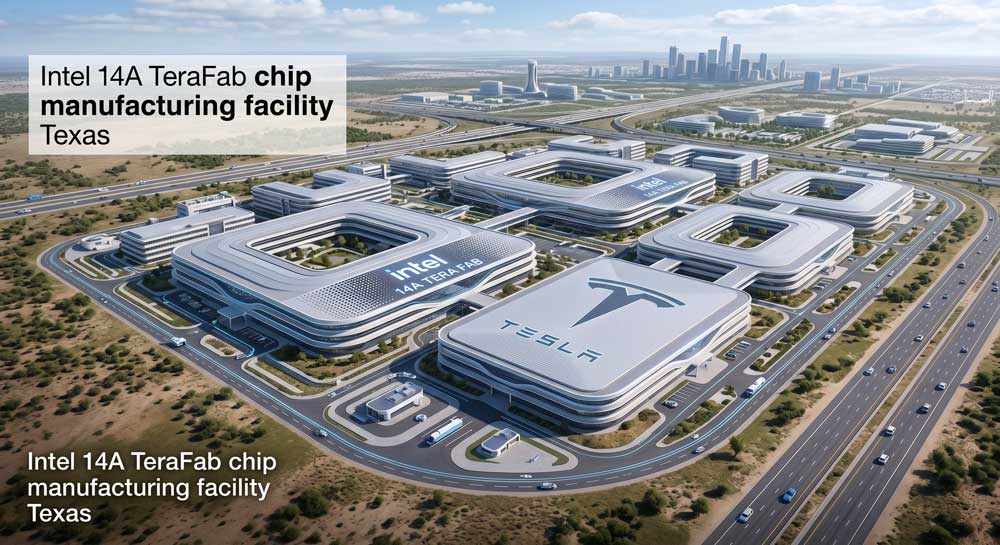
The commercial validation of that ambition arrived on April 7, when Tesla became Intel’s first major 14A customer through the TeraFab project — a planned chip manufacturing complex in Texas that also involves SpaceX and xAI. The initial phase involves a research fab costing approximately $3 billion, targeting several thousand wafers per month. Elon Musk’s stated long-term ambition is one million wafers per month, compared to TSMC’s annual capacity of over 17 million 12-inch wafers across its global network.
The timelines are ambitious and carry real execution risk. Musk himself acknowledged on Tesla’s earnings call that full TeraFab scale-up will be gradual, and Intel’s 14A node remains under development. However, securing a high-profile customer in Tesla provides commercial credibility that Intel’s foundry business has lacked for years.
Is Intel Undervalued Compared to AMD?
Despite its dramatic recovery, Intel’s market capitalisation of approximately $425 billion still sits roughly $100 billion below AMD’s $527 billion — a gap that warrants scrutiny given the underlying financials.
Intel vs AMD: Financial Snapshot (2025)
| Metric | Intel | AMD |
|---|---|---|
| Revenue (2025) | $52.8 billion | $34.6 billion |
| Gross Profit (2025) | $18.4 billion | $17.1 billion |
| Manufacturing Model | Integrated (IDM) | Fabless |
| CPU Market Share (PC + Server) | ~65–70% | ~30–35% |
| Market Cap (April 2026) | ~$425 billion | ~$527 billion |
Intel generates significantly more revenue and maintains higher absolute gross profit than AMD, while also holding a larger share of both the PC and server CPU markets according to IDC and Mercury Research data. Its integrated manufacturing model adds complexity and capital intensity, but with 14A now showing competitive yields, that model is shifting from liability to potential advantage.
The valuation gap reflects lingering investor scepticism about Intel’s execution history and the pace of its foundry ramp. That scepticism is not irrational — but it also suggests there may be room for the gap to close if Intel continues to deliver.
The Risk: AI Moves Faster Than Any Forecast
It would be a mistake to read this story as a simple, linear triumph. The same AI wave that nearly destroyed Intel — redirecting data center investment almost entirely toward GPUs — could reshape the competitive landscape again in ways that are difficult to predict from where we stand today.
The Oracle analogy is instructive here: when Oracle announced a $300 billion, five-year AI compute deal with OpenAI in 2024, its stock surged dramatically. Concerns about counterparty capacity and Oracle’s resulting debt load eventually brought the shares back to earth. Intel’s TeraFab partnership carries some of the same characteristics — a large, aspirational announcement with execution timelines that stretch years into the future.
The structural case for CPU demand in AI data centers is solid and supported by multiple independent sources. The specific bets on which companies capture that demand — and how quickly — remain genuinely uncertain.
What This Means for the Broader Chip Market
The CPU resurgence is not an Intel-exclusive story. AMD is already benefiting, with its EPYC server processors gaining significant data center traction. Google has developed its own Axion CPU for internal workloads, and Meta is partnering with Arm to build custom silicon. Microsoft has reportedly dedicated an entire building in its new Fairwater data center campus exclusively to CPU infrastructure.
The near-term consequence for end consumers is straightforward: component prices are rising. Server CPU prices have increased 10–15% since the start of 2026, with delivery lead times extending to as long as six months in some categories. Consumer-grade CPUs are next in line as manufacturers redirect production capacity.
For investors, the CPU AI data center theme represents one of the clearest structural tailwinds in the semiconductor space heading into the second half of 2026 — though as always, entry price and execution risk matter as much as the underlying thesis.
Reference Sources
- Reuters — Intel soars on signs AI boom for CPUs is here — Q1 2026 earnings and outlook analysis
- TrendForce — How Agentic AI Is Reshaping the CPU:GPU Ratio — structural demand analysis and supply crunch data
- Tom’s Hardware — Intel already shifting production from consumer chips to Xeon as CPU shortage intensifies
- Let’s Data Science — Tesla Selects Intel 14A for Terafab Chip Production — technical and commercial implications
- Business Insider — Intel Stock Soars to Record Highs After Blowout Sales Forecast — market reaction and analyst targets
- Fudzilla — Musk drags Intel 14A into Terafab plans — detailed breakdown of Tesla’s foundry partnership
- Yahoo Finance — Intel Hit Its Highest Price in 25 Years — year-to-date performance and long-term chart analysis
- ElevenLab — Personal Superintelligence Revealed: Inside Meta’s Unbelievable 5-Year Plan for Billions
- ElevenLab — AI Token Economy: 7 Brutal Truths That Will Redefine Who Gets Wealthy in the Next Decade
- ElevenLab — The Claude Code Leak: 1 Catastrophic Mistake That Could Supercharge Every AI Tool 100x