US Debt-to-GDP Ratio US Debt Tops GDP for First Time in 80 Years: 5 Risk Warnings You Can’t Ignore
For the first time since World War II, publicly held US federal debt has surpassed the nation’s nominal GDP — a threshold that carries serious implications for interest costs, credit ratings, and long-term economic stability. This isn’t a projection or a warning about a distant future. It’s happening now, and the consequences are already visible in federal budgets and financial markets.
US Debt-to-GDP Ratio Crosses 100%
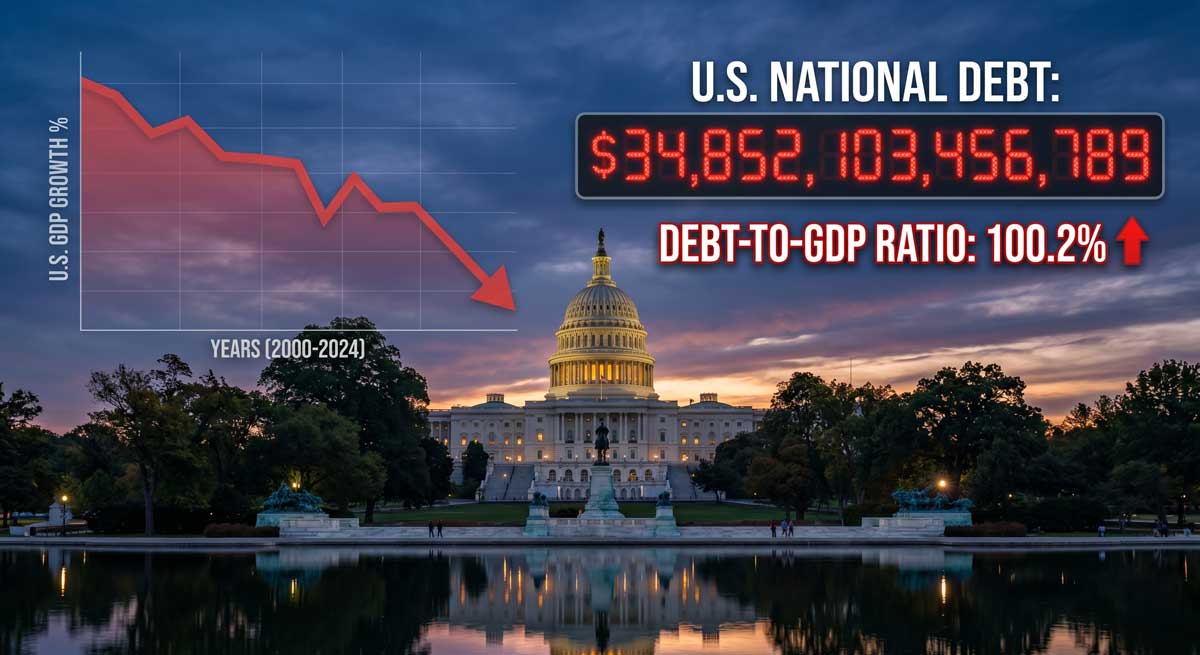
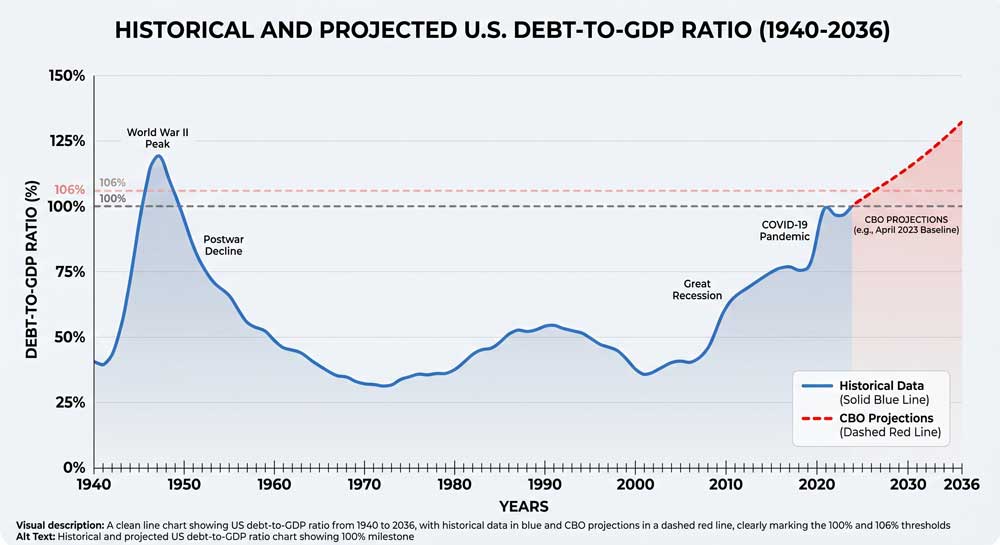
According to the Bureau of Economic Analysis, publicly held federal debt reached $31.27 trillion as of March 31, against a trailing 12-month nominal GDP of approximately $31.22 trillion. That puts the debt-to-GDP ratio at 100.2% — a level not seen since 1946, when the US was financing the largest military mobilization in its history.
The critical difference between then and now is stark. The post-WWII debt spike had a clear cause and a clear endpoint. Today’s debt accumulation reflects decades of both parties avoiding hard fiscal choices — persistent revenue shortfalls, unchecked entitlement growth, and tax cuts that were never offset with spending reductions. There was no emergency that justified this trajectory. It was a slow, deliberate drift.
| Year | Debt-to-GDP Ratio | Primary Driver |
|---|---|---|
| 1946 | ~106% | WWII military financing |
| 2008 | ~40% | Pre-financial crisis baseline |
| 2020 | ~100% | COVID-19 stimulus spending |
| 2025 | ~100.2% | Structural deficits, entitlement growth, interest costs |
| 2030 (projected) | ~108% | CBO baseline forecast |
The Congressional Budget Office projected in February that, on the current trajectory, publicly held debt will reach 108% of GDP by 2030 — surpassing the post-WWII record — and 120% by 2036.
Soaring Interest Costs Are Crowding Out the Federal Budget
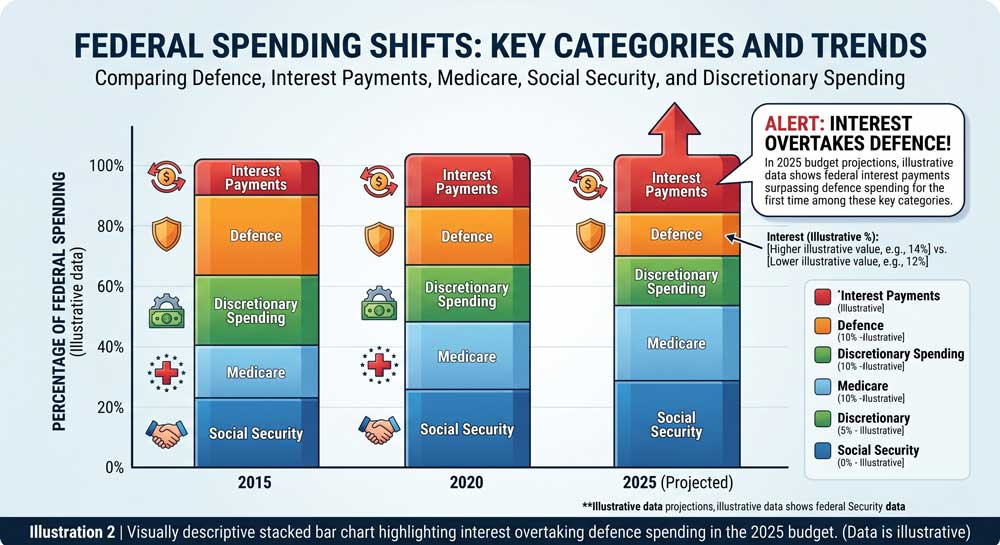
One of the most immediate and measurable consequences of high debt is the interest bill. Annual federal interest payments have now surpassed $1.2 trillion, exceeding national defense spending. The 30-year Treasury yield has recently pushed back toward 5%, and as older, lower-rate debt matures and gets refinanced at current market rates, that interest burden will only grow.
I think this is the part of the debt story that gets insufficient attention in public debate. The interest payment isn’t a future problem — it’s a present one. Every dollar spent on debt service is a dollar unavailable for infrastructure, healthcare, education, or defense. It’s a structural drag that compounds over time.
The Federal Reserve has signaled that rate cuts are unlikely in the near term. Fed funds futures suggest the next potential rate reduction won’t arrive until the second half of next year at the earliest. Fed officials have pointed to persistent inflation pressures from energy costs, tariffs, and geopolitical disruptions as reasons to keep policy rates elevated longer than many had anticipated. That means the refinancing environment for US debt remains punishing.
What the Debt Milestone Means for Financial Markets
High and rising debt doesn’t automatically trigger a crisis, but it meaningfully increases the probability of reaching one. There are several transmission channels worth understanding.
First, investor confidence. If markets begin pricing US Treasuries as a higher-risk asset — even marginally — yields rise further, making borrowing more expensive for both the government and the private sector. Businesses face higher financing costs for expansion, hiring, and capital investment. That’s not a theoretical risk; it’s a direct headwind to growth.
Second, credit rating pressure. Rating agencies have already taken note of US fiscal deterioration. A sovereign downgrade, even a partial one, can force institutional investors to reduce their Treasury holdings, amplifying yield pressure.
Third, entitlement fund solvency. Medicare and Social Security trust funds are projected to face depletion within a few years under current policy. That creates a compounding fiscal pressure that sits on top of the existing debt trajectory.
| Risk Factor | Near-Term Impact | Long-Term Impact |
|---|---|---|
| Rising Treasury yields | Higher federal interest costs | Crowding out of public investment |
| Credit rating downgrade | Institutional selling pressure | Elevated borrowing costs economy-wide |
| Entitlement fund depletion | Mandatory spending cliff | Benefit cuts or emergency tax hikes |
| Reduced fiscal flexibility | Limited crisis response capacity | Vulnerability to economic shocks |
Fed Chair Jerome Powell has described the US debt path as “unsustainable” — a word central bankers don’t use lightly. Mohamed El-Erian, chief economic adviser at Allianz, has argued that the surge in Treasury supply risks pushing yields even higher and worsening the financing environment further. These aren’t alarmist views; they reflect straightforward arithmetic applied to the current fiscal trajectory.
Political Dysfunction Is the Core Problem
The US Senate recently passed a fiscal year 2026 budget resolution that contained no meaningful plan to address structural deficits. The proposed FY2027 budget from the Trump administration calls for a defense spending increase of over 40% while cutting non-defense discretionary programs — a trade-off that does nothing to resolve the underlying imbalance driven by mandatory spending and interest costs.
The Peter G. Peterson Foundation has identified the primary drivers of this debt buildup as tax cuts, rising interest costs, and population ageing that inflates healthcare and Social Security expenditures. These are structural, not cyclical. They won’t resolve themselves with a year or two of strong GDP growth.
What’s needed is a frank reckoning with the mismatch between what the government spends and what it collects. The Committee for Economic Development has previously recommended targeting a return to a debt-to-GDP ratio around 70% as a more sustainable benchmark, and proposed a bipartisan fiscal commission made up of lawmakers who could deliberate on trade-offs with collective accountability and public legitimacy.
The broadly discussed baseline goal is reducing the annual deficit to below 3% of GDP — the level at which debt-to-GDP begins declining rather than rising. That alone would require roughly $10 trillion in cumulative deficit reduction over the next decade. The scale of the challenge is not in dispute. The political will to address it remains the central question.
Proposed Solutions and Their Challenges
One proposal gaining attention is a “super pay-as-you-go” fiscal rule, which would require any new spending or tax cut to be offset by fiscal savings at twice the size of the proposal. The logic is that this creates an asymmetric bias toward fiscal consolidation rather than just neutral pay-as-you-go accounting.
I think the underlying idea is sound — any fiscal rule that requires more fiscal discipline than it permits slippage is a meaningful improvement over the status quo. But even a rule like this would only be a first step. Stabilising the debt-to-GDP ratio requires far more comprehensive action: entitlement reform, revenue measures, and a genuine political settlement between the two parties on what the federal government is actually committed to funding.
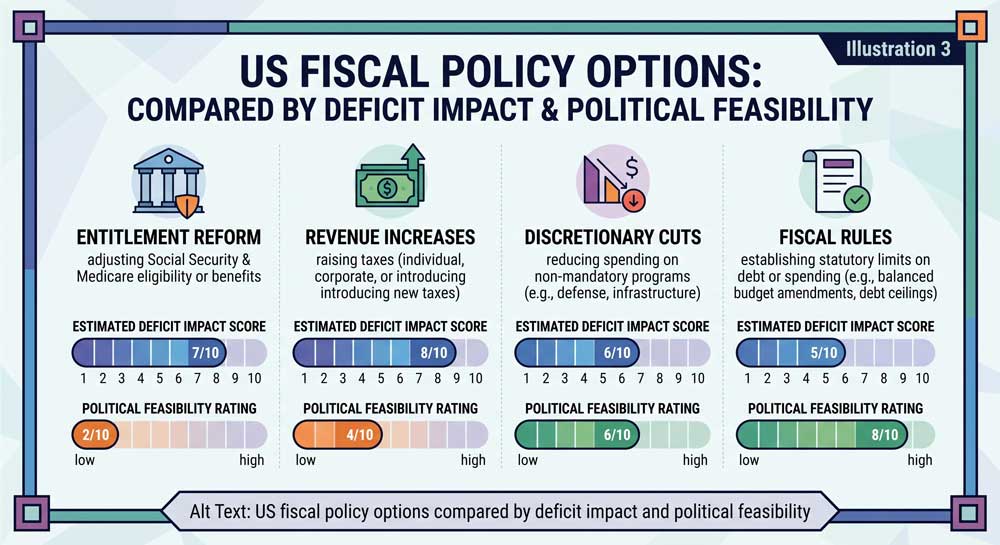
The proposal has attracted interest from both parties, but there is no concrete legislative pathway yet.
| Policy Approach | Estimated Deficit Impact | Political Feasibility |
|---|---|---|
| Super pay-as-you-go rule | Modest, incremental | Bipartisan interest, no legislation yet |
| Bipartisan fiscal commission | Framework for broader reform | Moderate — similar efforts have stalled before |
| Defense spending restraint | Significant if paired with cuts | Low under current administration |
| Entitlement reform (Medicare/Social Security) | Very large over 10–20 years | Very low — politically toxic for both parties |
| Revenue increases (tax reform) | Large, depends on scope | Low under current congressional majority |
The uncomfortable truth is that the math of US fiscal stabilisation requires politically unpopular decisions on both the spending and revenue sides. No combination of discretionary cuts alone — however aggressive — closes the gap. And the longer the delay, the more expensive and disruptive the eventual adjustment becomes.
The US crossing the 100% debt-to-GDP threshold is not just a symbolic milestone. It represents a point at which the feedback loop between debt, interest costs, and constrained fiscal flexibility becomes increasingly difficult to escape without deliberate, coordinated policy action. The signals from markets, central bankers, and budget analysts are consistent and clear. What remains to be seen is whether Washington’s political leadership is willing to act before the decision is made for them by the bond market.
Reference URLs
- Committee for a Responsible Federal Budget — Debt Surpasses Size of the Economy
- Congressional Budget Office — The Budget and Economic Outlook: 2025 to 2035
- Bureau of Economic Analysis — Gross Domestic Product, First Quarter 2025
- Peter G. Peterson Foundation — The U.S. Fiscal Situation
- Committee for Economic Development — Restoring Fiscal Responsibility
- Federal Reserve — Transcript: Chair Powell Press Conference, May 2025
- Allianz Global Investors — US Treasury Supply and Yield Dynamics
- ElevenLab — 7 Explosive Facts: The $39 Trillion US National Debt and Gold Reserves Crisis Reshaping Global Finance
- ElevenLab — 5 Powerful Reasons BlackRock’s Bond Market Strategy Warns of US Labor Market Weakness in 2026
- ElevenLab — 5 Critical Warning Signs the US Private Credit Crisis Is Triggering a $4.2 Trillion Banking Meltdown