Big Tech AI Spending Reaches $670B in 2026: Infrastructure Giants vs. Apple’s Strategic Pivot
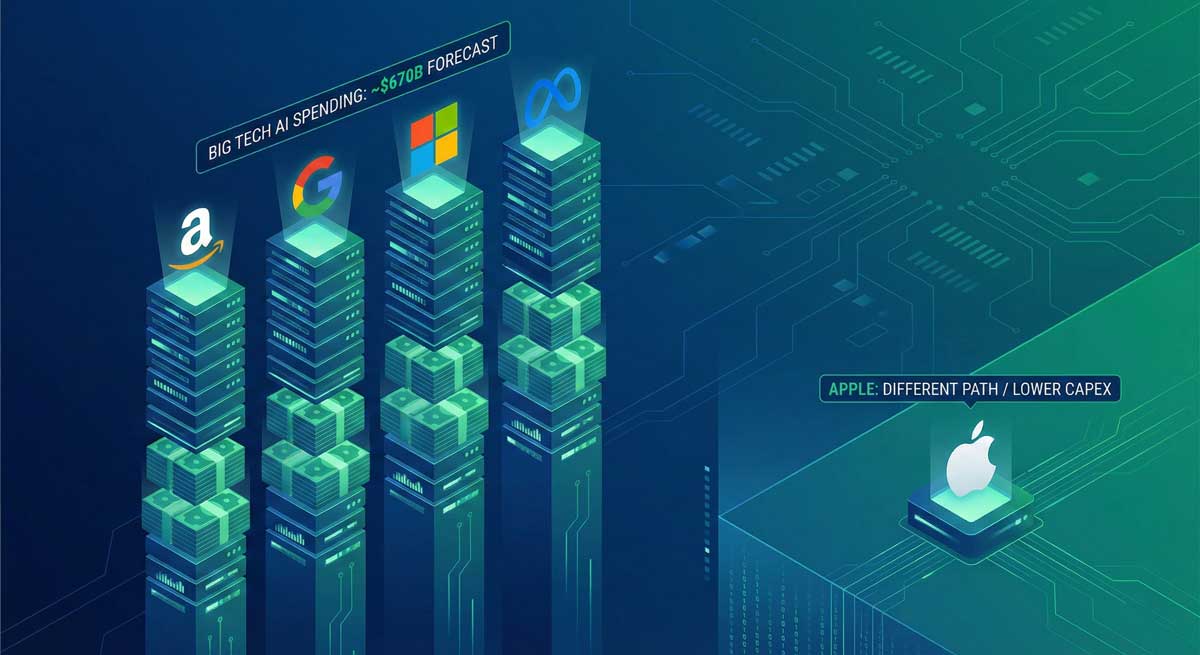
The artificial intelligence revolution has triggered the largest capital deployment in tech history. Four American technology titans—Meta, Amazon, Microsoft, and Google—are projected to invest between $630-670 billion in AI infrastructure during 2026, representing a jaw-dropping 70% increase from 2025 spending levels. This unprecedented Big Tech AI spending surge dwarfs entire national economies while reshaping competitive dynamics across the industry.
Meanwhile, Apple has chosen a radically different path, becoming the only major US tech company to reduce capital expenditure—down 19% year-over-year—while its competitors nearly double their investments. This strategic divergence raises fundamental questions about how companies will compete in the AI era.
The Historic Scale of AI Infrastructure Investment
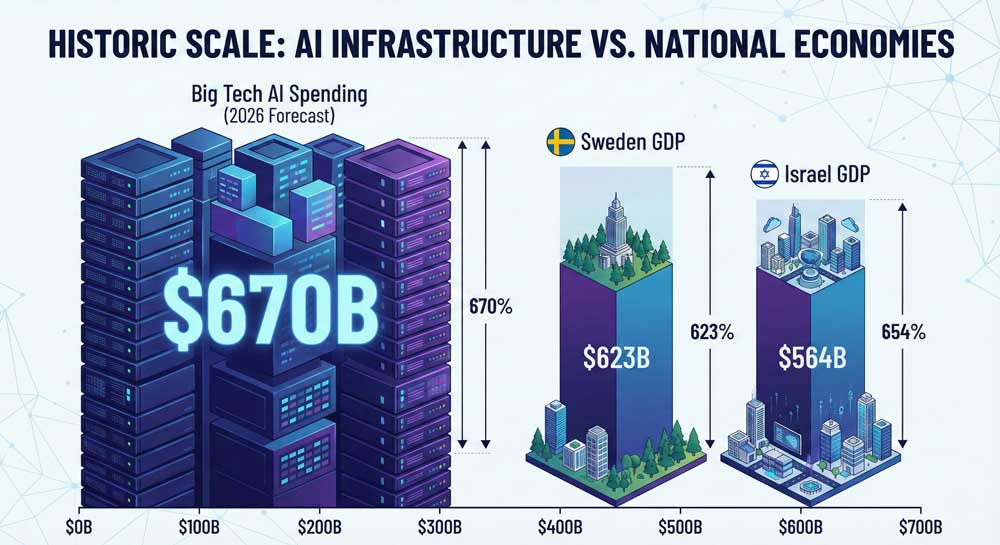
The magnitude of Big Tech AI spending in 2026 exceeds comprehension using conventional business metrics. At $670 billion, this single-year investment surpasses Sweden’s entire GDP ($662B) and Israel’s annual economic output ($610B).
According to Wall Street Journal analysis, this expenditure represents approximately 2.1% of total US GDP—the second-largest proportional investment in American history, trailing only the Louisiana Purchase of 1803 (3% of GDP). For context, the celebrated Apollo Moon Landing program consumed merely 0.2% of GDP, making it a statistical footnote compared to current AI infrastructure buildout.
2026 Capital Expenditure Projections:
| Company | Estimated Spending | Year-Over-Year Growth | Primary Focus |
|---|---|---|---|
| Amazon | $200 billion | +42% | AWS infrastructure, logistics AI |
| $175-185 billion | +95% | TPU clusters, data centers, Gemini | |
| Meta | $135 billion | +48% | Llama models, Reality Labs |
| Microsoft | $115+ billion | +89% | Azure expansion, OpenAI partnership |
These figures represent more than routine technology upgrades. Companies are fundamentally rebuilding the internet’s computational backbone, concentrating investments almost entirely on AI-specific data center infrastructure rather than diversified strategic portfolios.
Market Volatility and Investor Concerns Mount
The exponential trajectory of Big Tech AI spending has triggered significant market anxiety. Capital expenditure patterns shifted from gradual linear growth (2017-2023) to nearly vertical acceleration beginning in 2024, with spending curves showing no signs of plateauing.
For the first time in tech sector history, Meta’s projected 2026 capital expenditure may exceed 50% of total revenue—a ratio unprecedented for software companies that traditionally maintain high margins and limited physical infrastructure needs.
Quarterly Capital Spending Growth Comparison (Q4 2025):
| Company | YoY Growth Rate | Market Cap Loss (Recent Week) |
|---|---|---|
| +95% | Not disclosed | |
| Microsoft | +89% | Not disclosed |
| Meta | +48% | Not disclosed |
| Amazon | +42% | $124 billion |
| Apple | -19% | Minimal impact |
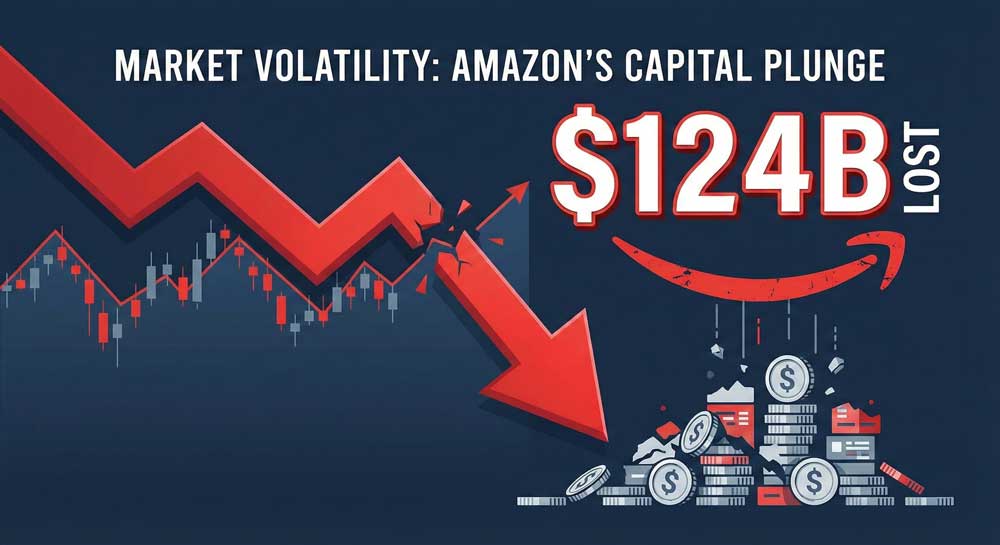
Amazon’s market capitalization plummeted by $124 billion in a single week following fourth-quarter earnings that highlighted escalating infrastructure costs. Across the broader software and services sector, nearly $1 trillion in market value evaporated during early February 2026 as investors questioned whether AI returns would justify these massive capital commitments.
Shareholder tension continues building. Tech giants are channeling virtually all available cash flow into infrastructure expansion rather than traditional shareholder returns through dividends or stock buybacks. This represents a fundamental shift from historical capital allocation strategies, raising sustainability concerns about whether AI monetization can keep pace with spending velocity.
NVIDIA Emerges as Dominant Beneficiary
While cloud providers hemorrhage capital, NVIDIA stands as the undisputed winner of the Big Tech AI spending boom. As the primary supplier of AI-optimized GPUs, NVIDIA’s 2025 revenue is projected to exceed $500 billion—driven entirely by insatiable demand from companies racing to secure computational advantage.
Global Cloud Infrastructure Market (2025):
According to Synergy Research Group data, cloud infrastructure services generated approximately $419 billion in revenue during 2025:
- Amazon AWS: 28% market share (leader)
- Microsoft Azure: 21% market share (aggressive growth)
- Google Cloud: 14% market share (catching up)
- Other providers: 37% market share (fragmented)
Each percentage point of market share requires billions in infrastructure investment, creating a self-reinforcing cycle where competitors must continuously increase Big Tech AI spending to maintain or grow position. NVIDIA supplies the critical hardware enabling this expansion, positioning the company as the “arms dealer” profiting from the AI infrastructure war.
Apple’s Contrarian Partnership Strategy
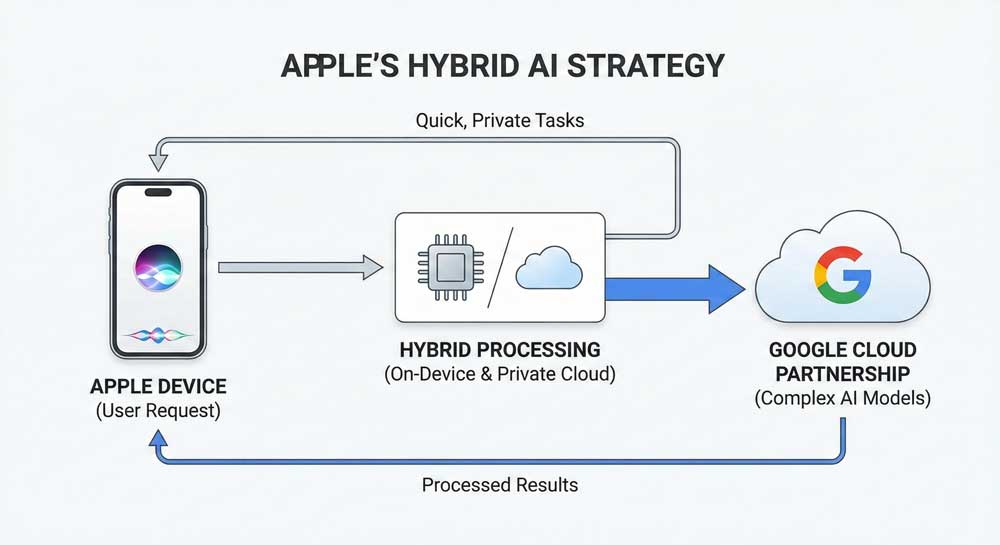
Apple’s approach represents a fundamental strategic departure from industry peers. While competitors pursue vertical integration—controlling everything from chips to models to applications—Apple is implementing a “hybrid model” that outsources computationally intensive AI processing.
Apple’s Two-Tiered AI Architecture:
- On-Device Processing: Leveraging proprietary Apple Silicon for privacy-focused, latency-sensitive tasks
- Cloud Partnership: Licensing Google Gemini (and potentially OpenAI models) for heavy-duty computational workloads
CEO Tim Cook confirmed this partnership strategy during recent earnings calls, emphasizing that Apple Intelligence will seamlessly blend proprietary and third-party capabilities. The financial implications are striking: Apple’s partnership with Google reportedly costs approximately $1 billion annually—less than 1% of what individual competitors spend on infrastructure.
Strategic Trade-offs:
| Approach | Advantages | Risks |
|---|---|---|
| Infrastructure (Amazon, Google, Microsoft, Meta) | Complete control, proprietary capabilities, potential platform dominance | Massive capital requirements, depreciation risk, uncertain ROI timeline |
| Partnership (Apple) | Minimal capital expenditure, preserved margins, flexibility to switch partners | Limited control over foundational technology, dependency on competitors, potential strategic vulnerability |
Apple’s strategy hinges on a critical assumption: that AI value will accrue primarily at the application and user experience layer rather than at the foundational model layer. With over 2 billion active devices globally, Apple controls unprecedented distribution reach—potentially more valuable than owning data centers if consumer AI adoption favors seamless integration over raw computational power.
However, this approach carries significant risk. If AI becomes the “new electricity”—essential infrastructure underlying all digital services—Apple may find itself perpetually dependent on competitors for mission-critical capabilities. The company experienced leadership turnover, internal reorganization, and talent attrition throughout 2025 as it navigated this strategic pivot.
The Sustainability Question Nobody Can Answer
The current Big Tech AI spending trajectory raises fundamental questions about financial sustainability and return on investment timelines. Companies are essentially asking investors to trust that current losses will yield future monopoly positions worth hundreds of billions.
Critical Uncertainties:
- Monetization Gap: AI products currently generate revenue far below infrastructure costs
- Energy Consumption: Data center power requirements strain electrical grids and raise environmental concerns
- Competitive Differentiation: As all players access similar computational resources, sustainable advantages remain unclear
- Technology Plateau Risk: If AI capabilities hit diminishing returns before reaching AGI, infrastructure investments may become stranded assets
Meta’s spending exceeding 50% of revenue represents an extreme position historically associated with capital-intensive industries like manufacturing or utilities—not software companies. If AI fails to deliver proportional value creation, the sector faces potential write-downs rivaling the dot-com bubble collapse.
Conversely, if these investments successfully establish dominant platform positions, companies may achieve winner-take-most economics justifying current valuations. The AWS model demonstrates how early infrastructure leadership can compound into sustained competitive advantage—Amazon’s cloud business now generates higher operating income than its retail operations.
Divergent Paths to AI Dominance
The 2026 landscape reveals two distinct strategic philosophies competing for validation:
The Infrastructure Thesis (Amazon, Google, Microsoft, Meta): Control of foundational computational resources will determine AI era winners. Companies must build massive proprietary infrastructure to train cutting-edge models, ensure supply security, and capture value at the platform layer.
The Experience Thesis (Apple): AI value will concentrate at the application and integration layer where users interact with technology. Controlling billions of endpoints and optimizing user experience matters more than owning data centers, especially when computational resources can be accessed through partnerships.
Both strategies carry profound implications. Infrastructure builders bet that AI represents a fundamental shift analogous to electricity or telecommunications—whoever controls the infrastructure controls the economy. Experience optimizers bet that AI will become commoditized infrastructure, with differentiation happening through design, integration, and ecosystem lock-in.
Apple’s redesigned Siri, expected to launch with enhanced capabilities via the Google partnership, will provide an early test case. If Apple delivers competitive AI experiences without massive infrastructure investment, other consumer technology companies may adopt similar partnership models. If the experience falls short, it may validate the infrastructure-first approach.

The Stakes: Winner-Take-Most or Collective Mirage?
Historical technology platform shifts suggest both scenarios remain possible. The mobile revolution validated Apple’s experience-focused strategy—iOS captured enormous value despite Android’s larger market share. Cloud computing validated Amazon’s infrastructure-first approach—early AWS investment created compounding advantages competitors struggle to overcome.
AI may follow either pattern, or forge entirely new competitive dynamics. What seems certain: the $670 billion Big Tech AI spending surge of 2026 represents an irreversible commitment. Companies cannot easily retreat from these investments without acknowledging strategic failure and triggering massive write-downs.
For investors, consumers, and competitors, the coming 18-24 months will prove decisive. Either AI monetization accelerates to justify current spending levels, or the industry faces a reckoning that could reshape technology sector economics for a generation.
The divergence between infrastructure giants and Apple’s partnership model ensures we’ll see multiple strategies tested simultaneously—providing valuable data about which approach better navigates the AI revolution’s uncertainties.
Related Sources & Further Reading
- Wall Street Journal: Big Tech’s AI Push Is Costing More Than the Moon Landing – Comprehensive GDP comparison analysis of 2026 AI infrastructure spending
- CNBC: Tech AI Spending Approaches $700 Billion, Cash Taking Big Hit – Detailed breakdown of Alphabet, Microsoft, Meta, and Amazon’s combined AI expenditure
- Reuters: Amazon Projects $200 Billion in Capital Spending – Official announcement of Amazon’s historic AWS infrastructure investment
- Campaign Asia: Big Tech’s AI Spend in 2026 – Following the Money – Quarter-by-quarter analysis of the “Big Four” AI capital deployment
- Reuters: Big Tech’s $600 Billion Spending Plans Exacerbate Investors’ AI Concerns – Market reaction and investor sentiment analysis regarding AI infrastructure ROI
- TradingView: Inside Big Tech’s $700B AI Spend – Bullish Leaders, Split Markets – Financial markets perspective on AI capital expenditure sustainability
- CNBC: Nvidia to Invest Up to $100 Billion in OpenAI Data Center Infrastructure – Exclusive coverage of Nvidia-OpenAI partnership and 10 gigawatt data center project
- Morningstar: Amazon Earnings – $200 Billion Capital Expenditure Guidance – Analyst perspectives on Amazon’s AWS expansion strategy and valuation impact
- CommBank: AI Boom, Bubble, or Both? – Economic analysis comparing current AI investment cycle to historical tech bubbles
- Oracle News: OpenAI Selects Oracle Cloud Infrastructure to Extend Microsoft Azure – Multi-cloud partnership strategy between Microsoft, Oracle, and OpenAI
- The $5 Trillion AI Investment Bubble: Can the Boom Outrun Reality?
- STAT News: DeepMind Opens AlphaGenome Source Code
- The Physical Truth Behind the US-China AI Race: Electrons, Not Just Silicon