Alternative Asset ETFs: 5 Shocking Truths Behind the 72% Youth Investment Exodus from Traditional Stocks
The 60/40 portfolio—60% stocks, 40% bonds—has been Wall Street’s golden rule for decades. But in 2026, that formula is crumbling. High inflation is devouring bond yields, and stock market volatility has investors questioning whether “buy and hold” still works.
A bombshell 2024 Bank of America study revealed that 72% of wealthy investors aged 21-43 no longer believe stocks and bonds alone can deliver above-average returns. Instead, they’re pivoting to Alternative Asset ETFs—investment vehicles that package once-exclusive assets like Bitcoin, gold, and private equity into tradeable funds. Global markets launched 1,097 new ETFs in 2025, with alternative strategies capturing $280 billion in assets under management.
This isn’t just a trend—it’s a fundamental restructuring of how modern investors build wealth.
What Makes Alternative Asset ETFs Different from Traditional Investments?
Alternative Asset ETFs wrap non-traditional assets—cryptocurrencies, commodities, private equity, and hedge fund strategies—into exchange-traded structures that trade like stocks. Unlike traditional ETFs tracking the S&P 500 or corporate bonds, these funds provide exposure to assets historically reserved for institutional investors and the ultra-wealthy.
The appeal is straightforward: diversification beyond correlation to stock markets. When equities plunge, gold often rises. When inflation spikes, Bitcoin can outperform. Alternative Asset ETFs allow retail investors to access these diversification benefits without the complexity of direct ownership.
State Street research found that 80% of financial advisors believe ETFs make alternative investments more accessible, while 82% say they provide effective downside protection during volatility. Perhaps most tellingly, 75% of advisors plan to increase alternative ETF allocations over the next 18 months.
5 Reasons Alternative Asset ETFs Are Crushing Traditional Portfolios
1. Shattered Barriers: $100 Buys What Once Required $1 Million
Private equity funds traditionally demanded minimum investments of $250,000 to $1 million, accessible only to accredited investors. Physical gold required purchasing bars or coins with 5-10% dealer markups, plus secure storage costs. Cryptocurrency meant navigating complex wallets and exchange security risks.
Alternative Asset ETFs obliterate these gatekeepers. For the price of a single share—often $50-200—investors gain professionally managed exposure to asset classes once exclusive to family offices and endowments. Connecticut financial advisors report young clients casually requesting “3-5% Bitcoin ETF exposure” in existing brokerage accounts without opening specialized crypto accounts.
2. Fee Wars Slashed Costs by 70%+
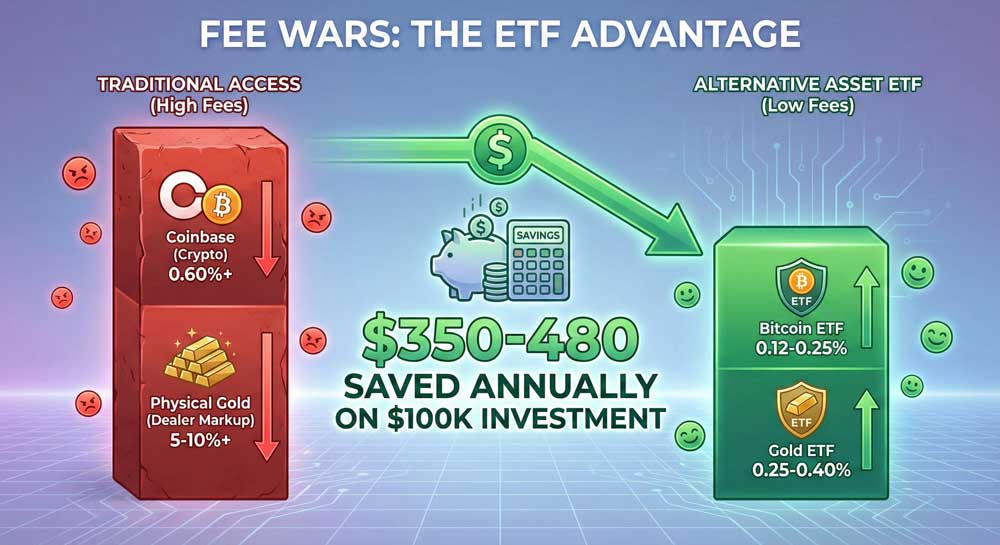
Direct cryptocurrency purchases on exchanges like Coinbase incur transaction fees up to 0.60%. Physical gold dealers charge 5-10% premiums over spot prices. Traditional private equity funds extract 2% annual management fees plus 20% performance fees.
Bitcoin ETFs have engaged in brutal fee competition, with leading funds charging just 0.12-0.25% annually. Australian Bitcoin ETF BTXX charges 0.49% while delivering 95% returns in 2025. Gold ETFs typically cost 0.25-0.40% with zero storage fees.
| Investment Method | Asset | Fee Structure | Cost on $100K |
|---|---|---|---|
| Coinbase Exchange | Bitcoin | 0.60% per trade | $600+ |
| Bitcoin ETF (IBIT) | Bitcoin | 0.12-0.25% annual | $120-250 |
| Physical Gold Dealer | Gold Bullion | 5-10% markup + storage | $5,000-10,000 |
| Gold ETF | Gold Trust | 0.25-0.40% annual | $250-400 |
| Private Equity Fund | PE Investments | 2% + 20% carry | $2,000+ |
On a $100,000 investment, these fee differences compound to tens of thousands of dollars over a decade.
3. Instant Liquidity Eliminates the Lock-Up Nightmare
Private equity investments lock capital for 3-7 years with limited secondary markets. Physical commodities require finding buyers and accepting dealer spreads. Real estate can take months to liquidate during market stress.
Alternative Asset ETFs trade on major exchanges during market hours with bid-ask spreads typically under 0.10%. Investors can enter and exit positions within seconds, accessing cash through standard T+2 settlement—identical to buying Apple stock. This liquidity proved critical during 2025’s volatility when alternative ETF holders could rebalance instantly while private fund investors remained trapped.
4. Explosive Performance Validated the Strategy
Australian Bitcoin ETF BTXX delivered 95.49% returns in 2025, while VBTC returned 76.53%. U.S. Bitcoin ETFs like IBIT and FBTC posted 54%+ one-year returns through mid-2025. Gold surged to record highs above $3,600 per ounce in September 2025, rewarding gold ETF holders with 38% gains.
Even diversified alternative strategy ETFs outperformed during periods when traditional 60/40 portfolios struggled. The combination of non-correlated returns and professional management justified the shift for performance-seeking investors.
5. Generational Wealth Transfer Demands New Tools
Millennials and Gen Z will inherit $84 trillion over the next two decades, and they’re rebuilding portfolios from scratch. Having witnessed the 2008 financial crisis, the 2020 pandemic crash, and persistent inflation, younger investors distrust traditional finance’s “this time is different” promises.
Alternative Asset ETFs align with their values: technological innovation (crypto), inflation hedging (gold), and democratized access (private equity). Rather than accepting standard advice, they’re demanding portfolio tools that address 2026’s economic realities.
The Generational Divide: How Age Shapes Alternative Asset Choices
Young Investors: Bitcoin ETFs as Digital Gold
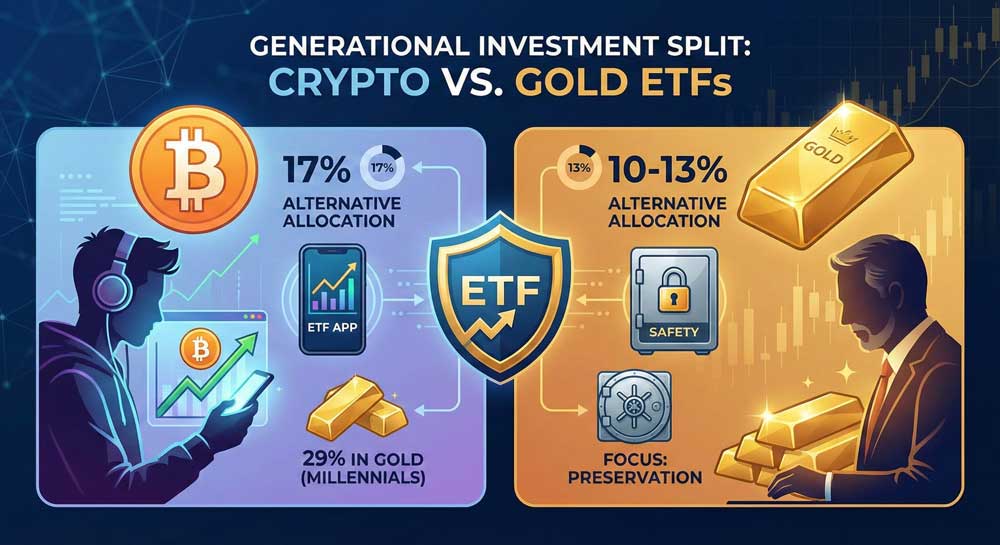
Millennials allocate an average 17% to alternatives, triple the 5% allocation of older generations. Among this cohort, Bitcoin ETFs serve as core holdings—not speculative bets.
The appeal transcends performance. Young investors value the operational simplicity of gaining crypto exposure without managing wallets, private keys, or exchange security. One 28-year-old investor allocated 3% of monthly contributions to Bitcoin ETF, gaining 12% in three months “with zero crypto headaches”.
Bitcoin ETFs legitimize cryptocurrency, transforming it from a “gamble” into a standard portfolio component comparable to international stocks or REITs.
Older Investors: Gold ETFs for Preservation
Gen X and Boomers focus on gold and commodity ETFs, viewing them as portfolio insurance rather than growth engines. Gen X allocates approximately 13% to gold, while Boomers allocate 10%—modest percentages representing substantial capital given their larger asset bases.
Gold’s 2025 performance surge to $3,600+ per ounce validated this defensive positioning. Gold ETFs delivered upside without physical ownership hassles: no storage fees, no insurance costs, no authentication concerns, and instant liquidity. During economic uncertainty, gold’s lack of counterparty risk and 5,000-year track record resonate with risk-aware investors approaching retirement.
3 Critical Risks That Could Destroy Your Alternative ETF Portfolio
Risk #1: The Private Equity Liquidity Trap
Morningstar analysts have issued stark warnings: private equity ETFs are “fundamentally incompatible” with daily trading structures. The core problem is a liquidity mismatch—ETFs promise instant trading, but private equity investments may transact quarterly or annually, if at all.
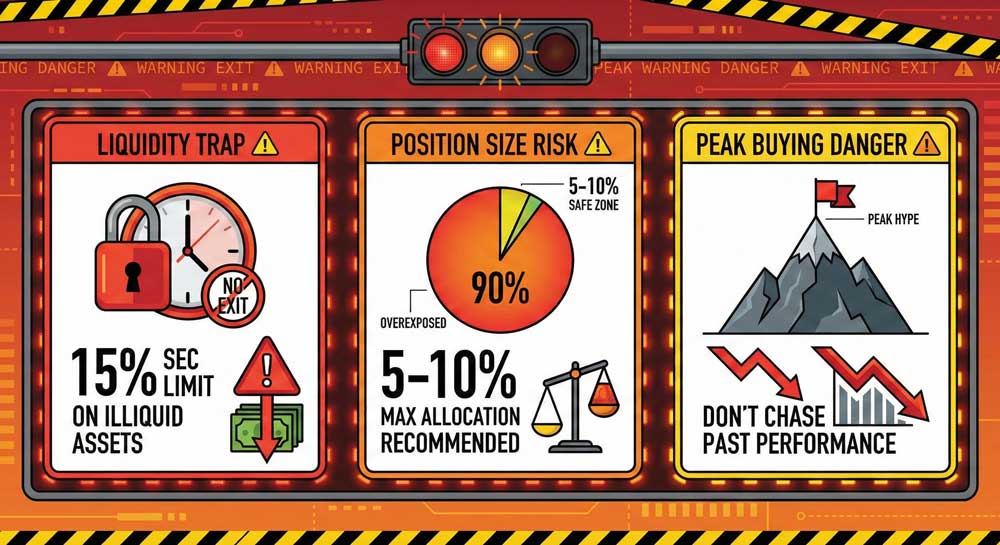
The SEC’s Liquidity Rule prohibits funds from holding more than 15% of assets in illiquid investments. When funds breach this threshold, they must take immediate remedial action. In a 2020 case, the SEC discovered a fund holding 21-24% in illiquid private shares, forcing fire-sale liquidations that harmed investors.
For private equity ETF investors, this creates three dangers: paying premiums for assets with unknowable true values, forced selling during redemption spikes, and subjective valuations that mask actual performance.
Risk #2: Ignoring the 5-10% Allocation Rule
Multiple institutional frameworks converge on critical guidance: alternative asset allocations should not exceed 5-10% for liquid alternatives, or maximum 15-20% when including illiquid alternatives.
Fidelity’s allocation framework suggests 5-10% liquid alternative allocations across investor types, with illiquid alternatives reaching 15% only for investors with medium liquidity needs. Historical analysis found that 10% alternative allocations significantly improved risk-adjusted returns, but 20% allocations created unacceptable drawdowns during market stress.
Why strict limits? Alternative assets exhibit higher volatility than traditional stocks and bonds. Bitcoin regularly experiences 10-20% intraday swings. Overconcentration in volatile alternatives can trigger panic selling during downturns, locking in losses and defeating diversification objectives.
Risk #3: Chasing Performance After Assets Peak
Asset management firms often launch alternative ETFs after underlying assets have already surged, hoping to capture “FOMO” capital from retail investors. Bitcoin ETFs debuted in January 2024 after Bitcoin recovered from 2022 lows. Gold hit $3,600 in September 2025, prompting record ETF inflows—potentially leaving late entrants vulnerable to corrections.
Smart investors distinguish between assets with fundamental long-term tailwinds and those experiencing speculative momentum. Past performance never guarantees future returns, especially when buying at peak valuations.
Building Your Alternative Asset ETF Strategy for 2026
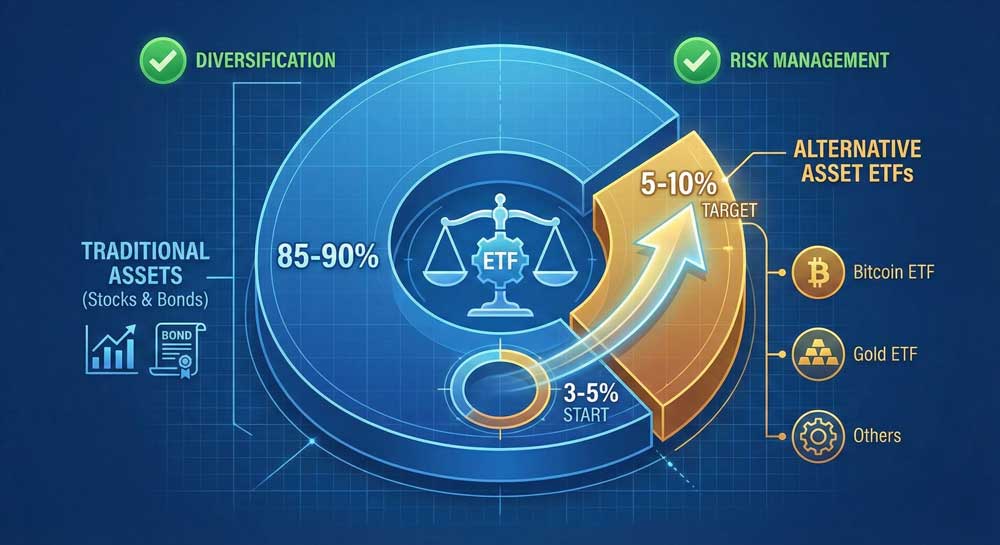
Start Small: The 3-5% Entry Point
For investors new to alternatives, beginning with 3-5% allocation to one or two alternative ETFs provides meaningful exposure without excessive risk. As comfort and market understanding grow, allocations can expand toward the 10% threshold for liquid alternatives.
Bitcoin ETFs suit higher risk tolerance and longer time horizons, accepting 20-40% annual volatility for potential outsized returns. Gold ETFs serve portfolio stabilization, providing negative correlation during market stress. Diversifying across multiple alternative types—crypto, commodities, and potentially liquid real estate—maximizes diversification benefits.
Focus on Fundamentals: Fees, Liquidity, Transparency
Low expense ratios directly improve returns through fee savings. Adequate liquidity—measured by daily trading volume and tight bid-ask spreads—ensures efficient entry and exit. Transparent holdings and clear strategies allow understanding exactly what you own.
Avoid ETFs with complex structures, opaque fees, or holdings in illiquid underlying assets. Prioritize established providers with track records and competitive fees over new entrants making aggressive marketing claims.
Maintain Portfolio Discipline
Alternative Asset ETFs should complement, not replace, traditional holdings. The 72% of young wealthy investors embracing alternatives haven’t abandoned stocks—they’ve rebalanced toward broader diversification.
BlackRock’s 2026 market playbook emphasizes “balance with bonds and alternatives” rather than wholesale portfolio replacement. Systematic rebalancing ensures alternative allocations don’t grow excessively during bull markets, maintaining discipline when selling winners feels uncomfortable.
The Final Verdict on Alternative Asset ETFs
The transformation of alternative assets from exclusive institutional investments to accessible ETFs represents one of financial history’s most significant democratizations. Young investors aren’t abandoning investing principles—they’re applying those principles to a broader asset universe that better addresses 2026’s economic realities.
Alternative Asset ETFs offer genuine benefits: drastically lower fees than traditional access methods, daily liquidity, and true portfolio diversification beyond stocks and bonds. However, they demand respect for their risks, disciplined position sizing at 5-10% of portfolios, and realistic return expectations.
The investors thriving with alternative ETFs aren’t chasing get-rich-quick schemes. They’re systematically building diversified portfolios that can weather inflation, market volatility, and economic uncertainty through fundamentally different return drivers. That approach—combining risk awareness with strategic diversification—remains the foundation of successful long-term investing, regardless of which assets fill the portfolio.
Deep-Dive Resources
- Bank of America Private Bank Study: Generational Investment Preferences – Original 72% statistic on young investors abandoning traditional portfolios
- State Street Alternatives ETF Impact Report 2025-26 – Comprehensive advisor survey on alternative ETF adoption and $280B AUM data
- Bitcoin ETF Performance and Fee Analysis 2025 – Detailed comparison of leading Bitcoin ETFs with fee structures
- InvestSMART 2025 Australian ETF Scorecard – Performance data showing 95% returns for alternative crypto ETFs
- SEC Liquidity Rule Enforcement: First Private Equity Case – Legal analysis of 15% illiquid asset threshold violations
- Fidelity Alternative Investment Implementation Framework – Professional portfolio construction guidelines for 5-10% alternative allocations
- Gen Z Gold Investment Trends 2025 – Millennial and Gen Z precious metals allocation data showing 29% exposure
- Silver’s 50% Crash and 30% Rebound: 5 Critical Insights for 2026 Investors
- AlphaGenome Breakthrough: 5 Ways Google DeepMind’s AI Decodes 98% of DNA “Dark Matter”
- The Great Capital Migration: Why Global Investors Are Fleeing Australian Assets in 2026
- BHP vs. CBA: Australia’s Market Duel and the Global Currency Reset in Motion