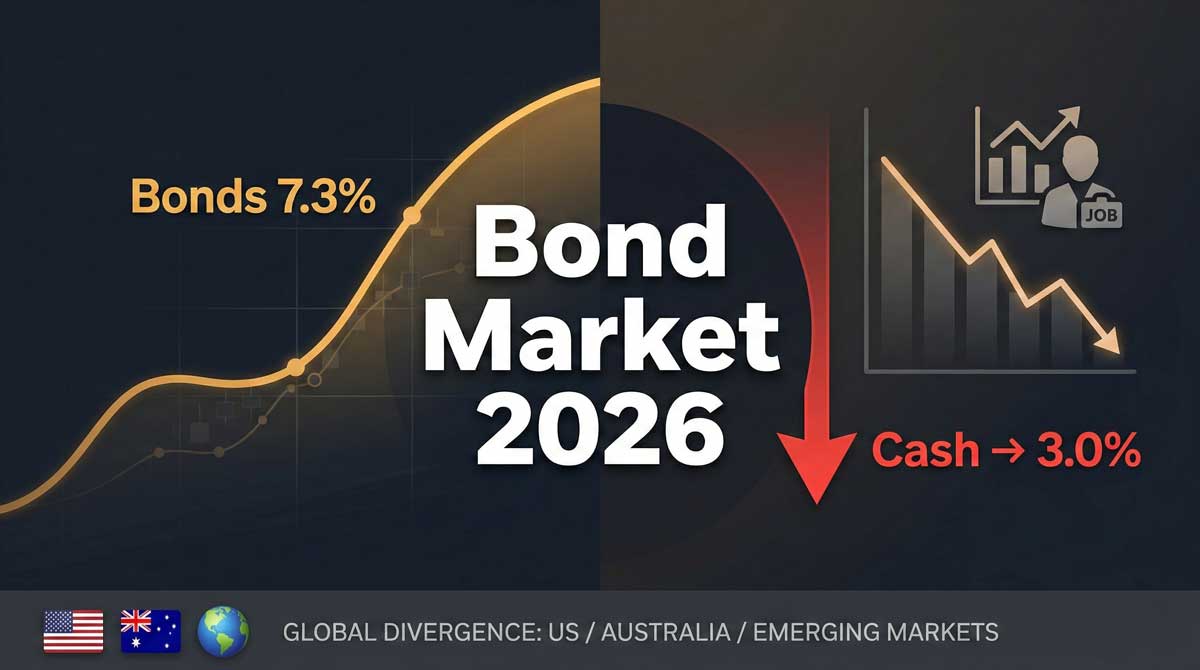
5 Powerful Reasons BlackRock’s Bond Market Strategy Warns of US Labor Market Weakness in 2026
BlackRock bond market strategy has made a decisive pivot — and it’s one every investor should understand. The world’s largest asset manager, overseeing more than $10 trillion in assets, is no longer losing sleep over inflation. Instead, BlackRock’s Global Chief Investment Officer of Fixed Income, Rick Rieder, is sounding the alarm on a quietly deteriorating US labor market that he believes will force the Federal Reserve to cut rates at least twice in 2026.
This isn’t just a macro observation. It’s a concrete investment thesis with clear implications for fixed income, emerging markets, and even Australian bonds. Here’s what’s driving the strategy — and where the opportunities lie.
Table of Contents
1. BlackRock Bond Market Strategy Declares Inflation “Yesterday’s Problem”
For three years, inflation dominated every Fed meeting, every portfolio review, and every financial headline. BlackRock’s current outlook marks a clear turning point.
While core inflation still sits marginally above the Fed’s 2% target, Rieder argues the structural forces behind the 2021–2023 price surge have been neutralized. What remains is residual stickiness — not a renewed threat. The excessive price increases of the post-pandemic era are, in BlackRock’s view, effectively contained.
This dovish stance carries extra weight given Rieder’s profile: he was reportedly on the shortlist for Federal Reserve Chair before President Trump nominated Kevin Warsh last month. His views don’t just reflect BlackRock’s positioning — they reflect how the world’s most influential fixed-income desk reads the policy landscape.
Key Takeaway: Positioning a portfolio around inflation fear in 2026 means fighting the last war. BlackRock’s bond market strategy is already looking at the next one.
2. The US Labor Market Is Weaker Than the Headline Numbers Suggest
A 4.4% unemployment rate looks manageable in isolation — until you trace where it came from and what’s hiding underneath it.
| Indicator | Data Point | Context |
|---|---|---|
| Current US Unemployment Rate | 4.4% | Up from historic low of 3.4% (April 2023) |
| Youth Unemployment (Ages 20–24) | 8.2% | New entrants struggling to find footholds |
| December Job Gains (ex-healthcare) | 29,000 | vs. 603,000/month average in 2021 |
| December Job Gains (ex-healthcare) | 29,000 | vs. 55,000/month average in 2024 |
The most alarming detail: strip out healthcare, and the US labor market added just 29,000 jobs in December. One sector is essentially carrying the entire employment picture on its back.
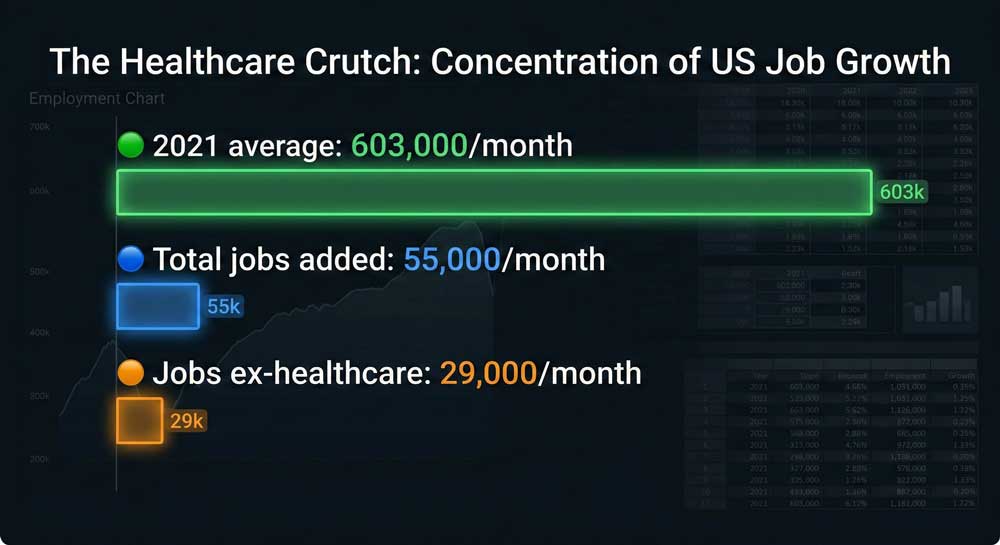
“Healthcare is single-handedly holding up the US labor market,” Rieder stated plainly.
There is also a productivity paradox at play. Post-pandemic productivity has surged well above its pre-pandemic trend — meaning companies are growing output without proportionally hiring. Broad labor participation in economic growth has stalled even as GDP holds up, which is exactly the kind of divergence that historically precedes Fed easing cycles.
3. At Least 2 Fed Rate Cuts Are Coming — And Bonds Are the Beneficiary
BlackRock’s bond market strategy is built on a specific rate call: the equilibrium federal funds rate — the level appropriate for current labor market conditions — sits meaningfully below where rates are today. The market agrees, pricing in at least two cuts through 2026.
This creates a compelling window for fixed-income investors, particularly at the short-to-intermediate end of the yield curve:
- Short-duration bonds offer higher immediate income plus price appreciation as rates fall
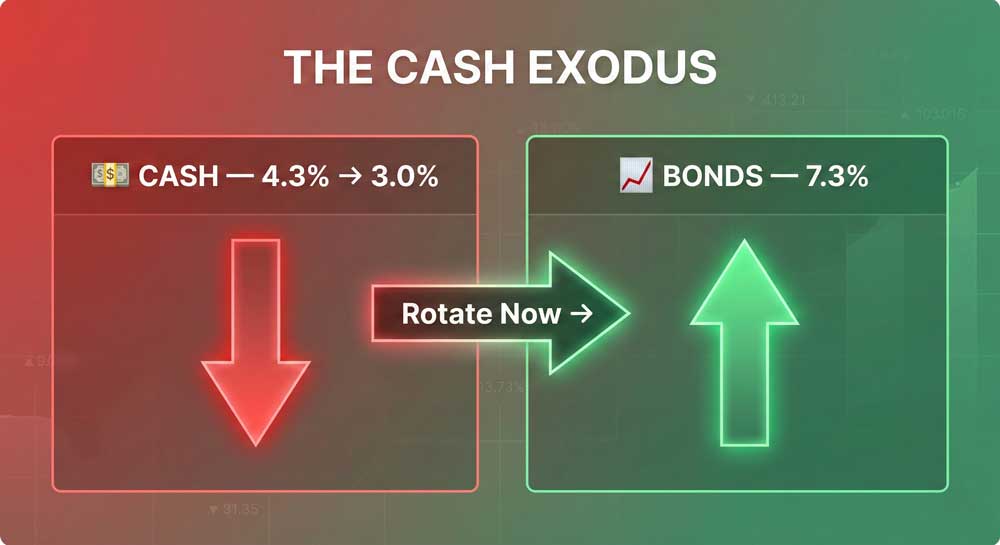
- Cash yields are projected to drop from ~4.3% toward 3% as cuts materialize
- The rotation from cash to bonds is already generating returns for early movers
| Asset Class | Recent Benchmark Return | 2026 Outlook |
|---|---|---|
| Cash Reserves | 4.3% | Declining toward ~3.0% |
| Fixed Income (Bonds) | 7.3% | Outperforming; capital appreciation expected |
| Investment-Grade Credit (US/EU) | Top third of long-term yield range | Historically strong entry point |
2025 marked the first year since 2020 that fixed income meaningfully outperformed cash. BlackRock expects this gap to widen — but warns the window won’t stay open indefinitely.
4. Australia Is the Hawkish Outlier — And That Creates Opportunity
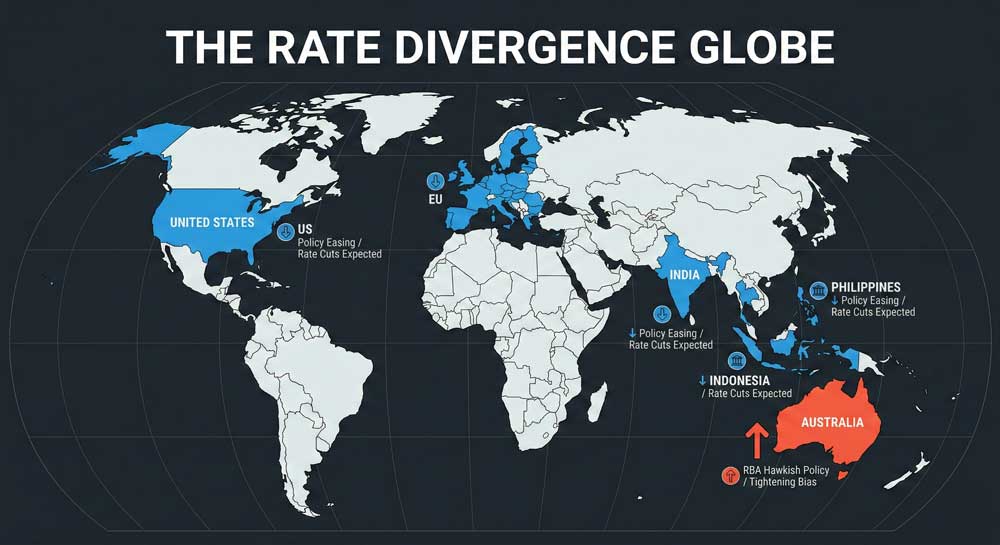
While the US, Europe, and most of Asia are easing, Australia is moving in the opposite direction. BlackRock explicitly flags this divergence as one of the defining features of the 2026 fixed-income landscape.
Persistent wage growth and resilient consumer spending have kept Australian core inflation elevated, giving the Reserve Bank of Australia (RBA) credible grounds to hold — or even raise — rates while peers cut.
| Region | Central Bank Direction | Primary Driver |
|---|---|---|
| United States | Cutting (2 cuts expected) | Weakening labor market |
| Philippines, India, Indonesia, Thailand | Cutting | Benign inflation environment |
| European Union | Cutting | Slowing growth |
| Australia | Hawkish / Potential Hikes | Persistent wage-driven inflation |
This policy divergence creates unique valuation and yield differentials between Australian bonds and regional peers — and genuine two-sided rate risk for global investors. Duration that hedges risk in one market can generate losses in another. BlackRock’s bond market strategy accounts for this explicitly: “Interest rates can hedge risk or inflict harm.”
5. The Best Opportunities Are Outside the Benchmark Index
Traditional aggregate bond indexes are heavily weighted toward government debt — and in a world of steepening yield curves, fiscal pressure, and policy divergence, that concentration can hurt risk-adjusted returns.
BlackRock’s bond market strategy identifies three under-allocated areas where the real opportunity sits:
- Asset-Backed Securities (ABS): Attractive spread compensation, systematically underrepresented in benchmarks
- Global Investment-Grade Corporate Debt: US and European spreads still in the top third of long-term historical ranges — a historically favorable entry point
- Emerging Market (EM) Debt: After years of improving fundamentals, stronger debt-servicing capacity, and consecutive years of net credit-rating upgrades, EM bonds are regaining serious institutional attention
The firm’s message is unambiguous: “The path forward lies not in broad beta exposure, but in precisely identifying opportunities where fundamentals, valuations, and liquidity converge.”
This is an environment that rewards precision over passivity — active security selection over index-hugging.
Act Before the Window Closes
BlackRock’s bond market strategy carries an implicit urgency: the income opportunity is real, but it’s time-limited. As rate cuts materialize in late 2026, yields will compress and today’s attractive entry points will narrow. For investors still holding excess cash from the high-rate era, the rotation calculus is becoming impossible to ignore.
The US labor market has become the Fed’s dominant concern. When the world’s largest asset manager says inflation is yesterday’s problem — and backs it with a $10 trillion balance sheet — it’s worth listening.
Further Reading
- BLS Employment Situation Summary – January 2026
- Federal Reserve – Monetary Policy Principles and Practice
- BlackRock Investment Institute – Fixed Income Outlook
- World Bank – Global Economic Prospects: Emerging Markets
- RBA – Statement on Monetary Policy, February 2026
- IMF – World Economic Outlook Update, January 2026
- Reuters – Kevin Warsh nominated as Federal Reserve Chair
- Alternative Asset ETFs: 5 Shocking Truths Behind the 72% Youth Investment Exodus from Traditional Stocks
- Trump Tariffs European Inflation: 5 Shocking Ways US Trade Barriers Are Crushing Eurozone Prices
- The Financial System Explained: 5 Stages from Basic Lending to Global Markets
- BHP vs. CBA: Australia’s Market Duel and the Global Currency Reset in Motion