Chinese AI Models: 7 Powerful Ways They’re Dominating the Global Developer Market in 2026
In the summer of 1858, a copper cable was laid across the floor of the Atlantic Ocean, connecting London and New York. Its true significance was never about transmission speed — it was about power. Whoever laid the cable controlled the flow of information, and therefore extracted value from it. The British Empire used this global telegraph network to hold colonial intelligence, commodity prices, and war dispatches in its hands.
Infrastructure was power then. It still is today.
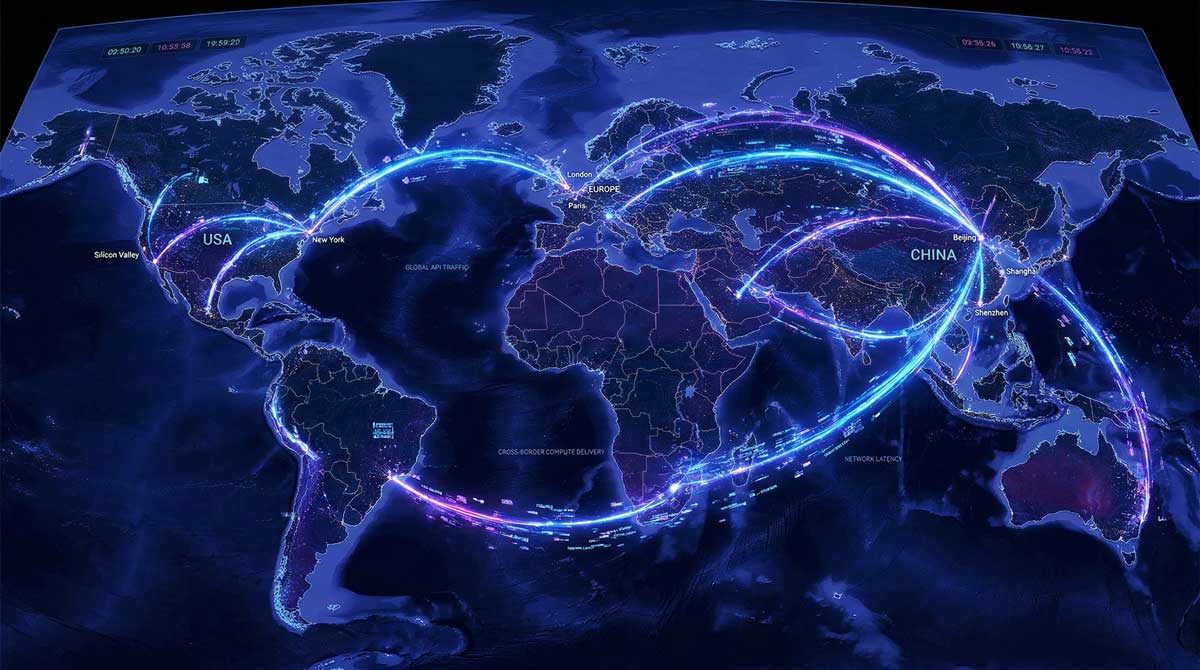
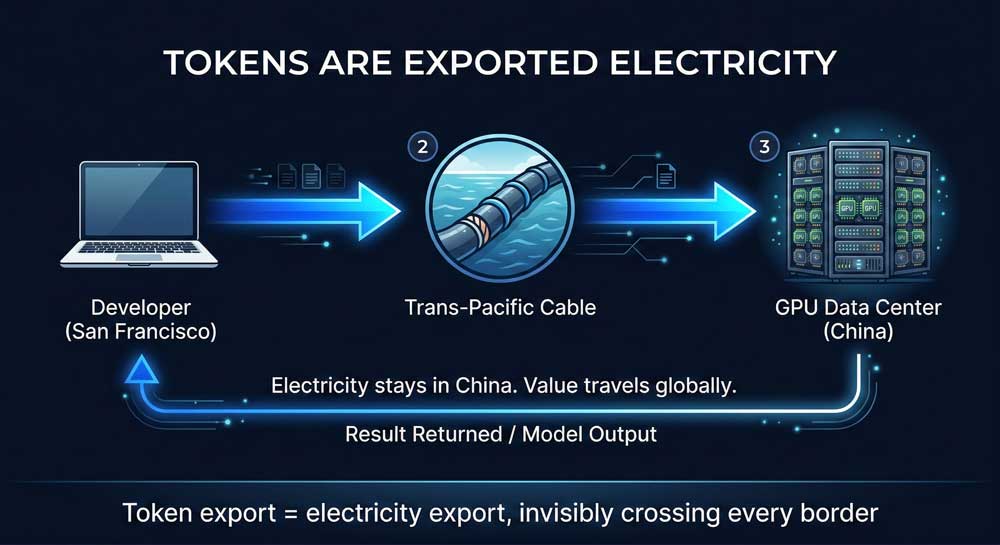
Over 160 years later, Chinese AI models are quietly rewriting the rules of global digital infrastructure. When developers in San Francisco, Berlin, or Singapore send an API request, those prompts travel through trans-Pacific submarine cables to data centers in China. The computation happens there. The electricity flows there. The result is returned in under two seconds.
The electricity never leaves the Chinese grid — but its value, delivered as AI tokens, has already crossed every border.
Table of Contents
1. Chinese AI Models Now Own 61% of Global Token Consumption
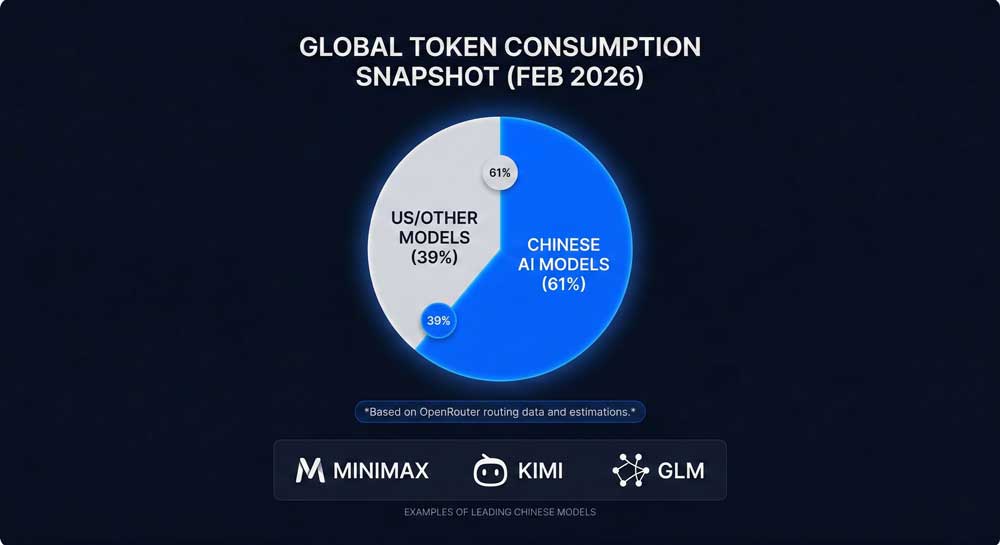
The numbers are stark. By the week ending February 24, 2026, OpenRouter — the world’s largest AI model aggregation platform — reported that Chinese AI models claimed 61% of all token consumption across the platform’s top 10 models. The top three models by usage were entirely from China.
Total token volume in that single week reached approximately 13.95 trillion tokens, up more than tenfold from the same period a year prior.
OpenRouter Top AI Models by Token Volume — February 2026
| Rank | Model | Company | Est. Token Share | Input Price (per 1M tokens) |
|---|---|---|---|---|
| 🥇 1 | MiniMax M2.5 | MiniMax (Shanghai) | ~28% | $0.30 |
| 🥈 2 | Kimi K2.5 | Moonshot AI | ~18% | $0.30 |
| 🥉 3 | Zhipu GLM-5 | Zhipu AI | ~15% | $0.30 |
| 4 | Claude Opus 4.6 | Anthropic (USA) | ~12% | $5.00 |
| 5 | GPT-4o | OpenAI (USA) | ~8% | $2.50 |
Source: OpenRouter, AIBase, SCMP — February 2026
OpenRouter’s COO Chris Clark confirmed the pattern directly: Chinese open-source models are capturing this share specifically because developers are deploying them inside production agentic workflows — not just experimental chat interfaces.
2. The OpenClaw Explosion Triggered the Migration
This dominance wasn’t accidental. A single open-source tool lit the fuse.
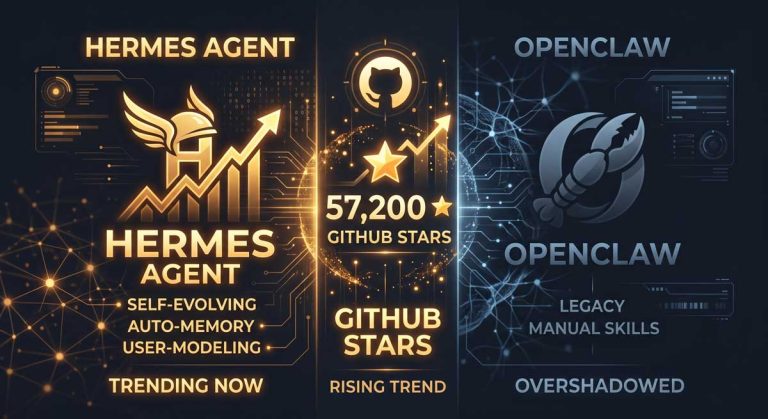
OpenClaw — an AI agent framework that lets AI autonomously control computers, execute commands, and run parallel complex workflows — exploded onto GitHub in early 2026, accumulating over 219,000 stars within weeks. It transformed AI from a conversational tool into a working agent that could monitor markets, write and execute code, file reports, and manage multi-step tasks entirely on its own.
The problem: agentic workflows don’t consume tokens linearly. A developer running OpenClaw for financial market monitoring reported burning through several hundred dollars in a single session — a bill that would have been negligible in a standard chat interface. Each background subtask calls its own context window, iterates repeatedly, and compounds the token burn exponentially.
Developers quickly discovered a workaround: route OpenClaw through flat-fee Claude Pro or Google AI Ultra subscription accounts via OAuth tokens, turning a $20–$200/month subscription into unlimited agentic compute.
The crackdown arrived swiftly:
- Anthropic updated its Consumer Terms of Service on February 19, 2026, explicitly banning OAuth subscription credentials from use in OpenClaw and similar third-party tools
- Google mass-suspended AI Ultra accounts found connecting Gemini to OpenClaw via OAuth — in some cases locking users out of Gmail and Workspace entirely
With the free ride over, developers faced a binary choice: pay Western API rates, or switch. For many, the decision was immediate.
3. The Economics Are Simply Impossible to Ignore
The performance gap between top Chinese and Western AI models in real-world software engineering tasks has effectively closed. MiniMax M2.5 scores 80.2% on SWE-bench (a standard software engineering benchmark) versus Claude Opus 4.6 at 80.8% — a gap smaller than the noise floor of most production use cases.
Yet the pricing gulf is enormous:
Performance vs. Price: Chinese AI Models vs. Western Flagships
| Model | SWE-Bench Score | Input (per 1M tokens) | Output (per 1M tokens) | Price Multiple |
|---|---|---|---|---|
| MiniMax M2.5 | 80.2% | $0.30 | $1.10 | 1× (baseline) |
| Kimi K2.5 | ~79% | $0.30 | $0.90 | 1× |
| Claude Opus 4.6 | 80.8% | $5.00 | $25.00 | ~17× more expensive |
| GPT-4o | ~79% | $2.50 | $10.00 | ~8× more expensive |
Source: OpenRouter, Intuition Labs — February 2026
For an agentic workflow burning 50 billion tokens per month — a realistic figure for a mid-sized developer team using OpenClaw — the monthly bill difference between Claude and MiniMax M2.5 exceeds $230,000. The migration calculus is not philosophical. It is financial.
4. Tokens Are Exported Electricity — And China Has a Physical Advantage
To truly understand what Chinese AI models are exporting, you need to decompose what a token actually costs to produce. Behind every lightweight digital token — approximately 0.75 English words — lies an entirely physical reality.
AI Token Cost Structure
| Cost Component | What It Represents | Physical Location |
|---|---|---|
| GPU amortization | Depreciation of H100/H800 hardware over inference cycles | Chinese data centers |
| Electricity | ~700W per GPU under full load + cooling overhead | Chinese power grid |
| Networking | Trans-Pacific submarine cable bandwidth | International infrastructure |
| Engineering & R&D | Model training, optimization, maintenance | China (+ open-source globally) |
China’s average commercial electricity rate runs approximately 40% lower than the US average. This is not a software optimization — it is a physical infrastructure advantage that no algorithm can fully eliminate. A data center processing trillion-token workloads in China saves tens of millions of dollars annually on electricity alone versus an equivalent US facility.
Because tokens have no physical form, they bypass customs, attract no tariffs, and appear in no conventional goods trade statistics. China is exporting algorithmic computation and electricity — invisibly — at a scale that existing trade frameworks were not designed to measure.
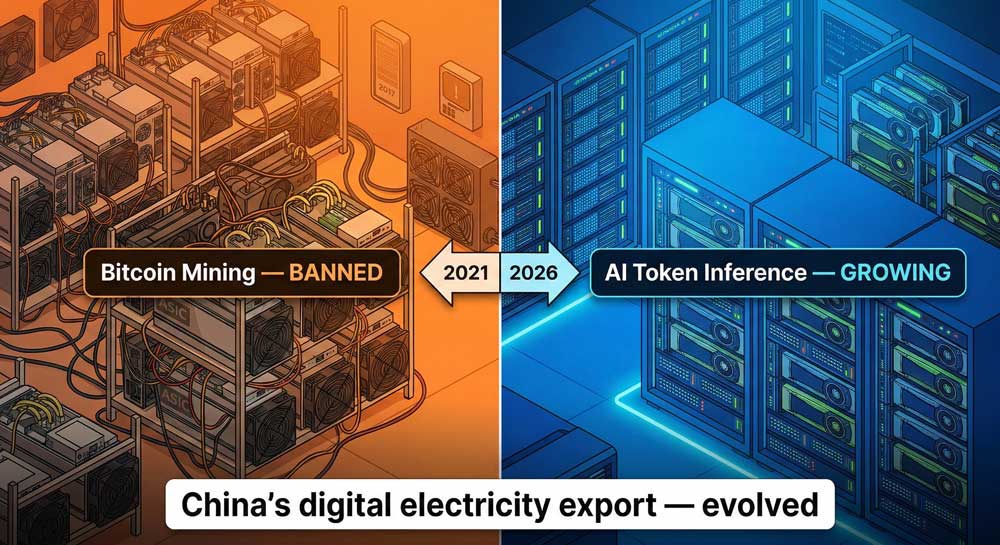
5. Bitcoin Mining to AI Tokens: China’s Digital Electricity Export Has Happened Before
This is not the first time China has exported electricity through a digital medium. The historical parallel is precise and instructive.
Around 2015, massive server farms in Sichuan, Yunnan, and Xinjiang began converting cheap hydroelectric and coal power into Bitcoin through proof-of-work hashing. At peak, China hosted over 70% of global Bitcoin mining hashrate. Electricity — without crossing any border — was converted into dollar-denominated value and exported to global markets through blockchain networks.
In 2021, Beijing banned crypto mining. The hashrate migrated to Kazakhstan, Texas, and Canada. The logic, however, survived.
The Evolution of China’s Digital Electricity Export
| Dimension | Bitcoin Mining (2015–2021) | AI Token Inference (2026–) |
|---|---|---|
| Physical input | Cheap electricity | Cheap electricity + GPU compute |
| Digital output | Bitcoin (financial asset) | AI tokens (cognitive service) |
| Value source | Artificial scarcity | Direct developer utility |
| Export mechanism | Blockchain peer-to-peer network | API over internet |
| Regulatory status in China | Banned (2021) | Actively encouraged |
| Developer lock-in potential | None | High — workflow dependency |
| Appearance in trade data | Invisible | Invisible |
The critical asymmetry: Bitcoin mining was driven out of China by regulators. Token export is being actively promoted. And the product has far deeper economic hooks.
6. The MoE Architecture Breakthrough Behind the Price Wall
The pricing advantage of Chinese AI models is not purely about cheap electricity or subsidized competition. There is genuine technical innovation at work.
DeepSeek-V3 — one of China’s most influential open-source models — uses a highly optimized Mixture-of-Experts (MoE) architecture. Despite carrying 671 billion total parameters, it activates only approximately 37 billion parameters per inference request. The result: GPU time per token drops dramatically.
The training efficiency is equally striking. The full training run for DeepSeek-V3 required only 2.788 million H800 GPU hours, at an estimated total cost of roughly $5.5 million — a fraction of what comparable Western frontier models consume.
MiniMax M2.5 follows the same design philosophy: 229 billion total parameters, only 10 billion activated per request.
Layer over this the nèijuǎn factor — the extreme competitive intensity of China’s domestic AI market. Alibaba, ByteDance, Baidu, Tencent, Moonshot, Zhipu, MiniMax, and over a dozen other companies are competing on the same benchmarks simultaneously, with pricing long since below any rational profit margin. What looks irrational from a Western VC perspective is a calculated race to capture global developer dependency.
7. The New Geopolitical Space Race — And Its Friction Points
The rise of Chinese AI models as global developer infrastructure is not frictionless. Three structural barriers constrain it:
Data Sovereignty is the most immediate wall. When a developer’s API request is physically processed in China, sensitive prompts — proprietary source code, financial data, legal documents — travel through Chinese infrastructure. For individual developers and consumer apps, this is often an acceptable tradeoff. For regulated enterprises in finance, healthcare, or government, it is a hard compliance barrier. Chinese model penetration in enterprise core systems remains minimal for exactly this reason.
US Export Controls represent a hardware ceiling. Restrictions on Nvidia H100 and H800 exports to China constrain the frontier compute buildout. MoE architectures and training efficiency innovations help significantly, but cannot fully offset hardware limitations at the absolute frontier.
Legislative Pressure is mounting. US lawmakers have proposed bills restricting federal use of Chinese AI models. Italy blocked DeepSeek in early 2025. Enforcement against globally distributed open-source models is legally complex, but political pressure continues to build.
Yet despite these barriers, the strategic trajectory is clear. The 1957 Sputnik launch sent shockwaves through Washington, triggering the Apollo program and billions in emergency investment. AI’s strategic stakes are arguably higher: unlike outer space, AI runs through the economic capillaries of daily life. Every line of production code, every automated pipeline, every business intelligence system could be running on a particular nation’s model. Whoever becomes the default API layer for global developers acquires structural influence over the digital economy — not through coercion, but through dependency.
When a developer’s entire codebase, agent orchestration layer, and institutional workflow knowledge are built around a specific model’s API and output format, migration costs grow compoundingly. The parallel to GitHub is apt: no serious software team today operates independently of it, regardless of political sentiment.
Today’s token export may be only the opening move.
The Bottom Line for Developers Today
For anyone building with AI in 2026, the practical implications are immediate:
- Cost-sensitive agentic workloads — coding pipelines, automated agents, multi-step orchestration — have a compelling economic case for Chinese model integration
- Regulated or enterprise workloads require careful data residency evaluation before any adoption of Chinese AI models
- Performance parity is real for most software engineering tasks; the price-to-performance ratio of Chinese models is currently unmatched
- Pricing pressure on Western providers will continue — OpenAI has already cut flagship model prices by approximately 80% since 2024 in response to Chinese competition
The new submarine cables are not being laid with copper. They are being laid with APIs, open-source weights, and $0.30-per-million-token pricing.
Deep-Dive Sources
- Chinese AI Models Hit 61% Market Share on OpenRouter — Dataconomy, Feb 2026: https://dataconomy.com/2026/02/25/chinese-ai-models-hit-61-market-share-on-openrouter/
- China’s AI Token Volume Overtakes the US — 36Kr English, Feb 2026: https://eu.36kr.com/en/p/3700980530851712
- MiniMax and Moonshot Top AI Token Rankings — South China Morning Post: https://www.scmp.com/tech/tech-trends/article/3344587/chinas-minimax-moonshot-top-ai-token-use-ranking-ending-year-us-dominance
- What’s Next for Chinese Open-Source AI — MIT Technology Review: https://www.technologyreview.com/2026/02/12/1132811/whats-next-for-chinese-open-source-ai/
- DeepSeek’s Low Inference Cost — MoE Architecture Explained — Intuition Labs: https://intuitionlabs.ai/articles/deepseek-inference-cost-explained
- DeepSeek-V3 Technical Report — arXiv (peer-reviewed): https://arxiv.org/abs/2412.19437
- DeepSeek: A Game Changer in AI Efficiency — Bain & Company: https://www.bain.com/insights/deepseek-a-game-changer-in-ai-efficiency/
- Anthropic Banned Third-Party OAuth Tools — What It Means — OpenClaw Blog: https://openclaw.rocks/blog/anthropic-oauth-ban
- LLM API Pricing Comparison 2025–2026 — Intuition Labs: https://intuitionlabs.ai/articles/llm-api-pricing-comparison-2025
- Enterprise AI Sovereignty and Data Residency — Katonic AI: https://www.katonic.ai/blog/china-ai-sovereignty
- Must Read: The 2028 Global Intelligence Crisis and the “Ghost GDP”
- 5 Critical Reasons Why OpenAI’s $750B IPO Could Reshape AI Economics by 2027
- Labor Devaluation Exposed: 5 Shocking Reasons Why It’s More Dangerous Than Unemployment in 2026