5 Shocking Truths: How Chinese FDI in India Is Being Used to Kill Chinese Imports
The landscape of Chinese FDI in India just experienced one of its most calculated shifts in years. On March 10, 2026, the Modi government announced a significant — but highly conditional — easing of foreign investment restrictions for countries sharing a land border with India. On the surface, it looks like an olive branch extended toward Beijing. Dig deeper, and a far more provocative strategy emerges: New Delhi wants to use Chinese money and engineering expertise to systematically eliminate its dependence on Chinese imported goods.
India’s Economic Times captured this bluntly: “India will stem the flood of Chinese imports with China’s own money.” This “have your cake and eat it too” approach is a fascinating — and risky — case study in geopolitical economics. Will it actually work? Let’s break it down.
Table of Contents
Truth #1: The New Chinese FDI Rules Are a Precision Filter, Not an Open Door
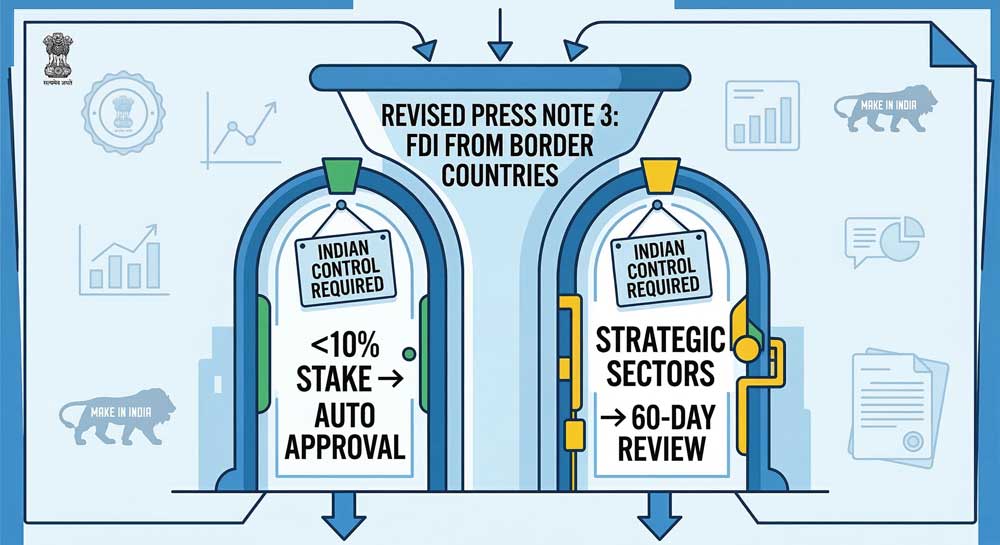
India’s amendment to the notorious Press Note 3 of 2020 — officially issued as Press Note 2 (2026 series) by DPIIT on March 15, 2026 — is less of a welcome mat and more of a heavily guarded checkpoint. The policy hinges on exactly two core conditions:
- The 10% Automatic Route: Non-controlling stakes where the Chinese beneficial ownership is under 10% can now bypass mandatory government review and proceed via the automatic approval route, subject to sectoral caps
- The 60-Day Fast-Track with a Catch: Investments in priority sectors — electronic components, polysilicon, ingot wafers, capital goods, and solar manufacturing inputs — are now processed within 60 days, but only if the receiving Indian entity remains majority-controlled by Indian residents
In plain terms: Chinese firms are invited to provide capital, supply technology, and have their engineers train local workers. However, they must surrender all decision-making authority at the border.
Press Note 3 Policy Shift at a Glance
Truth #2: Indian Manufacturing Can’t Survive Without Chinese FDI in India
If India genuinely wanted to protect its domestic market, why relax the rules at all? The candid answer: India’s manufacturing sector buckled under the weight of its own restrictions.
When Press Note 3 was introduced in 2020, the impact on Chinese FDI in India was immediate and severe:
| Financial Year | Chinese FDI into India |
|---|---|
| 2018 | USD 242 million |
| 2019–2020 | USD 163.8 million |
| 2021 | USD ~11 million |
| 2024–2025 | USD 2.7 million |
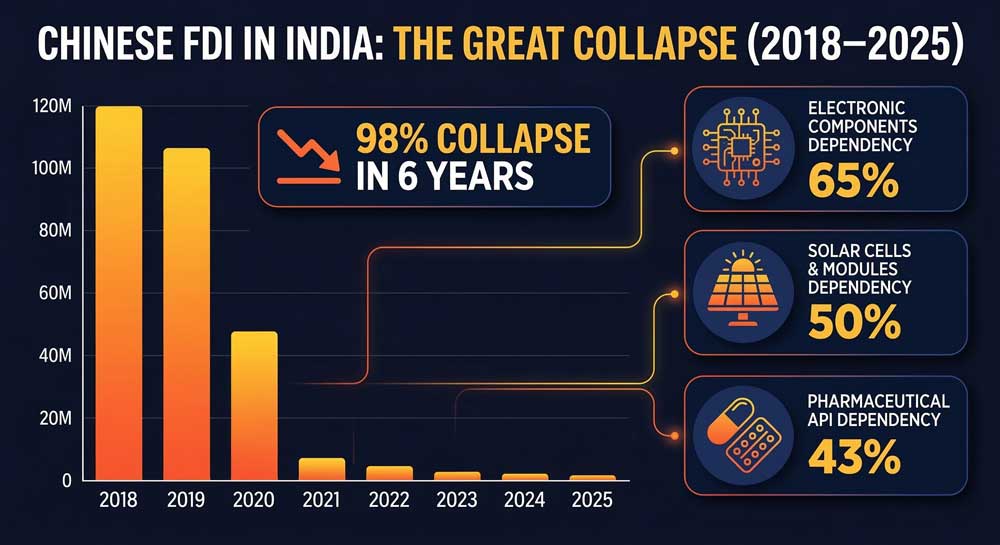
Chinese investment collapsed by over 98%. Yet India’s manufacturing sector didn’t rise to fill the gap — it simply became more dependent on Chinese exports instead. Consider these supply chain vulnerabilities cited by Indian industry bodies:
- Electronics: Nearly two-thirds of imported circuit boards and electronic components come from China
- Renewable Energy: Around 50% of India’s solar cells and modules are Chinese-made
- Pharmaceuticals: Roughly 43% of Active Pharmaceutical Ingredients (APIs) for India’s world-renowned generic drug sector are sourced from China
Without Chinese FDI in India to localize production, assembly plants face critical bottlenecks. Indian factory lines stall, workers go idle, and global orders migrate to competitors like Vietnam or Mexico. Domestic industry leaders lobbied New Delhi intensively, warning that without foreign capital and technology partnerships, India’s high-tech manufacturing ambitions were simply a pipe dream.
Truth #3: India’s Real Goal Is to Localize the Supply Chain It Cannot Escape
The Modi government’s deeper strategic logic, as Indian media openly acknowledged, is straightforward:
“Rather than letting China’s supply chains operate entirely outside India’s control, bring Chinese capital inside — so the supply chain sits within Indian territory.”
By attracting Chinese manufacturers to build on Indian soil, New Delhi hopes to accomplish three things simultaneously:
- Build domestic component production capacity in electronics and solar
- Progressively substitute Chinese imports with India-manufactured equivalents
- Create employment and absorb technology — while retaining full ownership control
South Asia advisor Arpit Chaturvedi at Teneo noted an additional benefit: allowing limited Chinese involvement could make India more attractive to multinationals pursuing “China-plus-one” diversification strategies, since they could still access Chinese resources while final assembly happens in India.
It’s an ambitious playbook. But it carries a critical flaw — it assumes Chinese companies will accept India’s terms.
Truth #4: Chinese Capital Has a “Blood and Tears” History in India
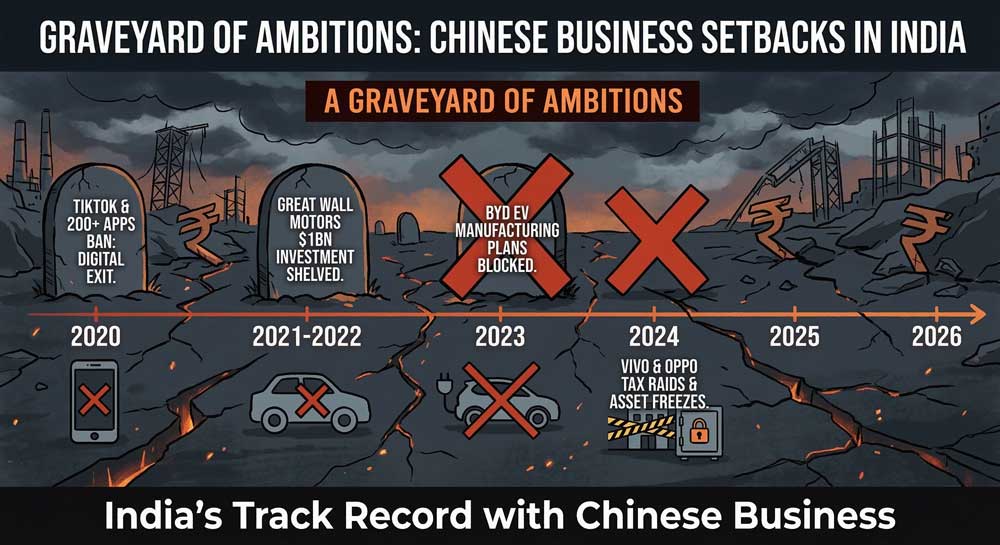
India has historically been viewed by foreign investors as a high-risk environment prone to arbitrary enforcement, regulatory harassment, and sudden policy reversals. For Chinese companies specifically, the past six years in India have been described as a “blood and tears” experience:
High-Profile Setbacks for Chinese Companies in India
| Company / Sector | The Incident | Outcome |
|---|---|---|
| TikTok & 200+ Chinese Apps | Blanket national security ban in 2020 | Total forced market exit; no compensation |
| Great Wall Motors | Planned USD 1B acquisition of GM plant in Maharashtra | Abandoned after years stuck in PN3 approval limbo |
| BYD (Electric Vehicles) | Proposed USD 1B EV and battery joint venture | Effectively blocked by regulatory obstacles |
| Vivo & OPPO | Subjected to aggressive tax evasion probes and asset freezes | Forced to restructure operations and cede ground to local partners |
Chinese enterprises are not afraid of fair market competition — they expand overseas for profit, not to run industrial charity programs. If a policy explicitly caps equity at under 10%, strips voting rights, restricts technology licensing, and openly states its goal is to replace Chinese exports with locally made substitutes, the incentive to invest is severely undermined.
Analysts note the foundational stability required for normalized bilateral economic relations remains fragile. Many Chinese firms are still sitting on the fence: why risk heavy asset investment in a volatile regulatory climate when you can simply export high-margin finished goods to a market that must buy them?
Truth #5: “Using Chinese Money to Kill Chinese Goods” May Be One-Sided Wishful Thinking
The Modi government’s revised policy is strategically clever — but cleverness isn’t enough. Sustainable Chinese FDI in India requires three things India has historically struggled to deliver: policy consistency, contract sanctity, and genuine profit opportunity.
For any Chinese firm considering re-entry, the rational playbook is extreme caution:
- Asset-light structures only — no heavy fixed investments until trust is demonstrated over multiple business cycles
- Watertight IP protections in JV agreements before any technology transfer
- Staged capital deployment — test small before scaling
- Clear exit provisions — because policies that tightened once can tighten again
Ultimately, the principle of win-win cooperation is the engine of global commerce. India’s attempt to weaponize foreign investment — embracing the capital while placing the investor in a chokehold — fundamentally misunderstands how foreign direct investment decisions are made. A company invests where it can grow and earn; it does not invest where the host government’s stated objective is to make the investor’s home-country export division obsolete.
Until New Delhi shifts from geopolitical zero-sum thinking to genuinely mutual economic partnerships — with stable rules, transparent enforcement, and real upside for foreign capital — its grand manufacturing ambitions risk remaining exactly what India’s own media suspects: a one-sided wish.
Authoritative Sources for Further Reading
- Economic Times: India will stem the flood of Chinese imports with China’s own money
- Business Standard: DPIIT amends Press Note 3 to ease FDI norms for border countries
- Times of India: Govt relaxes FDI investment rules from China and other neighbouring countries
- Reuters: India approves limited easing of Chinese investment curbs
- CNBC: India-China reset? Relaxed rules allow Beijing to invest in manufacturing
- India Briefing: India Relaxes FDI Rules for Neighboring Countries
- Technopolitik / Substack: Unpacking Press Note 3 Amendments
- The Wire: Opposition Hits Out at Modi Govt’s Reversal of Press Note 3
- 7 Harsh Realities of AI Job Displacement: Why 4,000+ Tech Layoffs Are Just the Beginning
- Google Gemini Comeback: 1,000 Days of Incredible Triumph in the AI War
- Trump Tariffs European Inflation: 5 Shocking Ways US Trade Barriers Are Crushing Eurozone Prices
- Labor Devaluation Exposed: 5 Shocking Reasons Why It’s More Dangerous Than Unemployment in 2026