Strait of Hormuz Control: 7 Shocking Reasons Iran Lost Its Ultimate Strategic Card
Strait of Hormuz control is the ultimate prize in global maritime security — and in March 2026, Iran surrendered it without a single concession in return. When Iran’s Permanent Mission to the United Nations announced that vessels from “non-belligerent nations” could safely transit the waterway, what sounded like a measured caveat was, in substance, an unconditional retreat. The strategic card Iran had brandished for four decades had been played, misplayed, and lost — all within three weeks.
This is the story of how that happened, why it matters for global energy markets, and who holds Strait of Hormuz control now.
Table of Contents
What Makes This Strait Irreplaceable
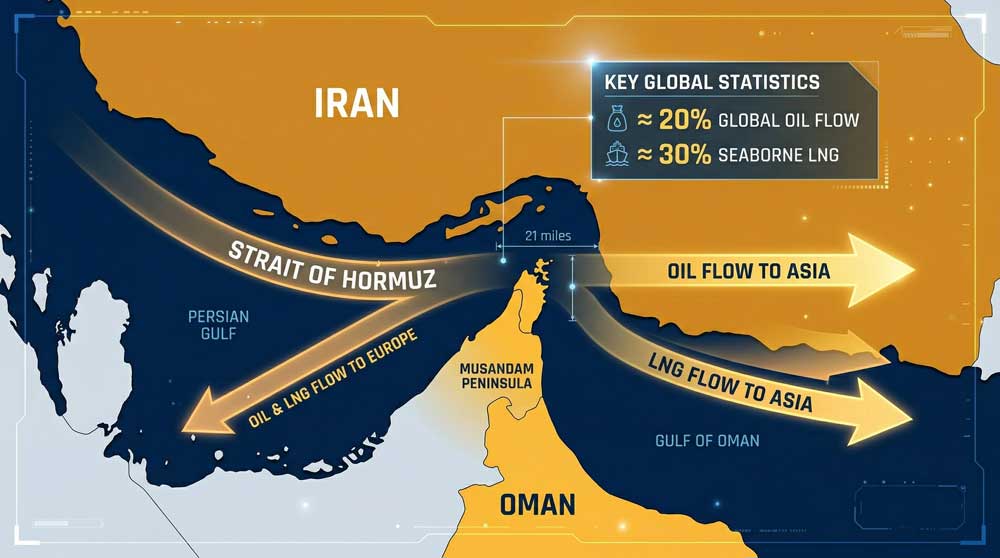
The Strait of Hormuz is the sole maritime passage connecting the Persian Gulf to the Gulf of Oman and the Arabian Sea. Approximately 20% of global oil and nearly one-third of all liquefied natural gas (LNG) flows through this narrow chokepoint every day. Under normal conditions, roughly 200 vessels transit it per 24-hour period. When it sneezes, global energy markets catch pneumonia.
Critically, the strait is not international water — it straddles the territorial seas of Iran and Oman. Oman, widely regarded as the “Switzerland of the Gulf” for its consistent neutrality and pragmatic diplomacy, has never sought to weaponize its share of the passage. That left Iran as the historically dominant power over the strait’s security equation — or so Tehran believed.
| Characteristic | Data |
|---|---|
| Daily oil transit | ~17–20 million barrels (~20% of global supply) |
| Daily LNG transit | ~30% of global LNG trade |
| Normal daily vessel traffic | ~200 ships |
| Territorial jurisdiction | Iran (north shore) + Oman (south shore) |
| Nearest alternative route | Cape of Good Hope (+15 days, +40% cost) |
The Historical Lesson Iran Forgot: Operation Praying Mantis
Threatening to close the Strait of Hormuz and actually closing it are two fundamentally different operations. Iran learned this the hard way in 1988 — and apparently forgot the lesson by 2026.
During the Iran-Iraq War Tanker War of 1986–1988, Iran targeted Kuwaiti oil vessels and laid mines in Gulf shipping lanes. The logic seemed sound: punish Kuwait for financially backing Saddam Hussein, and intimidate the broader Gulf into submission. Instead, it produced the opposite outcome.
Kuwait, lacking the military capacity to protect its own shipping, formally requested US Navy escorts. When USS Samuel B. Roberts struck an Iranian mine in April 1988, Washington’s response was devastating. Operation Praying Mantis — launched April 18, 1988 — dismantled Iranian minefields, destroyed two oil platforms, sank the frigate Sahand, and severely damaged the Sabalan within just two days. Iran lost the equivalent of half its functional surface navy. The US lost one helicopter.
“Iran, facing imminent naval annihilation, ceased hostilities almost immediately. One month later, the eight-year Iran-Iraq War itself ended — in no small part due to direct American military intervention.”
The trauma of Praying Mantis suppressed Iran’s Strait of Hormuz control ambitions for over two decades. It was only in 2011, during the Obama administration’s nuclear negotiations, that Tehran revived verbal Hormuz threats — and found them diplomatically effective without requiring any actual military action. Verbal threats with zero physical follow-through became Iran’s default playbook. That pattern set the stage for catastrophic miscalculation in 2026.
March 2026: A Blockade That Was Never Really a Blockade
On March 2, 2026, a senior Islamic Revolutionary Guard Corps (IRGC) adviser declared the Strait of Hormuz formally closed. The international community — which had heard similar threats dozens of times — was caught flat-footed. No one had seriously prepared for Iran to follow through.
But here is the uncomfortable truth: Iran hadn’t really followed through either.
The Fractured Command Chain
The physical execution of the blockade was remarkably thin. There were no large-scale mine-laying operations, no organized naval interdiction patrols — only sporadic, uncoordinated attacks on commercial vessels. Among those struck was a Thai-flagged tanker owned and operated by a Thai shipping company, with no conceivable connection to either the US or Israel. No Iranian government body ever explained the targeting logic.
This incoherence becomes legible when you consider Iran’s own acknowledgment that military command authority had been decentralized to grassroots units following the precision elimination of senior leadership. The “blockade declaration” was almost certainly not a deliberate high-level strategic decision — it was an impulsive reactive escalation by a command structure already in crisis. The IRGC’s chief adviser, not its operational commander, made the announcement. That detail alone speaks volumes.
The contradictory signals from Tehran confirmed the internal disarray:
- March 1: Iran’s Foreign Ministry pre-emptively stated Iran would not close the strait — the day before the IRGC declared it closed
- March 6: Iran’s regular army (Artesh) spokesman confirmed “control” of the strait but explicitly stated it “would not be closed,” limiting restrictions to US- and Israeli-linked vessels — a meaningless caveat since neither country relies on Hormuz for shipping
- March 10: The IRGC offered passage to any nation that “expelled US and Israeli ambassadors” — a transparently unserious demand, and notably one that excluded East Asian nations entirely
- March 20: Foreign Minister Araghchi signaled willingness to allow Japan-linked vessels through — even though Japan had committed to joining the US-led escort coalition
- March 25: Iran’s UN mission formally notified that “non-hostile vessels” could transit — effectively a full retreat dressed in conditional language
How Insurance Markets Achieved What Missiles Couldn’t
Here lies the most consequential dynamic of the entire crisis. The strait was never physically sealed — but the global shipping market treated it exactly as if it were.
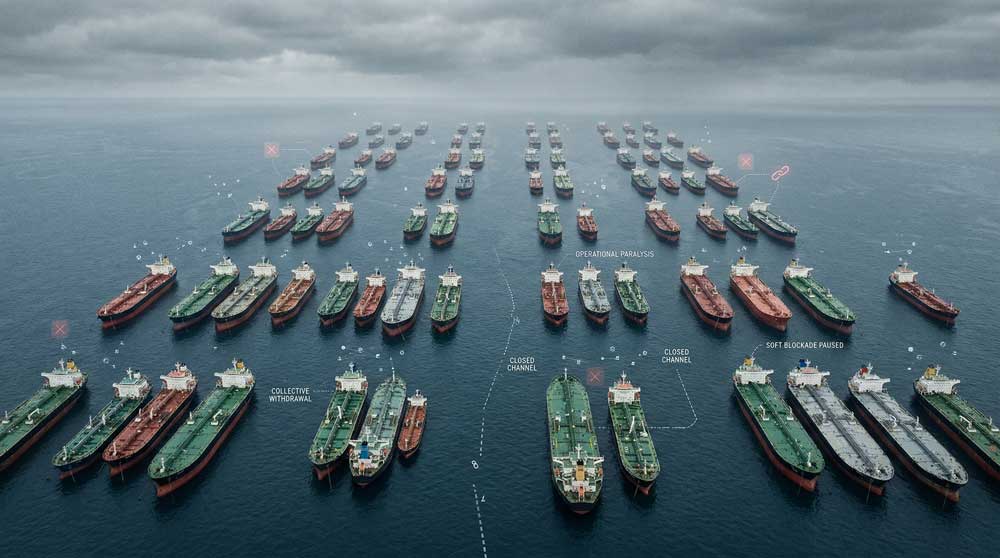
Within hours of the IRGC announcement, major maritime war-risk insurers — led by Lloyd’s of London syndicates — triggered collective coverage withdrawals for the Persian Gulf and Strait of Hormuz. This was not a cautious precautionary measure. It was a systemic chain reaction that produced complete operational paralysis:
Daily traffic through the strait collapsed from ~200 vessels to single digits almost overnight. The “soft blockade” was complete — achieved not by Iranian naval power, but by the rational risk calculus of global capital markets.
This distinction carries profound strategic implications. A physical blockade can be broken by military force. A collapse of market confidence cannot be reversed by a press statement. Even after Iran’s March 25 de facto reversal, shipping and insurance markets remain frozen — because no one can guarantee that the next IRGC unit won’t launch another “unauthorized” attack tomorrow.
Blockade Strategies Compared: 1988 vs. 2026
| Element | 1988 Tanker War | 2026 Crisis |
|---|---|---|
| Primary method | Physical mines + targeted strikes | Sporadic attacks + verbal declarations |
| US response | Direct kinetic retaliation (Praying Mantis) | Strategic delay, tactical observation |
| Market impact | High risk to individual vessels | Complete systemic insurance freeze |
| Duration of effective disruption | Months | Days (market effect persisted) |
| Outcome for Iran | Naval assets destroyed; forced ceasefire | Loss of market trust; forfeiture of maritime control |
Trump’s Calculated Inaction Was the Real Masterstroke
President Trump’s initial public reaction to the blockade was enthusiastic. On March 2, he posted that the US Navy would “begin escorting tankers through the Strait as soon as possible” and pledged to coordinate American insurance underwriting for Hormuz transits. Neither promise materialized into immediate action.
This is not indecisiveness. It is strategic patience calibrated to extract maximum geopolitical value.
The United States has structurally asymmetric exposure to a Hormuz disruption:
- The US is the world’s largest oil producer and largest refined petroleum exporter — high oil prices boost American energy revenues, not drain them
- US shale oil becomes highly profitable above ~$90/barrel, unlocking substantial reserve production capacity
- American dependence on Middle Eastern oil is near zero
Meanwhile, the Hormuz closure created unbearable pressure on precisely the parties Trump needed to move:
- Gulf monarchies (UAE, Qatar, Saudi Arabia) — whose sovereign wealth depends on oil export access — pivoted sharply and publicly against Iran, providing financial and political backing for the US-Israeli campaign. Nations that had maintained studied neutrality toward Tehran abandoned it overnight.
- Japan and South Korea, sourcing over 80% of their oil from Gulf producers, became urgently motivated to co-finance Hormuz security arrangements and deepen US military alliance commitments. Japan gained the rare domestic political justification to expand its overseas military participation — a long-standing governing coalition goal constrained by the “peace constitution”.
- European powers, exposed as strategically irrelevant to the crisis resolution, saw their already-diminished regional influence eroded further — an outcome Trump would not find unwelcome.
Every day of strategic delay was converting Hormuz pressure into US alliance leverage, defense cost-sharing commitments, and geopolitical realignment. The strait was doing Trump’s diplomatic work for him.
The Limits of Patience: Why Reopening Was Inevitable
The calculus eventually runs the other way. The United States, as the world’s dominant financial center, cannot afford a prolonged global recession triggered by sustained $150+/barrel oil prices. Political costs accumulate too: a president who brands himself on decisive strength cannot indefinitely preside over a paralyzed global shipping artery.
Iran’s March 25 announcement was the first step toward restoring normal transit — but not the last. Full normalization requires credible security guarantees that no single Iranian press release can provide. The endgame almost certainly involves:
- A US-anchored security framework with permanent or rotating naval presence near the strait
- Cost-sharing arrangements with Gulf states, Japan, South Korea, and European importers
- Possible new US basing rights in the Gulf region
- The permanent removal of the Hormuz threat from Iran’s strategic toolkit — not just physically, but diplomatically
What “Sea Power” Actually Means
Iran’s fundamental error was a conceptual one. Strait of Hormuz control was never about territorial ownership — it was always about the ability to guarantee safe passage.
Iran could threaten to close the strait. It demonstrated it could disrupt transit temporarily. But it never possessed the sustained capacity to keep the strait open for global commerce on terms that the shipping market, insurers, and international capital would trust. That capacity — the actual substance of sea power — now belongs to Washington.
Iran entered this crisis believing it held a trump card. It exits having confirmed that the card was never really in its hand. The Hormuz threat was valuable precisely because it was never used. The moment it was invoked — even incoherently — the deterrent collapsed, the market reacted, and the strategic advantage transferred to the party capable of restoring order.
For a regional power that invested decades in cultivating Hormuz as its ultimate strategic lever, there is no more sobering lesson.
Further Reading — Deep Links to Authoritative Sources
- CSIS — No One, Not Even Beijing, Is Getting Through the Strait of Hormuz
- Bloomberg — Shipping Insurance Costs to Cross Hormuz Soar After Vessel Attacks
- The Guardian — Maritime Insurers Cancel War Risk Cover in Gulf as Iran Conflict Disrupts Shipping
- Al Jazeera — Maritime Insurers Cancel War Risk Cover in Gulf: Will It Hike Energy Costs?
- ASPI Strategist — Ghost of Gallipoli: US Warships Cannot Control the Strait of Hormuz
- Straits Times — Iran Tells UN: ‘Non-Hostile’ Ships Can Transit Strait of Hormuz
- The National News — Iran Tells UN ‘Non-Hostile Vessels’ May Cross Hormuz
- NDTV Profit — Iran-US War: Hormuz Disruption Driven By Insurance Costs, Not Military Blockade
- US Naval Institute Proceedings — The Surface View: Operation Praying Mantis
- CNN — Trump Administration Underestimated Iran War’s Impact on Strait of Hormuz
- CNBC — Trump Wants U.S. Navy to Escort Tankers Through the Gulf — Why That Plan May Not Work
- NYT — Trump Says U.S. Navy Might Escort Tankers in Persian Gulf
- ElevenLab — Operation Epic Fury & the Middle East Geopolitical Crisis: 8,000 Airstrikes, 3 Market Warnings, and 1 Economic Tipping Point
- ElevenLab — US-Iran Conflict Oil Prices: 3 Alarming Ways Russia Secured a $6.5B Windfall
- ElevenLab — 5 Epic Reasons the Hong Kong Safe Haven Thrives After Dubai’s Collapse