US Dollar Purchasing Power: 8 Powerful Metrics Exposing a Worrying Fiscal Reality
US Dollar purchasing power is under compounding macroeconomic pressure. Federal debt has surpassed $39 trillion, annualized interest payments now exceed $1.2 trillion, and the Federal Reserve has quietly resumed balance sheet expansion — all while gold prices reach successive all-time highs.
These aren’t isolated data points. Eight core indicators are moving in the same direction simultaneously, and together they reveal a systemic, structural erosion of the dollar’s long-term value. Whether you hold cash savings, bonds, or equities, understanding these forces is essential for navigating today’s fiscal landscape.
Table of Contents
1. Federal Deficits: Structural Borrowing With No Exit
The US federal deficit trajectory is one of the clearest threats to US Dollar purchasing power.
Even under the most optimistic assumptions — no recession, no major conflict over the next decade — the government is projected to accumulate over $22 trillion in additional deficits, all financed through new Treasury issuance. That baseline is already under pressure: supplemental military spending requests and expanding entitlement obligations routinely push real deficits beyond projections.
When a government must borrow simply to cover existing operations, debt issuance becomes structurally permanent — not cyclical.
2. Debt-to-GDP: The Burden Beyond the Headline Number
| Metric | Current Figure |
|---|---|
| Total Federal Debt | $39+ trillion |
| Official Debt-to-GDP | ~124% |
| Government Share of GDP | ~37% |
| Adjusted (private-sector only) Debt Ratio | Materially higher |
The official 124% debt-to-GDP ratio understates the real burden. Because GDP accounting treats government spending as positive output, and government expenditure comprises roughly 37% of US GDP, the debt load relative to genuinely productive private economic activity is considerably heavier than official figures suggest.
3. Interest Payments: Soon the Largest Budget Item
The most immediate threat to US Dollar purchasing power may be the accelerating cost of debt service.
| Federal Expenditure | Annual Cost | Trajectory |
|---|---|---|
| Net Interest on Public Debt | ~$1.2 trillion | Rapidly increasing |
| Social Security | ~$1.4 trillion | Steadily increasing |
| National Defense | ~$850 billion | Variable |
Interest now consumes over 23% of all federal tax revenue and is on pace to surpass Social Security within months — making it the single largest line item in the federal budget. This dynamic is self-reinforcing: higher interest costs require more borrowing, which enlarges the debt stock, which generates even higher future interest payments. Fiscal flexibility contracts with every cycle.
4. Interest Rates: The Fed Controls Less Than It Appears
The Federal Reserve directly sets the Federal Funds Rate — the short end of the curve. But the 10-year Treasury yield, the global benchmark for asset pricing, is determined by the open market and cannot be fully controlled by policy.
| Rate | Controlled By | Key Significance |
|---|---|---|
| Federal Funds Rate | Federal Reserve (direct) | Short-term borrowing cost |
| 10-Year Treasury Yield | Broad bond market | Global asset pricing benchmark |
Historical Fed cycles illustrate the whipsaw pattern: near-zero rates post-2008, a gradual hike cycle through 2019, back to zero in 2020, then 500+ basis points of hikes in 18 months by 2023, and now easing — while inflation remains above target. When long yields rise independent of Fed intent, it signals bond market stress, not growth confidence.
5. The Fed Balance Sheet: Taper Cycles That Never Fully Deliver
The Fed’s balance sheet documents a repeating pattern that directly impacts US Dollar purchasing power.
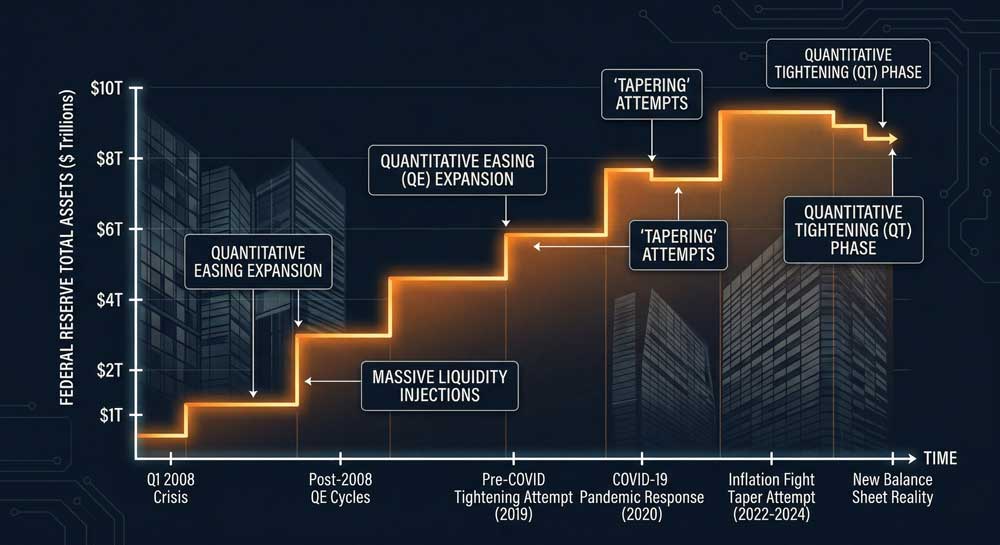
| Period | Approximate Size | Status |
|---|---|---|
| Pre-2008 | <$1 trillion | Normal operations |
| Post-GFC peak | ~$4.5 trillion | QE expansion |
| Pre-COVID (2019) | ~$3.8 trillion | Partial taper |
| COVID peak | ~$9 trillion | Emergency stimulus |
| Current | ~$7+ trillion | Expanding again |
Each tightening cycle has been interrupted before balance sheet normalization was achieved. The new expansion is framed as “reserve management” rather than quantitative easing — but critics note that purchasing government bonds with newly created currency is functionally equivalent regardless of the label.
6. Money Supply: 40% Created in a Short Window
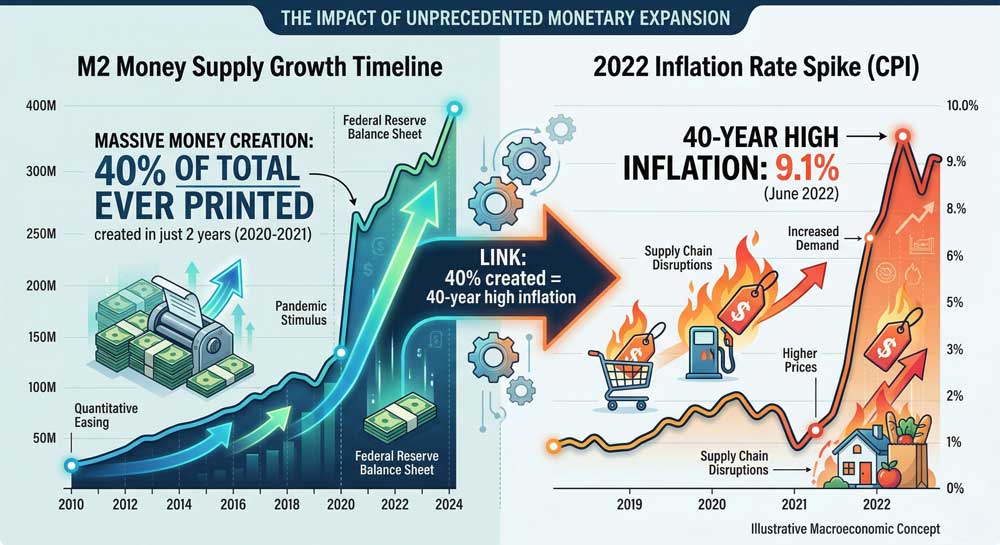
The long-run average annual growth rate of US M2 money supply sits around 6.8%. During the pandemic response, this pace was dramatically compressed: an estimated 40% of all dollars in existence were created within a short period. The direct consequence was the 40-year high inflation of 2022 — a textbook demonstration of more currency units chasing the same quantity of goods.
The money supply remains elevated relative to pre-pandemic trends, and balance sheet expansion will continue adding to it.
7. CPI: A Policy Signal More Than a Precise Gauge
The Consumer Price Index attempts to average price changes across 334 million Americans using a single basket — despite the fact that every individual’s actual spending pattern differs significantly. The government also retains authority over basket composition and weightings, which has changed multiple times over decades.
For investors tracking US Dollar purchasing power, CPI is best read as a policy trigger indicator: the number that determines Fed behavior, not necessarily an accurate reflection of real-world cost of living. Independent methodologies that recalculate CPI using pre-1990 formulas typically show inflation running 2–4 percentage points above official figures.
8. Gold at Record Highs: The Market’s Composite Verdict
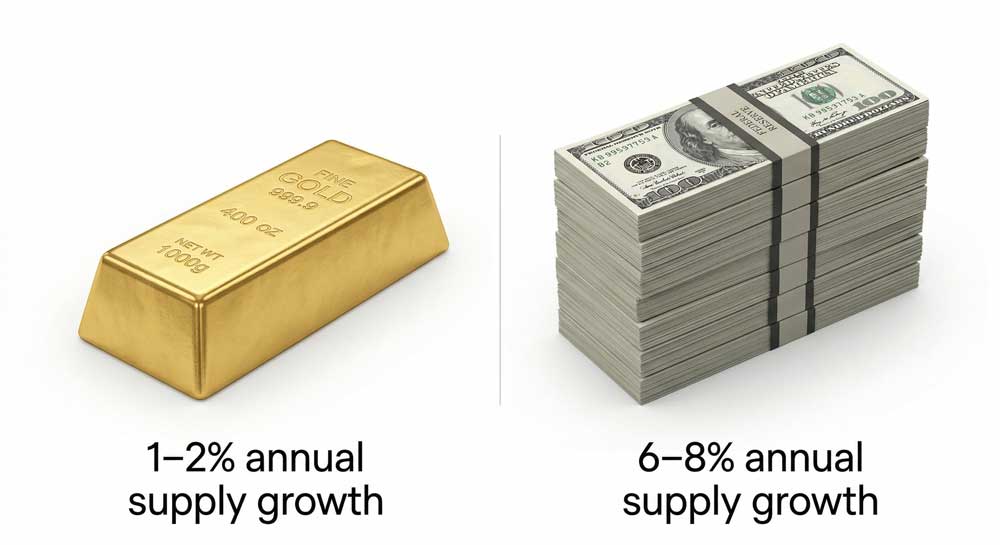
| Asset | Annual Supply Growth | Counterparty Risk |
|---|---|---|
| US Dollar (M2) | ~6–8% long-run average | Federal Reserve / Treasury |
| Gold | ~1–2% | None |
Gold’s annual new supply grows at only 1–2% through mining — structurally immune to the debasement that affects fiat currencies. It carries no counterparty risk, no government credit dependency, and no political allegiance. Record gold prices in 2024–2025 represent the bond and commodity markets’ collective assessment of all seven indicators above: more debt, more money creation, and sustained pressure on US Dollar purchasing power.
The 8-Indicator Dashboard
| Indicator | Status | Direction |
|---|---|---|
| Federal Deficit | $2+ trillion/year | Worsening |
| Federal Debt | $39T+ (124% GDP) | Rising |
| Interest Payments | $1.2T/year, 23% of revenue | Accelerating |
| Federal Funds Rate | Easing cycle underway | Downward |
| 10-Year Treasury Yield | Elevated, volatile | Uncertain |
| Fed Balance Sheet | Expanding again | Upward |
| M2 Money Supply | Post-surge, still elevated | Expanding |
| Gold Price | All-time highs | Upward |
No single indicator signals imminent currency crisis. But eight metrics moving in the same direction — more debt, more money creation, rising costs, weakening fiscal space — form a coherent structural case for ongoing erosion of US Dollar purchasing power that long-term investors cannot responsibly ignore.
Authoritative Sources
- Federal Debt as % of GDP — FRED, St. Louis Fed
- US Treasury Interest Expense on the Debt Outstanding
- CBO Budget & Economic Outlook 2024–2034
- Federal Reserve Balance Sheet Recent Trends
- M2 Money Supply — FRED
- BLS — Handbook of Methods Consumer Price Index History
- World Gold Council — Gold Supply & Demand Data
- Peterson Foundation — Interest Costs on the National Debt
- Nvidia H200 Chips China Sales Hit Zero: 7 Shocking Reasons Trump’s Strategy Backfired
- Trump Tariffs European Inflation: 5 Shocking Ways US Trade Barriers Are Crushing Eurozone Prices
- Labor Devaluation Exposed: 5 Shocking Reasons Why It’s More Dangerous Than Unemployment in 2026
- The Physical Truth Behind the US-China AI Race: Electrons, Not Just Silicon