Australia Fuel Crisis: 7 Urgent Risks as Global Conflict Threatens Economic Collapse
The Australia fuel crisis is no longer a distant concern — it is already reshaping the cost of living, straining supply chains, and forcing governments into emergency mode. Alongside this, escalating global conflicts are raising questions that would have seemed unthinkable just a few years ago.
This article examines both crises, how they are connected, and why the next 12 months may be the most consequential period Australia has faced in a generation.
Table of Contents
Is the World Sliding Toward a Third World War?
Few questions feel more uncomfortable to ask — yet strategic analysts, financial experts, and defence commentators are now asking it openly.
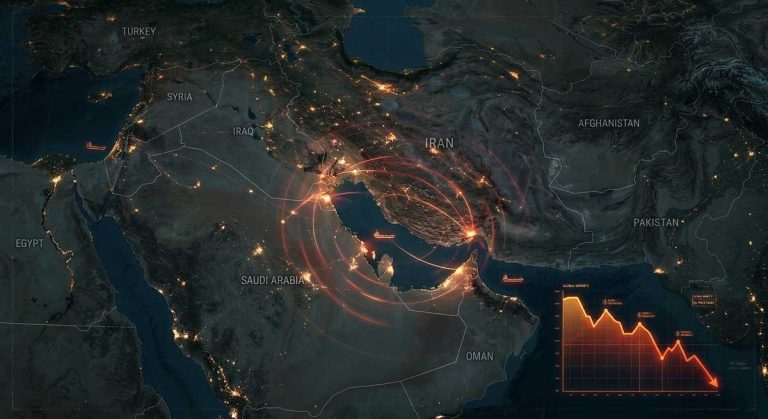
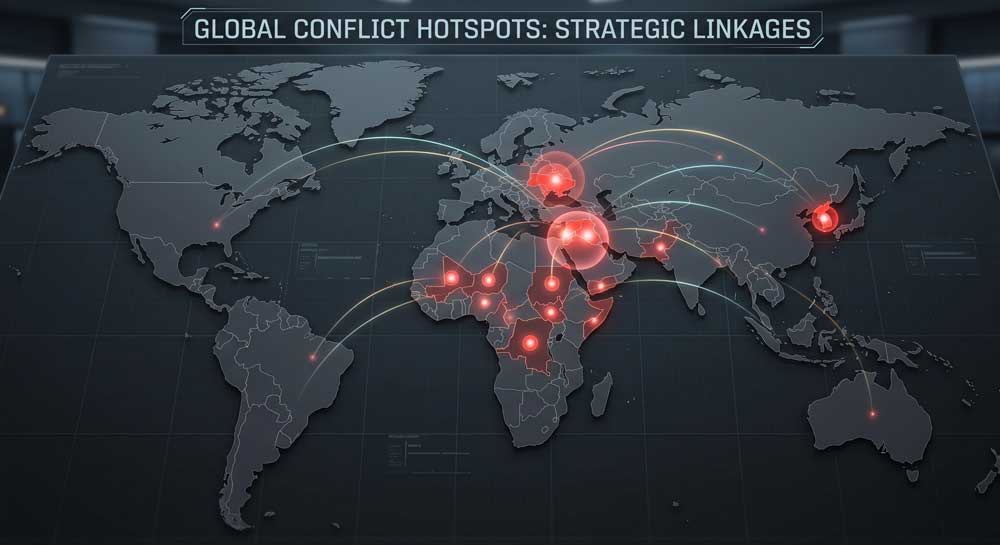
The confluence of active conflict zones is striking. The Middle East remains deeply destabilised following the Iran conflict and its closure of the Strait of Hormuz. The Russia-Ukraine war has ground into a prolonged attritional phase. Tensions on the Korean Peninsula have not eased. And parts of sub-Saharan Africa continue to experience political and military upheaval.
The Oxford Dictionary defines a world war as “a war involving many countries of the world.” Cambridge emphasises “large forces from many nations.” Merriam-Webster goes furthest — “a war engaged in by most of the principal nations of the world.” By those definitions, the threshold remains arguably unmet — but the direction of travel is what concerns analysts most.
Defence strategist David Kilcullen, who served 22 years in the Australian Army and held diplomatic roles for both Australian and US governments, has drawn a clear line: when the same group of nations are fighting simultaneously across Europe, the Middle East, Asia, and Africa, that is functionally a world war. What he finds alarming is that early signs of exactly that pattern are already visible.
His warning about timing is particularly striking. He suggests that people typically recognise they are living through a world war only after the fact — a point history tragically validates. When World War II began, most observers framed it as a European regional conflict. It took the invasion of the Soviet Union and the attack on Pearl Harbor to reveal its true scale.
Ray Dalio’s 13-Stage Warning
The geopolitical risk is not confined to defence circles. Billionaire investor Ray Dalio has outlined what he calls the 13 stages on the path to a third world war. His assessment is that the world currently sits at stage nine — characterised by simultaneous multi-front conflicts.
The stages that follow, in his framework, include domestic mobilisation, direct military confrontations between major powers, rising taxation, sovereign debt crises, and in extreme scenarios, the closure of financial markets.
| Dalio’s Stage | Characteristics | Current Status |
|---|---|---|
| Stage 7–8 | Proxy conflicts, sanctions, economic decoupling | Recently passed |
| Stage 9 | Multiple simultaneous active conflicts | Active now |
| Stage 10–11 | Domestic mobilisation, direct state confrontations | Risk horizon |
| Stage 12–13 | Financial market disruption, debt crises, potential market closure | Tail risk |
This is not a prediction of inevitability — it is a risk map. But the fact that serious investors are using this framework to reposition capital says something important about where informed opinion currently sits.
Australia’s Exposure: More Than It Appears
The instinct many Australians have — that geography offers protection — is understandable but increasingly misplaced.
Australia already has military assets deployed in the Middle East, primarily in a protective capacity for citizens and personnel. Prime Minister Albanese has authorised extended deployments of E-7A Wedgetail aircraft, while emphasising the absence of offensive engagement. That framing matters politically, but it also confirms one clear fact: Australia is already operating within the perimeter of this crisis.
More fundamentally, Australia is one of the most trade-exposed developed economies in the world. It does not manufacture its own fuel at scale. Its food supply, retail sector, and construction industry all depend on long-haul road freight. And that freight runs almost entirely on diesel.
The Taiwan Strait presents an additional dimension. Any significant escalation involving China, Taiwan, and the United States would place Australia in an almost impossible diplomatic and strategic position, regardless of which posture Canberra chose to adopt.
The Australia Fuel Crisis: Diesel Is the Real Problem
While petrol prices attract more media attention because they affect private motorists directly, the diesel crisis poses the deeper structural threat.
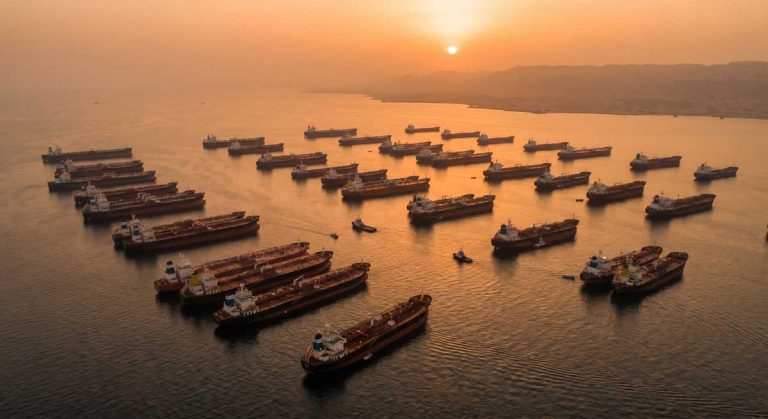
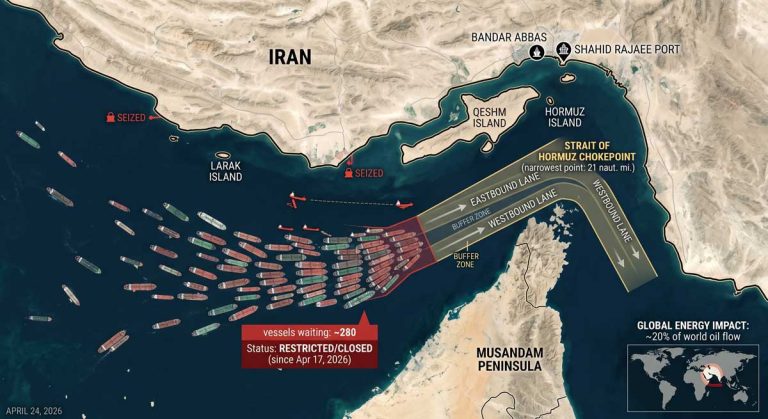
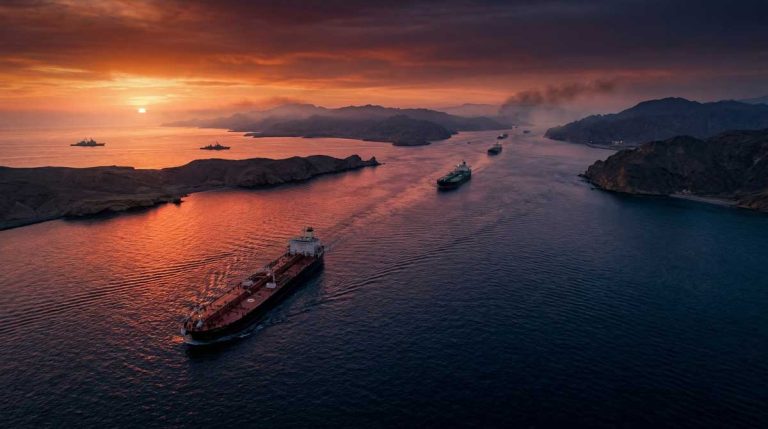
In early March 2026, the closure of the Strait of Hormuz — through which roughly 20 per cent of global oil shipments pass — triggered an immediate supply disruption. Australia sources approximately 30 per cent of its refined fuel through Asian refineries that depend on Middle Eastern crude. When tanker traffic through Hormuz fell by around 70 per cent, the downstream consequences were rapid and severe.
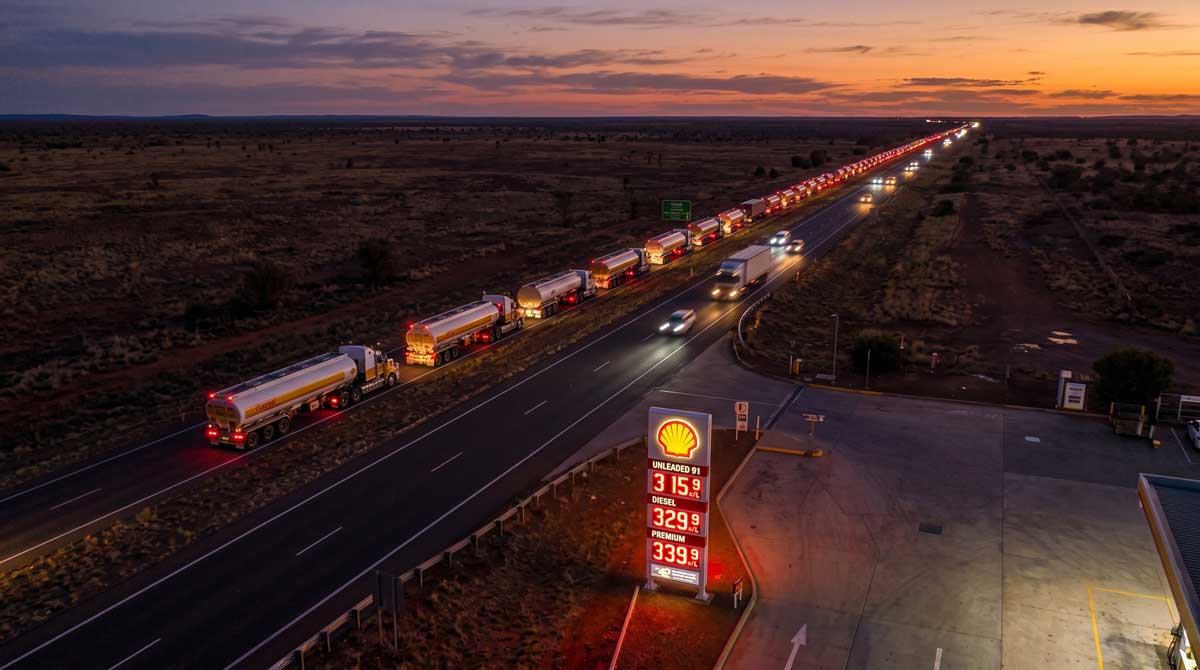
The national average diesel price reached 312.7 cents per litre as of mid-April 2026 — more than double the cost transport operators were paying before the conflict escalated. The federal government had already cut fuel excise by 32 cents per litre, yet that relief was absorbed by the market within weeks.
| Metric | Pre-Crisis (Feb 2026) | Mid-April 2026 | Change |
|---|---|---|---|
| National avg diesel price | ~$1.60/L | $3.13–$3.23/L | +~96% |
| National avg petrol price | ~$2.09/L | ~$2.38/L | +~14% |
| Service stations without diesel | Negligible | 274+ nationwide | Significant |
| Oil price (Brent crude) | ~$70/barrel | ~$114/barrel | +~63% |
Why Diesel Matters More Than Petrol
The distinction between petrol and diesel demand is critical and often misunderstood.
Petrol demand is relatively elastic — people can drive less, use public transport, or delay discretionary trips. Diesel demand is almost entirely inelastic. Around 90 per cent of Australian consumer goods travel by road at some point in their journey from producer to shelf. Those vehicles run on diesel. Mining equipment runs on diesel. Agricultural machinery runs on diesel. Refrigerated food transport runs on diesel.
When diesel prices double, the cost does not stay in the fuel tank — it flows into every invoice, every freight quote, every retail price. The Melbourne Institute of Applied Economic and Social Research has noted this directly: diesel demand shows almost no price sensitivity because the underlying economic activity that depends on it cannot simply stop.
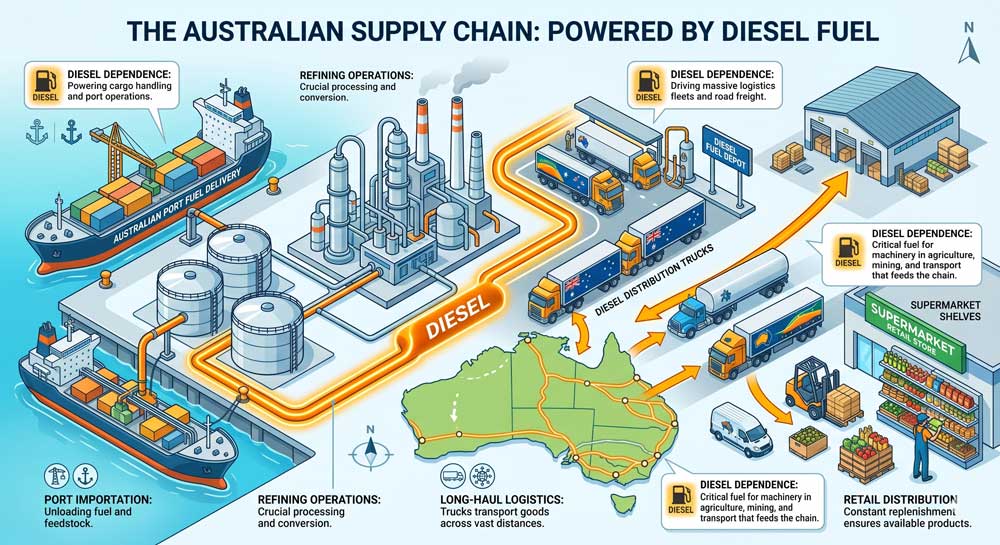
This is why the trucking industry is facing a structural crisis, not a temporary squeeze. One in twelve road transport companies ceased operations in 2025, even before this fuel shock. The Australian Trucking Association has made clear that expecting operators to absorb further cost increases is not a viable ask.
The potential consequences, if the supply situation deteriorates further, include empty supermarket shelves, disrupted medical supply chains, and reduced agricultural output — outcomes that would represent a genuine economic emergency.
Supply Security: What the Government Is Doing
The Australian government has moved on several fronts to address the immediate supply shortfall:
- Energy Minister Chris Bowen confirmed 57 vessels carrying 4.1 billion litres of fuel are secured through May 2026
- Up to 762 million litres of petrol and diesel are being released from the Strategic Petroleum Reserve
- Fuel quality standards have been temporarily lowered for 60 days to allow higher-sulphur fuel into the domestic market, adding approximately 100 million litres per month
- Heavy vehicle road user charges have been reduced to ease pressure on freight operators
- Diplomatic negotiations are underway with Brunei, Malaysia, and Singapore to secure alternative supply agreements
- Australia and Singapore have established a joint fuel trade agreement, with similar deals being pursued across Asia
These are meaningful short-term measures. The harder question is what happens beyond May, if the Strait of Hormuz remains closed and global competition for available refined fuel intensifies.
The Economic Ripple Effect: Recession Risk Is Real
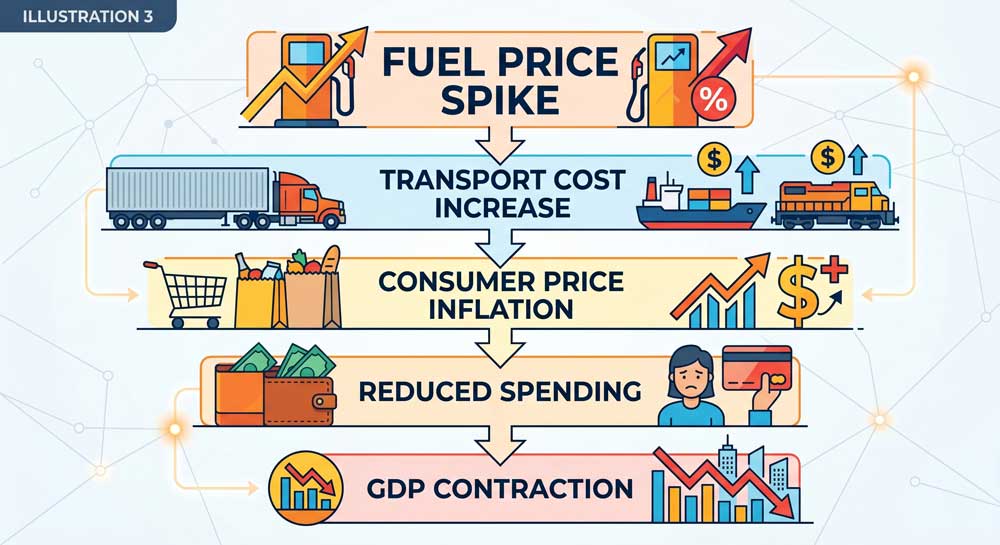
The fuel crisis feeds directly into broader economic conditions through a chain that is already in motion.
Higher diesel prices raise transport costs. Higher transport costs raise the price of every physical good. Higher consumer prices suppress discretionary spending. A contraction in consumer spending slows GDP growth. Meanwhile, tighter monetary conditions compound the pressure — Westpac’s chief economist has flagged the possibility of further rate increases this year as energy-driven inflation filters through the CPI.
| Economic Channel | Mechanism | Near-Term Risk |
|---|---|---|
| Consumer inflation | Fuel cost pass-through to goods | High — already occurring |
| Business insolvency | Transport sector margin compression | High — accelerating |
| Interest rates | Inflation forcing RBA hand | Medium — flagged by Westpac |
| Agricultural output | Fuel and fertiliser shortages | Medium to High |
| Export competitiveness | Higher logistics costs | Medium |
For more on how geopolitical disruptions transmit into Australian supply chains, RMIT University’s analysis and Grant Thornton’s supply chain advisory are valuable starting points.
The Australian Competition and Consumer Commission is already investigating fuel pricing practices among major suppliers including Ampol, BP, Mobil Oil, and Viva Energy. Whether that review produces structural change in the short term remains to be seen.
The deeper structural problem is that Australia’s fuel pricing is benchmarked to the Singapore refinery market rather than domestic production costs. That benchmark, in turn, is heavily exposed to Middle Eastern supply dynamics — meaning that as long as the Strait of Hormuz remains a chokepoint under threat, Australian prices will reflect that risk.
What This Means for Everyday Australians
The two threads of this article — global conflict escalation and the domestic fuel crisis — are not parallel stories. They are the same story at different scales.
Geopolitical instability drives energy insecurity. Energy insecurity drives inflation. Inflation drives interest rate pressure. Interest rate pressure compounds household financial stress. And household financial stress, multiplied across the economy, produces the conditions for recession.
Most Australians are currently experiencing this as “things costing a bit more.” That framing may understate where the trajectory leads if conditions do not stabilise. For practical guidance on how Australian businesses can manage supply chain exposure, the Australian Industry Group’s supply chain resilience resources offer actionable frameworks.
The next few months will be decisive. Supply lines are secured through May. Beyond that, the outlook depends heavily on geopolitical developments no government can fully control.
Reference URLs
- ABC News — Australia’s fuel shipments secured well into May — Energy Minister Bowen’s latest update on supply security
- BBC News — ‘Out of control’ diesel prices threaten Australia’s crucial freight industry — detailed breakdown of trucking sector impact
- Grant Thornton Australia — Geopolitical instability exposes Australia’s supply chain vulnerabilities — Hormuz closure and downstream effects on importers
- RMIT University — The ripple effects of Middle East conflict on Australian imports — expert analysis of energy and shipping disruptions
- SBS News — Australia’s fuel supply situation in charts — visualised data on reserve releases and shortage distribution
- Australian Industry Group — Fuel Supply and Supply Chain Watch — ongoing tracker of business impact and government response measures
- ABC News — Higher oil and fuel prices hit road transport industry — direct accounts from freight operators on margin collapse
- ElevenLab — 5 Harsh Realities of the US Oil Price Impact: Why Energy Independence Isn’t Enough
- ElevenLab — Cyrus the Great: 7 Timeless Leadership Lessons Iran Urgently Needs Today
- ElevenLab — 5 Devastating Realities of the Middle East Energy Crisis Destroying Global Markets