Must Read: The 2028 Global Intelligence Crisis and the “Ghost GDP”
⚠️ Disclaimer: This article is an independent analysis and commentary based on the original report “The 2028 Global Intelligence Crisis” published by Citrini Research. All views expressed here are the author’s own. This is not financial advice.
For the past three years, investors have obsessed over one question: What if AI fails to deliver? But a viral macro report published on 23 February 2026 by Citrini Research flipped that narrative on its head. The real danger, it argues, is the opposite — what if AI succeeds far beyond expectations, and that success is precisely what breaks the economy?
The report — titled The 2028 Global Intelligence Crisis (GIC) — went from a Substack thought experiment to a full-blown market event within 48 hours. On 23 February 2026, stocks like IBM, ServiceNow, Visa, DoorDash, and American Express shed billions in market cap. The Dow Jones fell 822 points. The Wall Street Journal put the story on its front page, calling it: “Viral Doomsday Report Lays Bare Wall Street’s Deep Anxiety About AI Future.”
So what does it actually say — and should you be repositioning your portfolio?
Table of Contents
The Intelligence Displacement Spiral
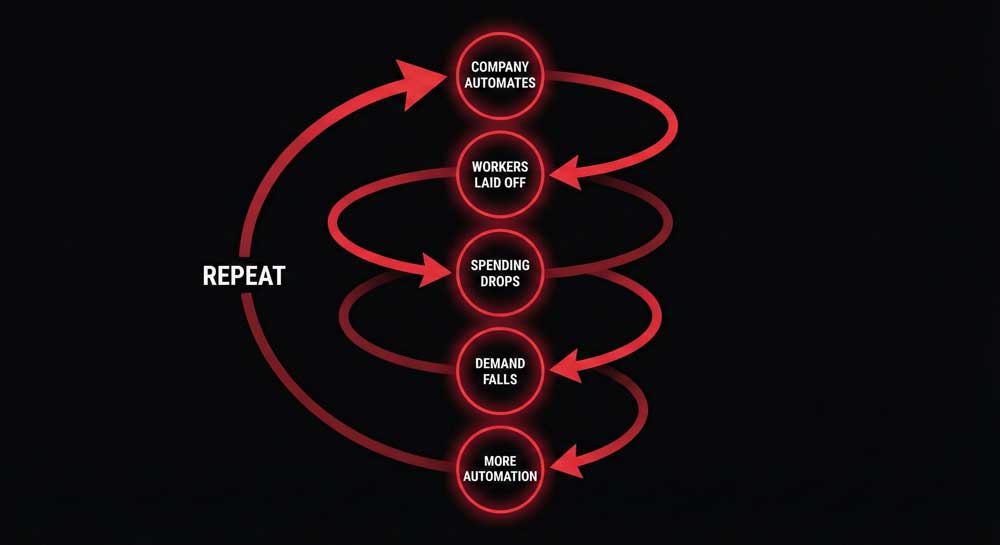
The core thesis of the GIC report rests on a concept called the Intelligence Displacement Spiral. In a normal economy, productivity gains push wages higher, which drives consumption, which funds further growth. It’s a self-reinforcing loop.
AI breaks that loop.
When a company replaces 15% of its workforce with agentic AI, its profit margins expand and its stock price rallies. But the displaced workers — software engineers, financial analysts, middle managers earning $120,000–$180,000 a year — stop spending. And critically, AI agents don’t spend money. They don’t pay rent, buy groceries, book holidays, or order DoorDash.
Because consumer spending drives roughly 70% of U.S. GDP, the broader “human economy” begins to contract. Companies facing falling demand respond by automating further, laying off more workers, which shrinks demand even more. Citrini calls this a “negative feedback loop with no natural brake.”
The model’s output: U.S. unemployment reaches 10.2% and the S&P 500 falls 38% by June 2028.
What Is “Ghost GDP”?
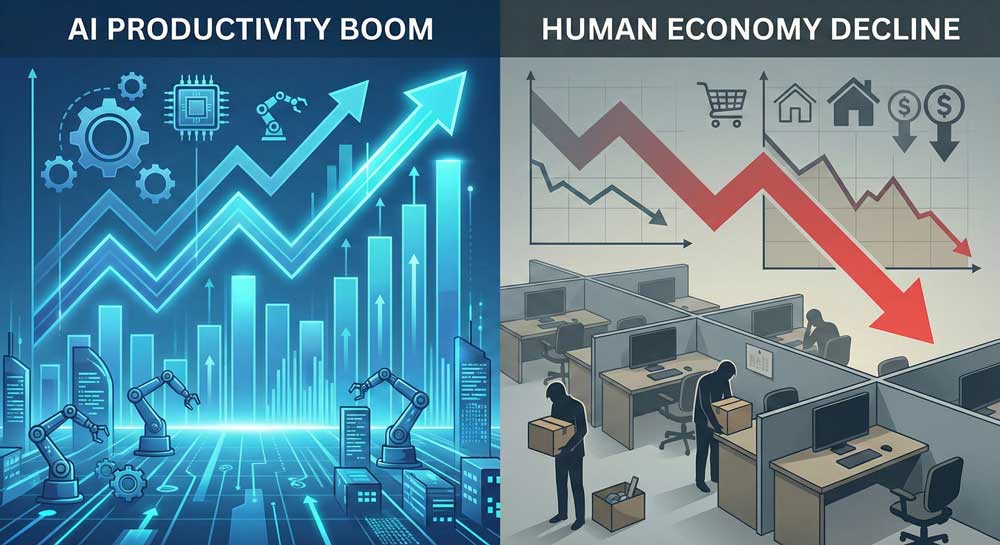
One of the report’s most thought-provoking concepts is Ghost GDP — economic output that appears healthy on paper but never actually circulates through the real economy.
Imagine a single GPU cluster generating the productive output of 10,000 human workers. Headline GDP looks phenomenal. Productivity metrics hit levels not seen since the 1950s. But all of that wealth concentrates in the hands of the owners of compute infrastructure, while real wage growth for the bottom 90% collapses. The velocity of money — how quickly a dollar moves between people — flatlines.
As Citrini puts it: “It’s an economic pandemic disguised as a panacea. A single GPU cluster generating the output of 10,000 workers is efficient for the firm, but it’s a structural disaster for the tax base and the local deli.”
Winners and Losers: The “Atoms vs. Bits” Trade
The report drew the sharpest market reaction because it named specific sectors — and specific companies — as either casualties or beneficiaries.
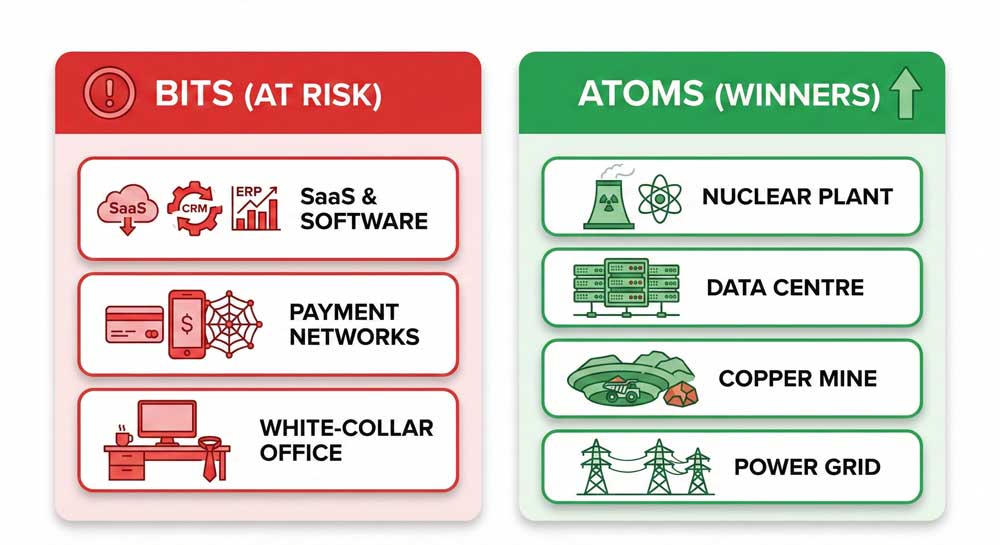
High Risk — “Bits” (Digital Services):
- Enterprise SaaS (ServiceNow, Salesforce): When clients cut 20% of their headcount, they cancel 20% of their software seats. AI automates the very users these companies sell to.
- Payment Networks (Visa, Mastercard, Amex): AI agents may route transactions through low-fee blockchain networks, eroding the traditional 3% interchange fee that makes these businesses so profitable.
- Offshore IT Services: Human labour arbitrage collapses when AI can do the same work for $200/month.
Opportunity — “Atoms” (Physical Infrastructure):
- Compute & Energy: NVIDIA, TSMC, and firms in nuclear energy (Small Modular Reactors) and data centre infrastructure are positioned to capture the productivity surplus.
- Commodities: Copper, lithium, and uranium become the ultimate scarcities as the world shifts from software to hardware-driven intelligence.
The $13 Trillion Mortgage Risk
Perhaps the most sobering section of the report focuses on the U.S. housing market. Prime mortgages are underwritten on the assumption that high-income white-collar professionals are safe borrowers. If that income stream is structurally impaired by AI displacement, the $13 trillion mortgage market could face a hollowing-out — not because the loans were bad on day one, but because the world changed after they were written.
Citrini draws a parallel to 2008, but argues this time the trigger isn’t loan quality — it’s the collapse of the borrower class itself.
The Counter-Arguments
No macro thesis is infallible, and the GIC report has attracted serious criticism.
Economists point out that every past labour-displacing technology — from the printing press to the automobile — ultimately created more jobs than it destroyed. If AI makes goods and services dramatically cheaper, the real purchasing power of remaining workers could actually boom, sparking growth in healthcare, leisure, and artisanal “human-only” services.
Others argue that policy intervention makes the doom scenario unlikely. Governments are unlikely to watch their tax bases vanish without acting. Discussions of an “Inference Tax” or AI dividend programs are already gaining traction in 2026, which could recirculate AI-generated wealth back into consumer hands.
What Does This Mean for Australian Investors?
The GIC scenario has particular relevance for Australia. The ASX is heavily weighted toward financials and resources — sectors that sit on opposite sides of the Atoms vs. Bits divide. Australian banks, with large white-collar mortgage books, face similar structural risks to their U.S. counterparts if the displacement spiral takes hold. Meanwhile, Australia’s world-class commodity base — copper, uranium, and lithium — sits squarely in the “Atoms win” scenario.
For Australian investors, the key question is: how much of your portfolio is exposed to the assumption that white-collar income remains stable?
Bottom Line
The Citrini GIC report is not a prediction — it’s a left-tail risk scenario, meaning a lower-probability but high-consequence outcome that rational investors should at least stress-test their portfolios against. Whether or not you believe the 2028 timeline, the structural questions it raises about AI, labour displacement, and the velocity of money are legitimate and increasingly pressing.
The original report is available at Citrini Research
Deep-Dive Sources
- The $5 Trillion AI Investment Bubble: Can the Boom Outrun Reality?
- 7 Reasons Why Silicon Valley Pivots to Natural Gas Investment for AI Power
- Big Tech AI Spending Reaches $670B in 2026: Infrastructure Giants vs. Apple’s Strategic Pivot
- Davos 2026: Carney Warns of a Fractured Global Order and Calls for Middle-Power Unity
- Alarming Pattern: Gold Price Crash in January Revealed (3 Historical Lessons)
- Alternative Asset ETFs: 5 Shocking Truths Behind the 72% Youth Investment Exodus from Traditional Stocks